QUESTION IMAGE
Question
which rule explains why these triangles are congruent?
options: sas, sss, asa, aas, these triangles cannot be proven congruent.
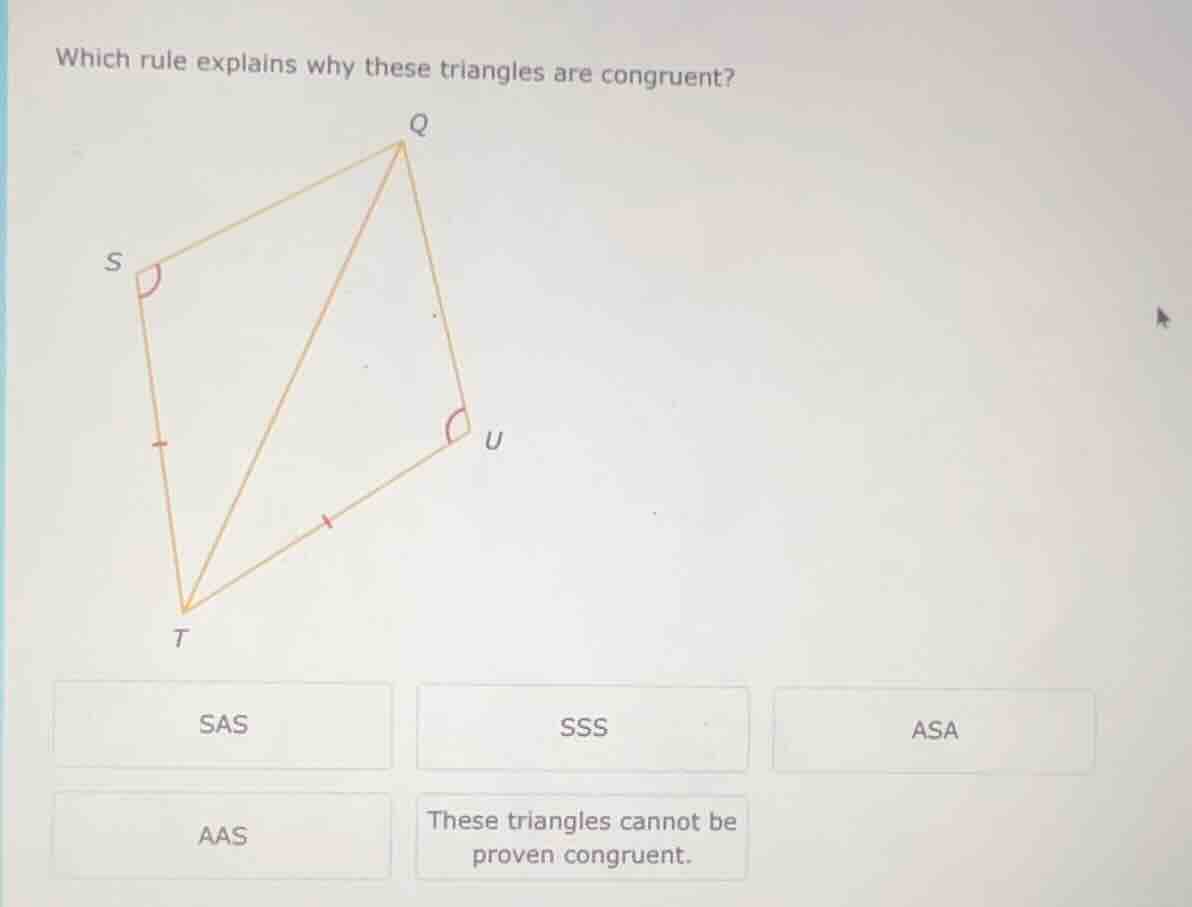
To determine the congruence rule, we analyze the triangles \( \triangle QST \) and \( \triangle QUT \):
- \( ST = UT \) (marked congruent sides).
- \( \angle S = \angle U \) (marked right angles, or congruent angles).
- \( QT \) is a common side (shared by both triangles).
The AAS (Angle - Angle - Side) congruence rule states that if two angles and a non - included side of one triangle are congruent to the corresponding two angles and non - included side of another triangle, the triangles are congruent. Here, we have two angles (\( \angle S \) and the angle at \( T \) which is common in terms of the side \( QT \)) and a non - included side (\( ST = UT \)) congruent. Wait, actually, more accurately, we have \( \angle S\cong\angle U \), \( ST\cong UT \), and \( \angle QTS\cong\angle QT U \)? No, better: The two triangles have a pair of congruent sides (\( ST = UT \)), a pair of congruent angles (\( \angle S=\angle U \)), and the side \( QT \) is common. So, angle - angle - side (AAS) because we have two angles (the right angles and the angles at \( T \) which are equal as \( QT \) is common) and a side. Alternatively, looking at the given markings: we have one pair of congruent sides (\( ST = UT \)), one pair of congruent angles (\( \angle S=\angle U \)), and the side \( QT \) is common. So, by AAS (Angle - Angle - Side) congruence criterion, the triangles are congruent.

Snap & solve any problem in the app
Get step-by-step solutions on Sovi AI
Photo-based solutions with guided steps
Explore more problems and detailed explanations
AAS