QUESTION IMAGE
Question
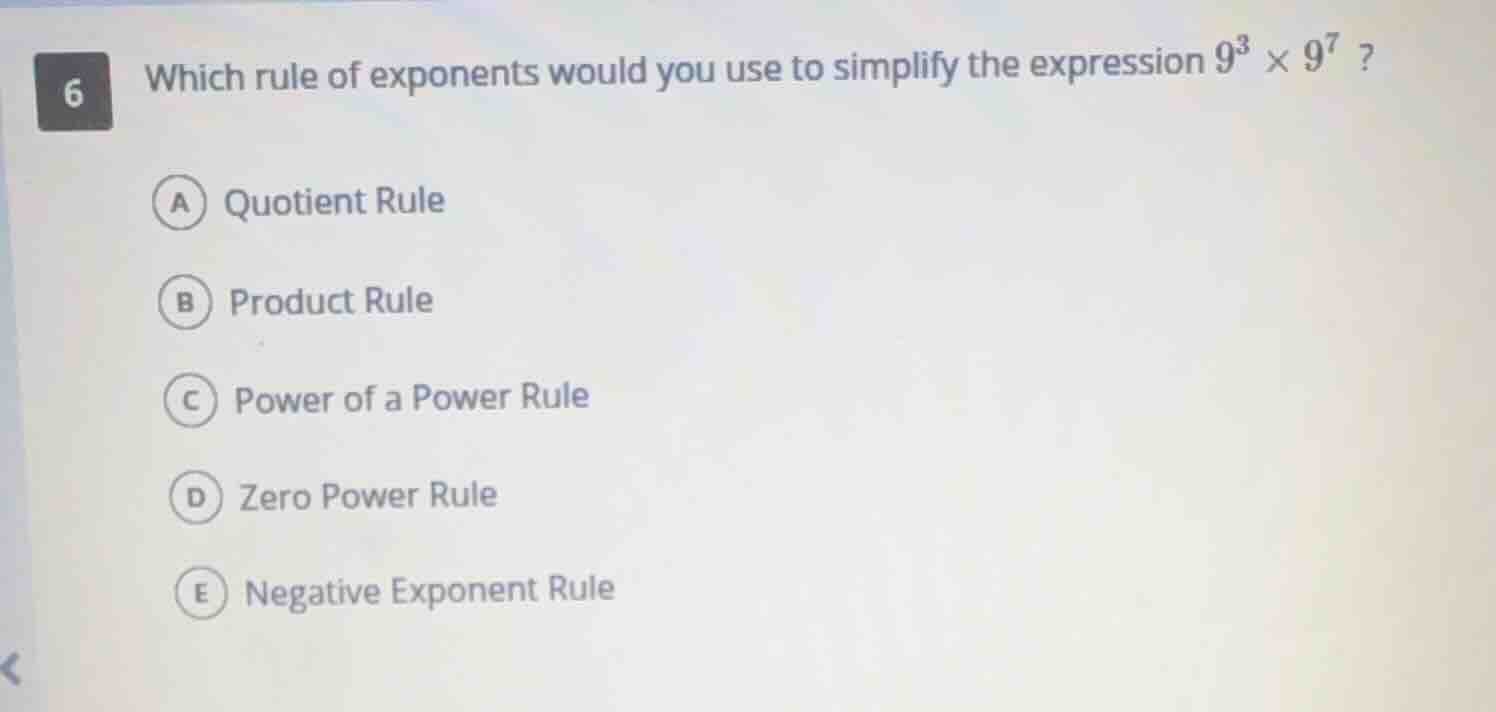
6 which rule of exponents would you use to simplify the expression $9^3 \times 9^7$ ? a quotient rule b product rule c power of a power rule d zero power rule e negative exponent rule
Brief Explanations
To simplify \(9^{3} \times 9^{7}\), we analyze the exponent rules:
- The Quotient Rule (\( \frac{a^m}{a^n}=a^{m - n}\)) applies to division of exponents, not multiplication, so A is incorrect.
- The Product Rule for exponents states that \(a^{m}\times a^{n}=a^{m + n}\) (where \(a\) is a non - zero base and \(m,n\) are real numbers). Since we have the product of two exponential terms with the same base (\(9\)) and different exponents (\(3\) and \(7\)), the Product Rule is applicable here.
- The Power of a Power Rule (\((a^{m})^{n}=a^{m\times n}\)) is used when raising a power to a power, not for multiplying two powers with the same base, so C is incorrect.
- The Zero Power Rule (\(a^{0}=1\) for \(a
eq0\)) is about exponents of zero, not relevant here, so D is incorrect.
- The Negative Exponent Rule (\(a^{-n}=\frac{1}{a^{n}}\) for \(a
eq0\)) deals with negative exponents, not the product of exponents, so E is incorrect.

Snap & solve any problem in the app
Get step-by-step solutions on Sovi AI
Photo-based solutions with guided steps
Explore more problems and detailed explanations
B. Product Rule