QUESTION IMAGE
Question
which rule can be used to describe the x - coordinates in the translation below?.
options:
x + 0
x + 6
x - 6
Step1: Identify a point's coordinates
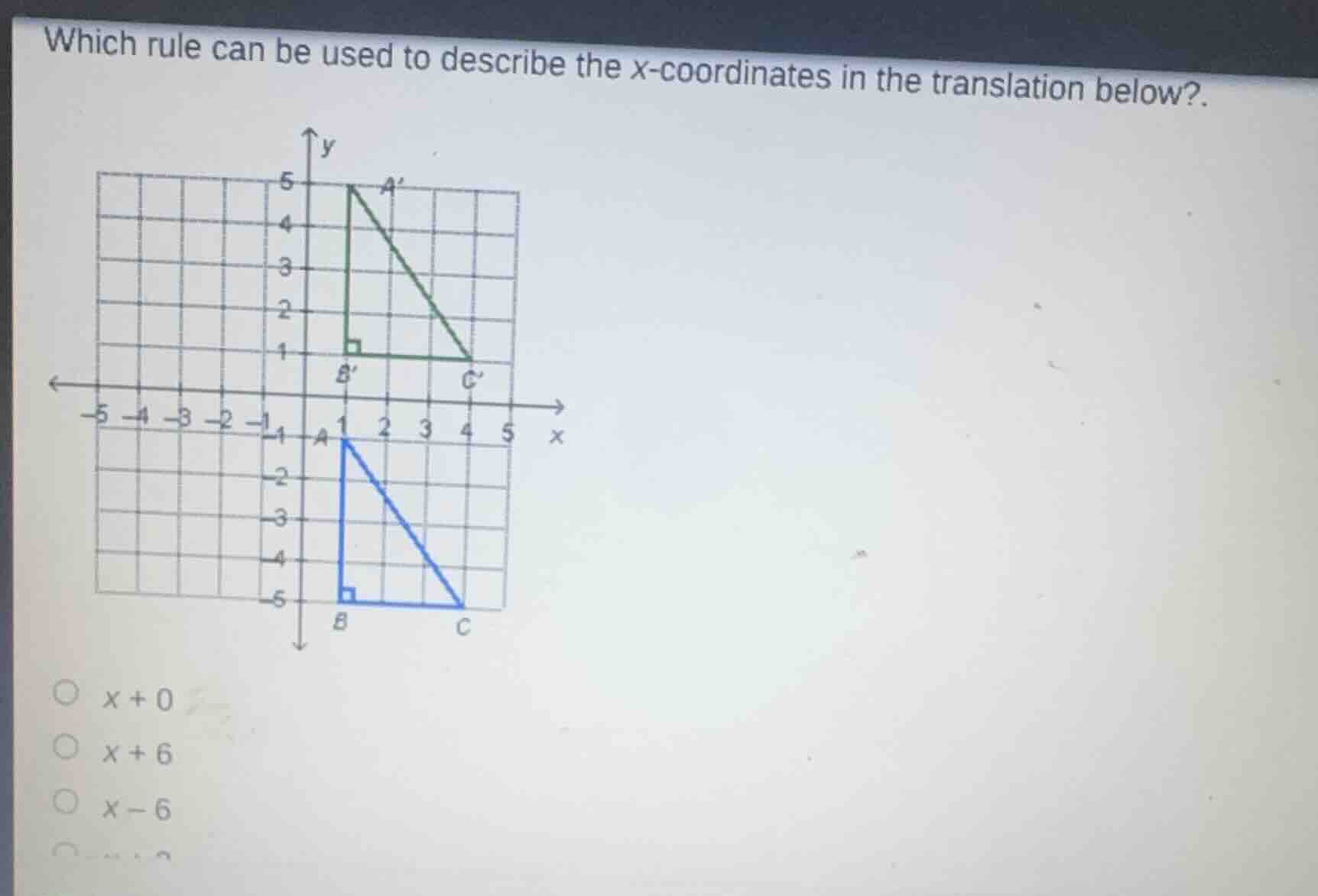
Take point \( A \) (blue) and \( A' \) (green). Coordinates of \( A \): \( (1, -1) \), coordinates of \( A' \): \( (1, 5) \)? Wait, no, wait. Wait, looking at the graph, blue triangle: let's check point \( B \) (blue) at \( (1, -5) \), \( B' \) (green) at \( (1, 1) \). Wait, maybe better to take \( A \): blue \( A \) is at \( (1, -1) \)? Wait no, the blue triangle: let's see, blue \( B \) is at \( (1, -5) \), blue \( A \) is at \( (1, -1) \), blue \( C \) is at \( (4, -5) \). Green triangle: \( B' \) at \( (1, 1) \), \( A' \) at \( (1, 5) \), \( C' \) at \( (4, 1) \). So for \( x \)-coordinate: \( B \) has \( x = 1 \), \( B' \) has \( x = 1 \)? Wait no, that can't be. Wait, maybe I misread. Wait, blue \( A \): let's check the grid. The x-axis: blue \( A \) is at \( x = 1 \), y = -1? Wait, no, the blue triangle: point \( A \) (top of blue triangle) is at \( (1, -1) \)? Wait, no, the blue triangle's \( B \) is at \( (1, -5) \), \( A \) is at \( (1, -1) \), \( C \) is at \( (4, -5) \). Green triangle: \( B' \) at \( (1, 1) \), \( A' \) at \( (1, 5) \), \( C' \) at \( (4, 1) \). Wait, so the \( x \)-coordinate of \( B \) is 1, \( x \)-coordinate of \( B' \) is 1? No, that's same. Wait, maybe another point. Wait, no, maybe I made a mistake. Wait, the translation: from blue to green, the \( x \)-coordinate: let's check \( C \) (blue) at \( (4, -5) \), \( C' \) (green) at \( (4, 1) \). Wait, \( x \)-coordinate is same? No, that can't be. Wait, no, wait the graph: the blue triangle is below the x-axis, green above. Wait, maybe the \( x \)-coordinate doesn't change? Wait, but the options: \( x + 0 \), \( x + 6 \), \( x - 6 \). Wait, maybe I messed up the points. Wait, let's re-express: blue \( A \): let's see, the blue triangle's \( A \) is at \( (1, -1) \)? No, the y-axis: blue \( A \) is at y = -1, x = 1. Green \( A' \) is at y = 5, x = 1. Wait, so \( x \)-coordinate is 1 for both. So \( x \)-coordinate doesn't change. So the rule for \( x \)-coordinate is \( x + 0 \)? Wait, but that seems odd. Wait, maybe I misread the points. Wait, another approach: take point \( C \) (blue) at \( (4, -5) \), \( C' \) (green) at \( (4, 1) \). So \( x \)-coordinate: 4 in both. So \( x \)-coordinate remains the same. So the rule is \( x + 0 \). Wait, but the options include \( x + 6 \), \( x - 6 \), \( x + 0 \). So the \( x \)-coordinate doesn't change, so the rule is \( x + 0 \). Wait, but maybe I made a mistake. Wait, let's check point \( B \) (blue) at \( (1, -5) \), \( B' \) (green) at \( (1, 1) \). \( x \)-coordinate: 1, same. So \( x \)-coordinate: original \( x \), new \( x = x + 0 \).
Step2: Confirm with another point
Take point \( C \): blue \( C \) at \( (4, -5) \), green \( C' \) at \( (4, 1) \). \( x \)-coordinate: 4, same. So \( x \)-coordinate rule is \( x + 0 \).

Snap & solve any problem in the app
Get step-by-step solutions on Sovi AI
Photo-based solutions with guided steps
Explore more problems and detailed explanations
\( x + 0 \) (the first option, assuming the options are: \( x + 0 \), \( x + 6 \), \( x - 6 \), etc. So the correct rule for \( x \)-coordinates is \( x + 0 \).