QUESTION IMAGE
Question
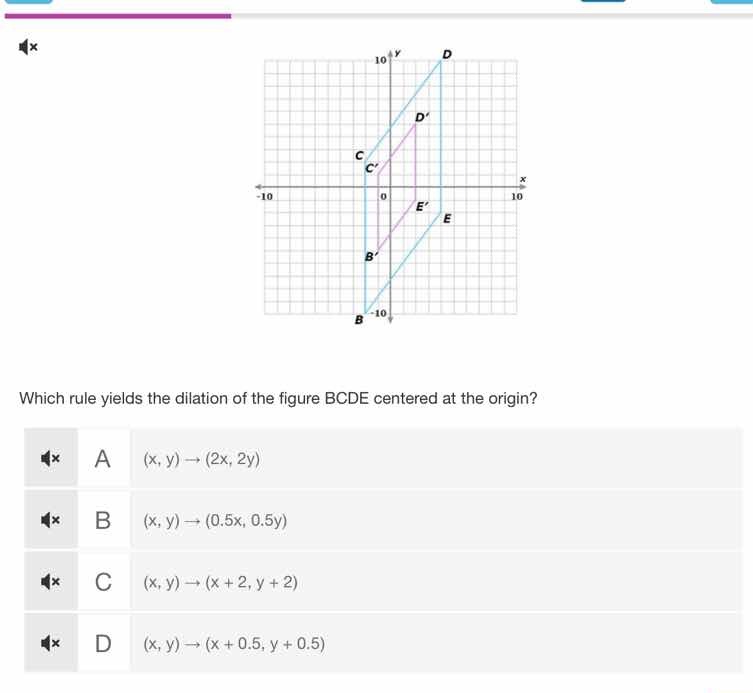
which rule yields the dilation of the figure bcde centered at the origin? a ((x, y) \to (2x, 2y)) b ((x, y) \to (0.5x, 0.5y)) c ((x, y) \to (x + 2, y + 2)) d ((x, y) \to (x + 0.5, y + 0.5))
Step1: Identify a point on BCDE
Let's take point B. From the graph, assume B has coordinates (let's estimate from the grid) say B is at ( -2, -10 )? Wait, no, looking at the grid, maybe B is at ( -2, -10 )? Wait, no, let's check the dilated figure B'C'D'E'. Wait, actually, let's take a point, say E. Let's assume E is at (4, -2) and E' is at (2, -1). Wait, or maybe B is at (-2, -10) and B' is at (-1, -5). So the x-coordinate of B is -2, B' is -1 (which is 0.5(-2)), and y-coordinate of B is -10, B' is -5 (0.5(-10)). So the scale factor is 0.5. So the dilation rule is (x,y) → (0.5x, 0.5y).
Step2: Check the options
Option A is scale factor 2, which would make points further, but here the dilated figure is smaller, so scale factor less than 1. Option B is scale factor 0.5, which matches. Option C and D are translations, not dilations (dilation is scaling, translation is shifting). So the correct rule is (x,y) → (0.5x, 0.5y).

Snap & solve any problem in the app
Get step-by-step solutions on Sovi AI
Photo-based solutions with guided steps
Explore more problems and detailed explanations
B. \((x, y) \to (0.5x, 0.5y)\)