QUESTION IMAGE
Question
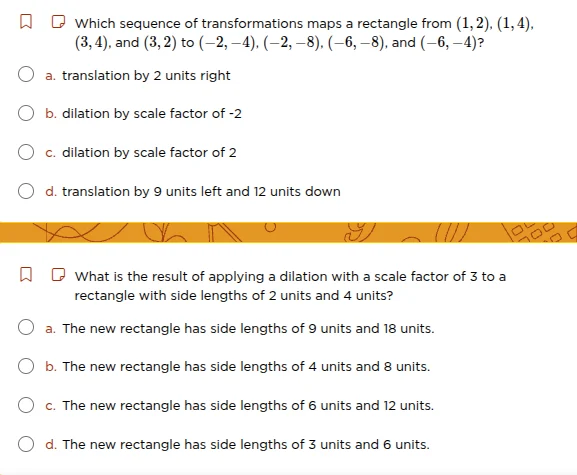
- which sequence of transformations maps a rectangle from (1,2), (1,4), (3,4), and (3,2) to (-2,-4), (-2,-8), (-6,-8), and (-6,-4)?
a. translation by 2 units right
b. dilation by scale factor of -2
c. dilation by scale factor of 2
d. translation by 9 units left and 12 units down
- what is the result of applying a dilation with a scale factor of 3 to a rectangle with side lengths of 2 units and 4 units?
a. the new rectangle has side lengths of 9 units and 18 units.
b. the new rectangle has side lengths of 4 units and 8 units.
c. the new rectangle has side lengths of 6 units and 12 units.
d. the new rectangle has side lengths of 3 units and 6 units.
First Question
Step1: Compare corresponding points
Take the first pair of points: $(1,2)$ and $(-2,-4)$. Calculate the ratio of the new coordinates to the original:
$\frac{-2}{1}=-2$, $\frac{-4}{2}=-2$
Step2: Verify with another point
Take $(1,4)$ and $(-2,-8)$:
$\frac{-2}{1}=-2$, $\frac{-8}{4}=-2$
Step3: Confirm all points follow the same ratio
Check $(3,4)$ and $(-6,-8)$:
$\frac{-6}{3}=-2$, $\frac{-8}{4}=-2$
Check $(3,2)$ and $(-6,-4)$:
$\frac{-6}{3}=-2$, $\frac{-4}{2}=-2$
All points have a scale factor of $-2$.
Step1: Apply scale factor to side lengths
Multiply each original side length by the scale factor of 3.
For the 2-unit side: $2 \times 3 = 6$
For the 4-unit side: $4 \times 3 = 12$

Snap & solve any problem in the app
Get step-by-step solutions on Sovi AI
Photo-based solutions with guided steps
Explore more problems and detailed explanations
b. dilation by scale factor of -2
---