QUESTION IMAGE
Question
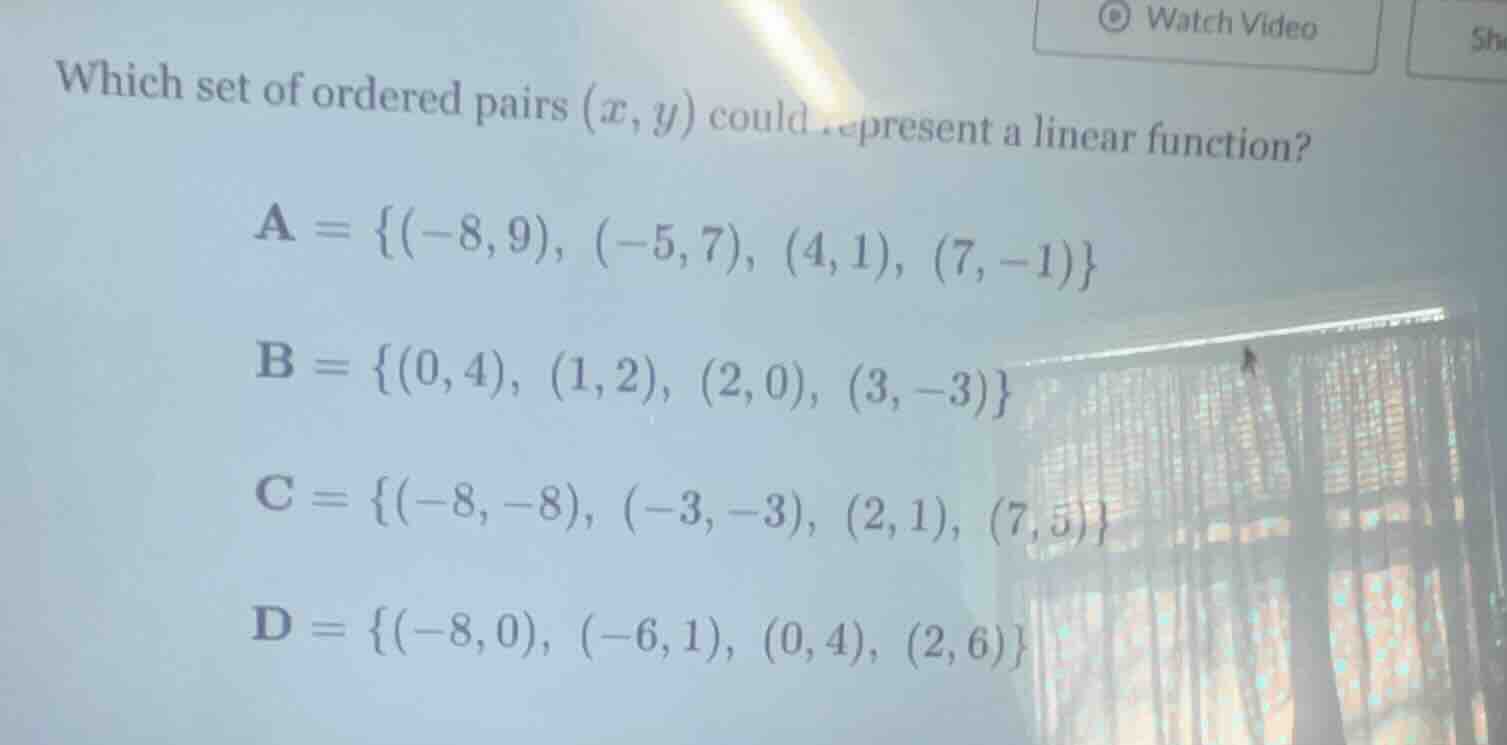
which set of ordered pairs $(x, y)$ could represent a linear function?
$mathbf{a} = \\{(-8,9), (-5,7), (4,1), (7,-1)\\}$
$mathbf{b} = \\{(0,4), (1,2), (2,0), (3,-3)\\}$
$mathbf{c} = \\{(-8,-8), (-3,-3), (2,1), (7,5)\\}$
$mathbf{d} = \\{(-8,0), (-6,1), (0,4), (2,6)\\}$
Step1: Recall linear function slope rule
A set of ordered pairs represents a linear function if the slope (rate of change) between every pair of consecutive points is constant. The slope formula is $m=\frac{y_2-y_1}{x_2-x_1}$.
Step2: Calculate slopes for Set A
Between $(-8,9)$ and $(-5,7)$: $m_1=\frac{7-9}{-5-(-8)}=\frac{-2}{3}$
Between $(-5,7)$ and $(4,1)$: $m_2=\frac{1-7}{4-(-5)}=\frac{-6}{9}=-\frac{2}{3}$
Between $(4,1)$ and $(7,-1)$: $m_3=\frac{-1-1}{7-4}=\frac{-2}{3}$
All slopes are equal.
Step3: Verify slopes for Set B
Between $(0,4)$ and $(1,2)$: $m_1=\frac{2-4}{1-0}=-2$
Between $(1,2)$ and $(2,0)$: $m_2=\frac{0-2}{2-1}=-2$
Between $(2,0)$ and $(3,-3)$: $m_3=\frac{-3-0}{3-2}=-3$
Slopes are not constant.
Step4: Verify slopes for Set C
Between $(-8,-8)$ and $(-3,-3)$: $m_1=\frac{-3-(-8)}{-3-(-8)}=1$
Between $(-3,-3)$ and $(2,1)$: $m_2=\frac{1-(-3)}{2-(-3)}=\frac{4}{5}$
Slopes are not constant.
Step5: Verify slopes for Set D
Between $(-8,0)$ and $(-6,1)$: $m_1=\frac{1-0}{-6-(-8)}=\frac{1}{2}$
Between $(-6,1)$ and $(0,4)$: $m_2=\frac{4-1}{0-(-6)}=\frac{3}{6}=\frac{1}{2}$
Between $(0,4)$ and $(2,6)$: $m_3=\frac{6-4}{2-0}=1$
Slopes are not constant.

Snap & solve any problem in the app
Get step-by-step solutions on Sovi AI
Photo-based solutions with guided steps
Explore more problems and detailed explanations
A = {(-8,9), (-5,7), (4,1), (7,-1)}