QUESTION IMAGE
Question
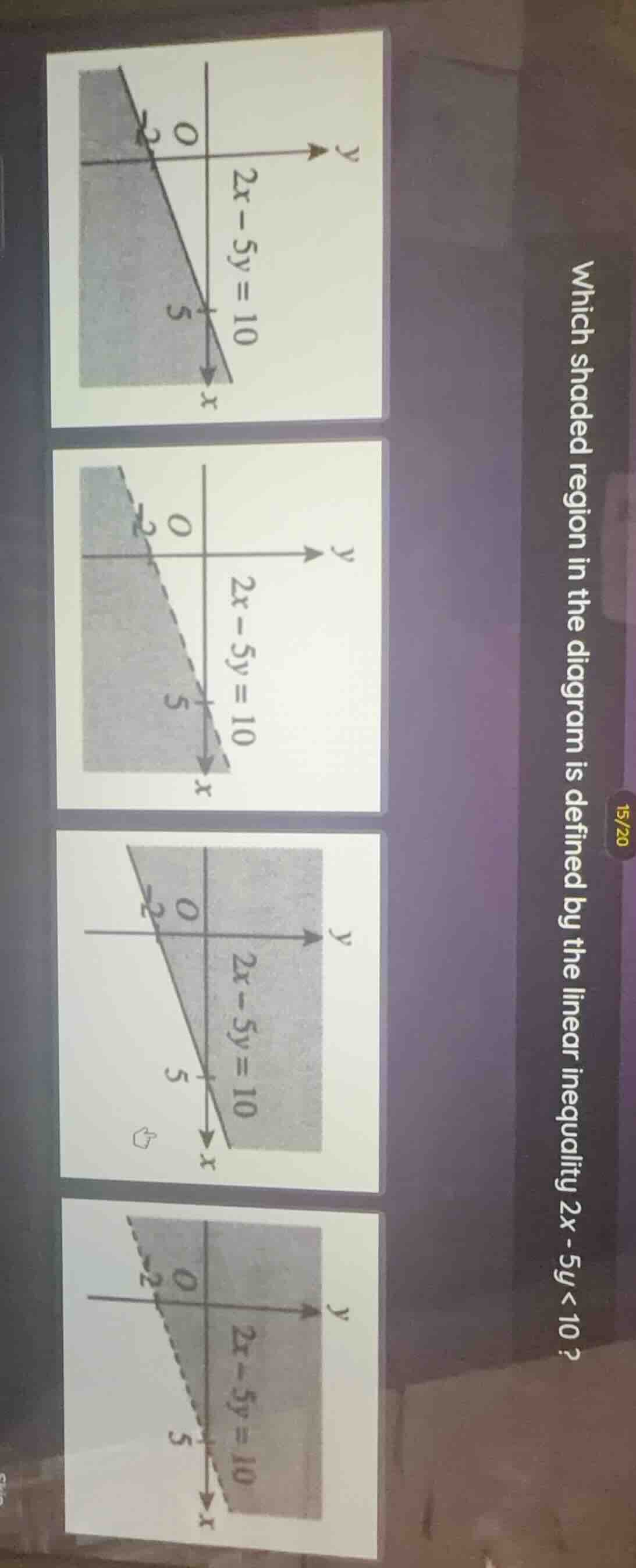
which shaded region in the diagram is defined by the linear inequality (2x - 5y < 10)?
Step1: Rewrite inequality to slope-intercept
Rearrange \(2x-5y<10\) to solve for \(y\):
\[
\]
(Note: Inequality flips when dividing by negative -5)
Step2: Identify line style
The inequality uses \(<\) (strict inequality), so the boundary line \(2x-5y=10\) must be dashed. This eliminates the first and third regions (solid lines).
Step3: Test a point to find region
Use the origin \((0,0)\) to test the inequality \(2(0)-5(0)<10\), which simplifies to \(0<10\) (true). Check which dashed-line region includes \((0,0)\):
- For \(y>\frac{2}{5}x - 2\), the origin satisfies this, so the shaded region is above the line? No, correction: Wait, original inequality \(2x-5y<10\) can be tested directly: substitute (0,0): 0 - 0 <10 is true. Now check which dashed region includes (0,0): the second region (dashed line, shaded left/below) includes (0,0), while the fourth (dashed line, shaded right/above) does not. Wait, no: when we rewrite to \(y > \frac{2}{5}x -2\), (0,0) gives 0 > -2, which is true, so the region is above the line? No, wait the line \(2x-5y=10\) has x-intercept (5,0) and y-intercept (0,-2). The region \(2x-5y<10\) is equivalent to all points where the value of \(2x-5y\) is less than 10. For a point below the line (like (0,-3)), \(2(0)-5(-3)=15>10\) (false). For (0,0), 0<10 (true), which is above the line? Wait no, the line goes from (5,0) down to (0,-2). So (0,0) is above the line, and \(2x-5y<10\) is true there. But wait the second region is shaded below the dashed line, which would be points like (0,-3) which gives 15>10, which violates the inequality. Wait I made a mistake in rearrangement:
\(2x -5y <10\)
\(-5y < -2x +10\)
Divide by -5 (flip inequality): \(y > \frac{2}{5}x -2\). So the region is above the line. But the fourth region is shaded above the dashed line? No, looking at the diagrams:
First: solid line, shaded below
Second: dashed line, shaded below
Third: solid line, shaded above
Fourth: dashed line, shaded above
Wait testing (0,0) in \(y > \frac{2}{5}x -2\): 0 > -2, which is true, so (0,0) is in the solution region, which is above the line. But wait \(2x-5y <10\) at (0,0) is 0<10, true. At (6,0): 12-0=12>10, which is false, so (6,0) is not in the region. The line has x-intercept (5,0), so (6,0) is to the right of the line, which is above the line? No, the line goes from (5,0) to (0,-2), so to the right of (5,0) is below the line? Wait no, slope is 2/5, so as x increases, y increases. So (6,0): y=0, the line at x=6 has y=(2/5)(6)-2=12/5-2=2/5=0.4, so (6,0) is below the line (0 < 0.4). And \(2(6)-5(0)=12>10\), which violates the inequality, so points below the line do not satisfy the inequality. Points above the line, like (0,0): line at x=0 has y=-2, 0 > -2, and 0<10, which is true. So the solution region is above the dashed line, which is the fourth region? Wait no, wait the question's inequality is \(2x-5y <10\). Let's use the test point (5,1): 2(5)-5(1)=10-5=5<10, which is true. (5,1) is above the line (line at x=5 is y=0, 1>0). (5,-1): 10 - (-5)=15>10, false, which is below the line. So the solution is above the dashed line, which is the fourth region? Wait no, the second region is dashed line, shaded below, which is false. The fourth is dashed line, shaded above, which is correct. Wait I messed up earlier. Let's recheck:
Step 1: Strict inequality \(<\) means dashed line (eliminate solid line options 1 and 3).
Step 2: Test (0,0) in \(2x-5y <10\): 0 <10, true. So (0,0) must be in the shaded region. Looking at the dashed line options:
- Second…

Snap & solve any problem in the app
Get step-by-step solutions on Sovi AI
Photo-based solutions with guided steps
Explore more problems and detailed explanations
The second (top-to-bottom) shaded region (dashed line \(2x-5y=10\), shaded area below/left of the line)