QUESTION IMAGE
Question
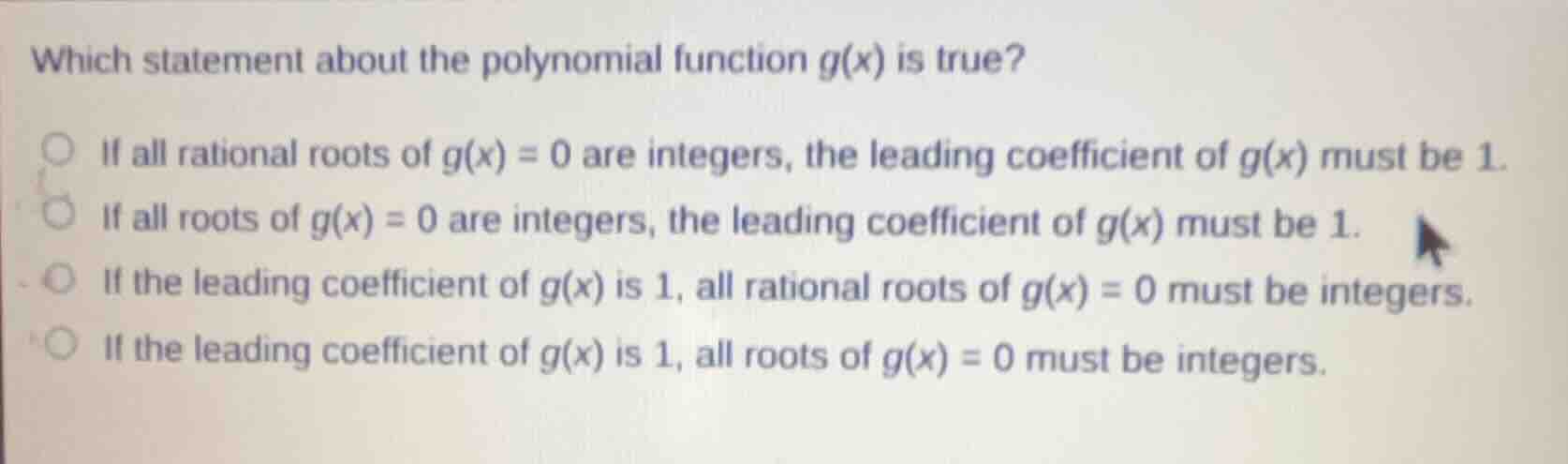
which statement about the polynomial function $g(x)$ is true?
if all rational roots of $g(x) = 0$ are integers, the leading coefficient of $g(x)$ must be 1.
if all roots of $g(x) = 0$ are integers, the leading coefficient of $g(x)$ must be 1.
if the leading coefficient of $g(x)$ is 1, all rational roots of $g(x) = 0$ must be integers.
if the leading coefficient of $g(x)$ is 1, all roots of $g(x) = 0$ must be integers.
We use the Rational Root Theorem, which states that any rational root $\frac{p}{q}$ of a polynomial $g(x)=a_nx^n+...+a_1x+a_0$ (with integer coefficients) has $p$ dividing the constant term $a_0$ and $q$ dividing the leading coefficient $a_n$.
- For the first option: A polynomial like $2x-2$ has rational root $x=1$ (integer), but leading coefficient is 2, so this is false.
- For the second option: A polynomial like $2(x-1)(x-2)=2x^2-6x+4$ has integer roots 1 and 2, but leading coefficient is 2, so this is false.
- For the third option: If leading coefficient $a_n=1$, then $q$ (denominator of rational root $\frac{p}{q}$) must divide 1, so $q=\pm1$. Thus all rational roots are integers $\pm p$, which is true.
- For the fourth option: A polynomial like $x^2-2$ has leading coefficient 1, but roots $\sqrt{2}$ and $-\sqrt{2}$ are irrational, not integers, so this is false.

Snap & solve any problem in the app
Get step-by-step solutions on Sovi AI
Photo-based solutions with guided steps
Explore more problems and detailed explanations
C. If the leading coefficient of $g(x)$ is 1, all rational roots of $g(x) = 0$ must be integers.