QUESTION IMAGE
Question
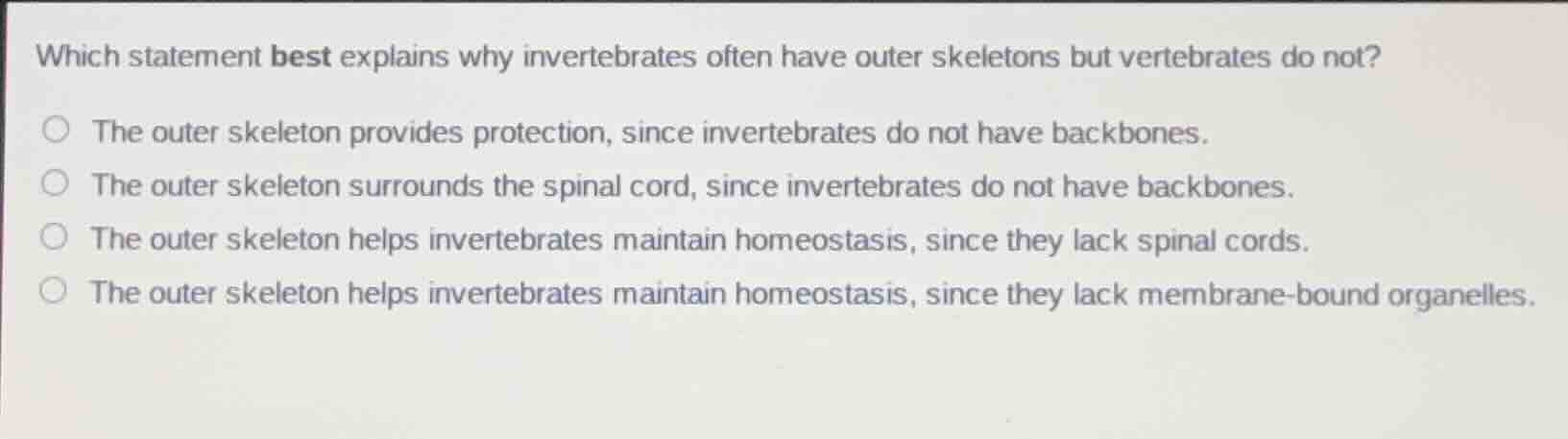
which statement best explains why invertebrates often have outer skeletons but vertebrates do not?
the outer skeleton provides protection, since invertebrates do not have backbones.
the outer skeleton surrounds the spinal cord, since invertebrates do not have backbones.
the outer skeleton helps invertebrates maintain homeostasis, since they lack spinal cords.
the outer skeleton helps invertebrates maintain homeostasis, since they lack membrane - bound organelles.
Brief Explanations
- The second option is incorrect because invertebrates do not have a spinal cord, so an outer skeleton cannot surround it.
- The third option is wrong because outer skeletons are not primarily for homeostasis, and the link to lacking a spinal cord is invalid.
- The fourth option is incorrect because invertebrates (like arthropods) have membrane-bound organelles, and the homeostasis claim is unrelated.
- The first option is correct: invertebrates lack backbones (vertebrae) for internal support/protection, so an outer skeleton provides the necessary physical protection and structural support.

Snap & solve any problem in the app
Get step-by-step solutions on Sovi AI
Photo-based solutions with guided steps
Explore more problems and detailed explanations
A. The outer skeleton provides protection, since invertebrates do not have backbones.