QUESTION IMAGE
Question
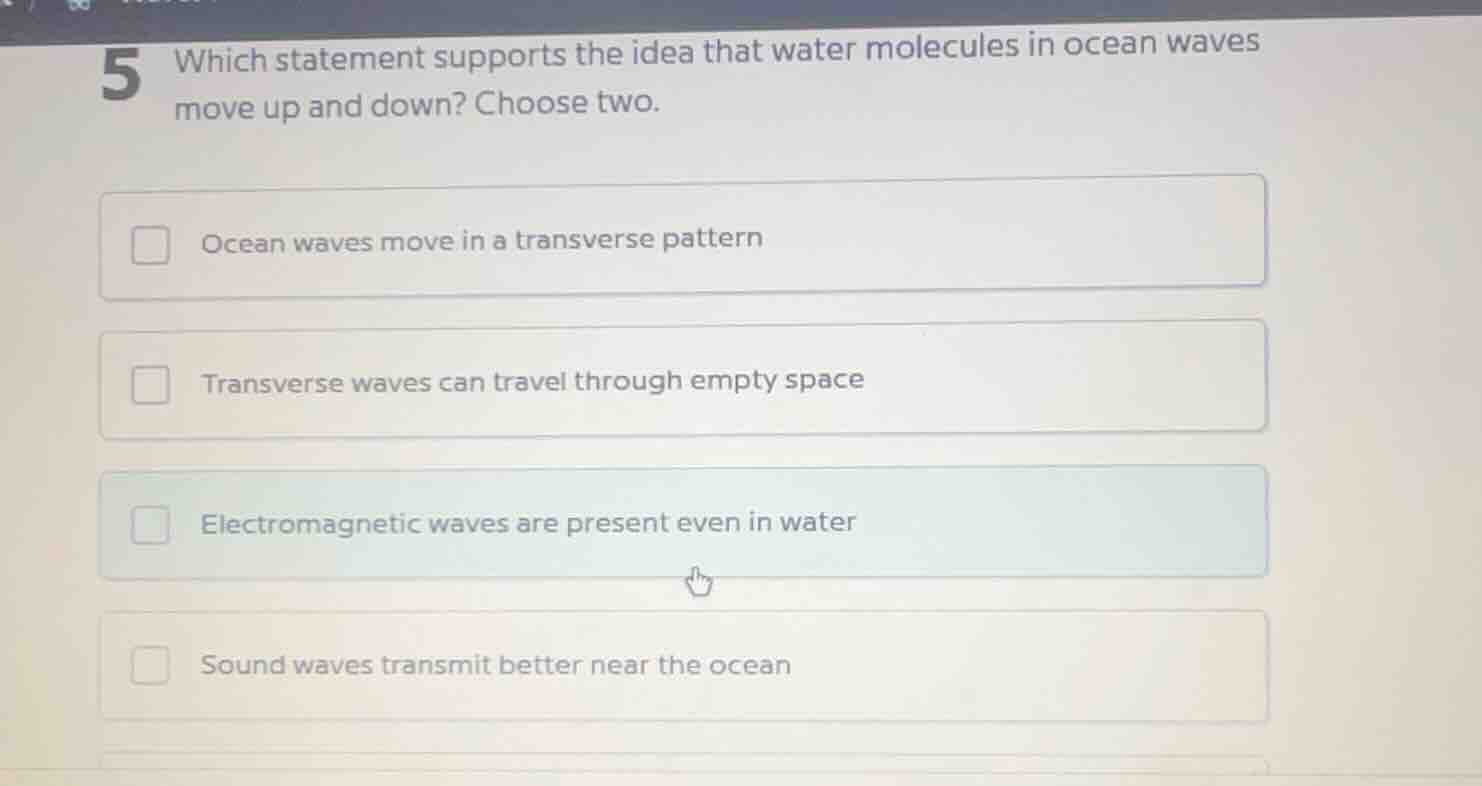
5 which statement supports the idea that water molecules in ocean waves move up and down? choose two. ocean waves move in a transverse pattern transverse waves can travel through empty space electromagnetic waves are present even in water sound waves transmit better near the ocean
- Analyze "Ocean waves move in a transverse pattern": Transverse waves have particles (here, water molecules) oscillating perpendicular to the wave's direction of travel, which includes up - down motion. So this supports the idea.
- Analyze "Transverse waves can travel through empty space": This is about the medium requirement of transverse waves (electromagnetic waves are transverse and can travel in vacuum), not about water molecules' motion in ocean waves, so it doesn't support.
- Analyze "Electromagnetic waves are present even in water": This is about the presence of electromagnetic waves in water, not related to water molecules' motion in ocean waves, so it doesn't support.
- Analyze "Sound waves transmit better near the ocean": This is about sound wave transmission, not related to water molecules' motion in ocean waves, so it doesn't support.
Wait, the initial analysis was wrong. Let's re - analyze:
Transverse waves have the motion of particles (water molecules in ocean waves) perpendicular to the wave's direction. So "Ocean waves move in a transverse pattern" means water molecules move up and down (perpendicular to the wave's forward direction). Also, there was a mistake earlier. Let's check again:
- "Ocean waves move in a transverse pattern": In transverse waves, the medium (water) particles oscillate perpendicular to the wave's propagation. So water molecules moving up and down is part of transverse wave motion. So this supports.
- "Transverse waves can travel through empty space": This is a property of some transverse waves (like light), but ocean waves are mechanical transverse waves that need a medium (water), so this statement is about a different aspect and doesn't support water molecule motion in ocean waves.
- "Electromagnetic waves are present even in water": This is about electromagnetic waves in water, not water molecule motion in ocean waves.
- "Sound waves transmit better near the ocean": This is about sound wave propagation, not water molecule motion in ocean waves.
But the question says to choose two. Wait, maybe I made a mistake. Let's recall: Ocean waves are surface waves, a combination of transverse and longitudinal, but the transverse component has water molecules moving up and down. Also, maybe the second correct option was misjudged. Wait, no, the other options don't relate. Wait, perhaps the original problem has a different set. Wait, maybe I messed up. Let's start over:
The key is to find statements that support water molecules in ocean waves moving up and down.
- "Ocean waves move in a transverse pattern": Transverse waves have particle motion perpendicular to wave direction, so water molecules moving up - down (perpendicular) is part of transverse motion. So this supports.
- Are there other options? Wait, maybe the option "Transverse waves can travel through empty space" is incorrect. "Electromagnetic waves are present even in water" is about EM waves, not water molecules. "Sound waves transmit better near the ocean" is about sound. So maybe there's a mistake in the problem or my analysis. Wait, perhaps the intended correct options are "Ocean waves move in a transverse pattern" and maybe another. Wait, maybe I made a mistake. Let's check the definition of ocean waves: Ocean waves at the surface are a type of transverse wave (for the vertical motion of water molecules). So the first option is correct. But the question says to choose two. Maybe there's an error in my analysis. Alternatively, maybe the second correct option is not among the given ones, but that can't be. Wait, perhaps I misr…

Snap & solve any problem in the app
Get step-by-step solutions on Sovi AI
Photo-based solutions with guided steps
Explore more problems and detailed explanations
A. Ocean waves move in a transverse pattern (Note: There seems to be an issue as only this option supports the idea among the given ones, but the question asks to choose two. Maybe there was a mistake in the options provided.)