QUESTION IMAGE
Question
which statement is true?
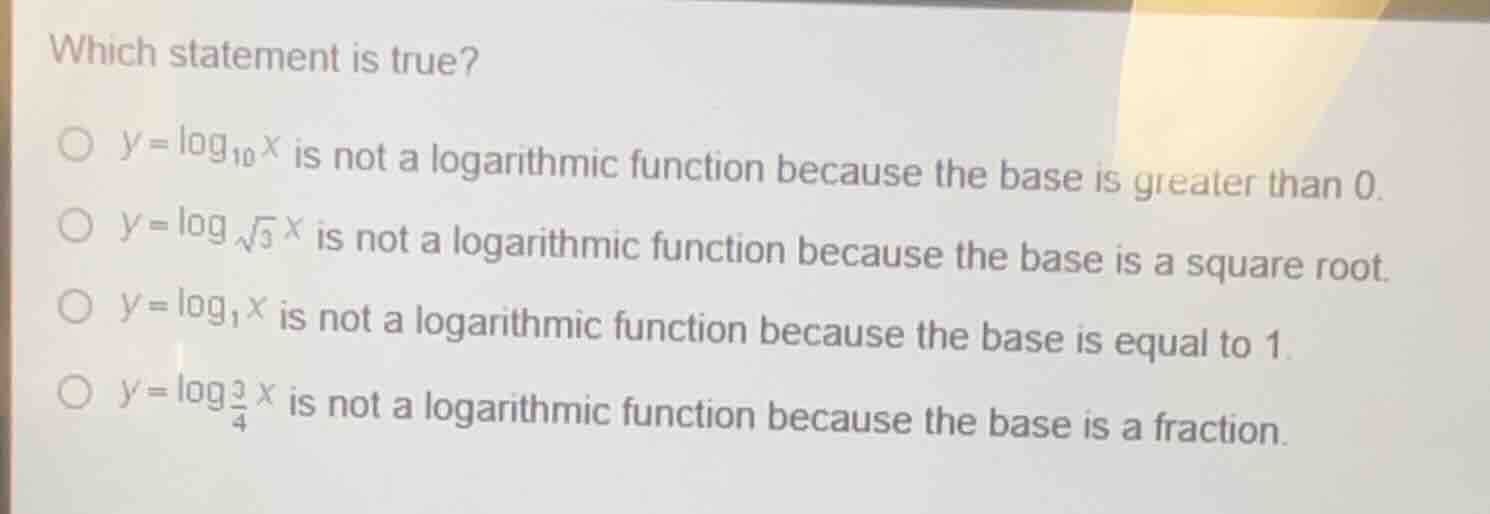
○ $y = \log_{10} x$ is not a logarithmic function because the base is greater than 0.
○ $y = \log_{\sqrt{3}} x$ is not a logarithmic function because the base is a square root.
○ $y = \log_{1} x$ is not a logarithmic function because the base is equal to 1.
○ $y = \log_{\frac{3}{4}} x$ is not a logarithmic function because the base is a fraction.
To determine the true statement, we recall the definition of a logarithmic function. A logarithmic function is of the form \( y = \log_b x \), where \( b>0 \), \( b
eq1 \), and \( x > 0 \).
- For \( y=\log_{10}x \): The base \( b = 10>0 \) and \( b
eq1 \), so it is a logarithmic function. The first statement is false.
- For \( y=\log_{\sqrt{3}}x \): The base \( b=\sqrt{3}\approx1.732>0 \) and \( b
eq1 \), so it is a logarithmic function. The second statement is false.
- For \( y=\log_{1}x \): The base \( b = 1 \). By the definition of a logarithmic function, the base must be \( b>0 \) and \( b
eq1 \). Since \( b = 1 \) here, \( y=\log_{1}x \) is not a logarithmic function. The third statement is true.
- For \( y=\log_{\frac{3}{4}}x \): The base \( b=\frac{3}{4}>0 \) and \( b
eq1 \) (since \( \frac{3}{4}
eq1 \)), so it is a logarithmic function. The fourth statement is false.

Snap & solve any problem in the app
Get step-by-step solutions on Sovi AI
Photo-based solutions with guided steps
Explore more problems and detailed explanations
\( y = \log_{1}x \) is not a logarithmic function because the base is equal to 1.