QUESTION IMAGE
Question
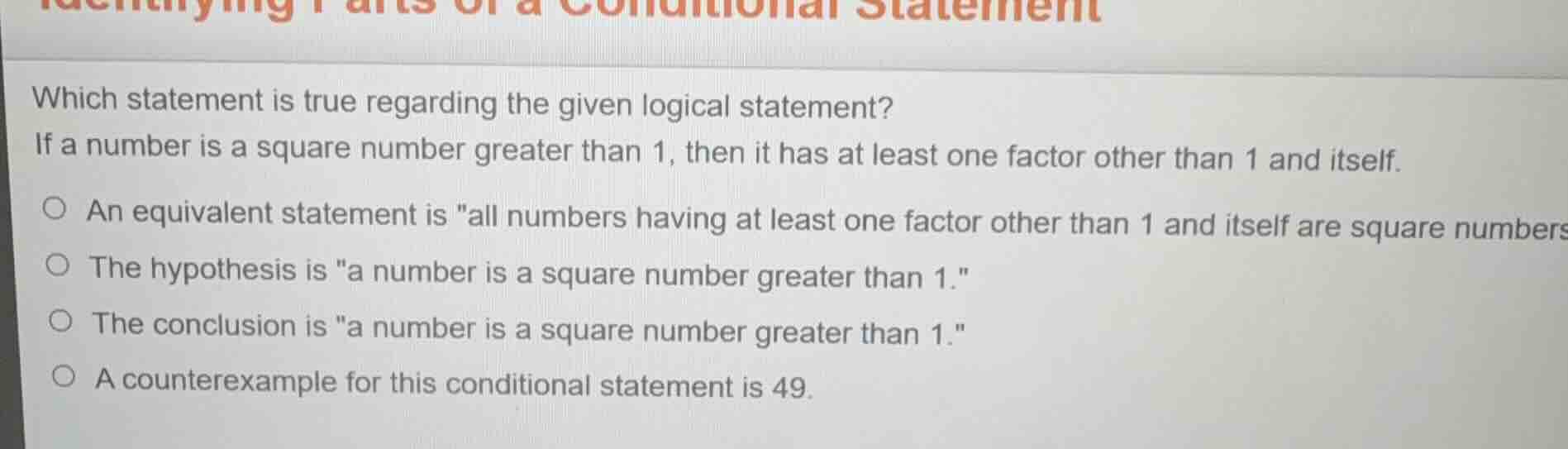
which statement is true regarding the given logical statement?
if a number is a square number greater than 1, then it has at least one factor other than 1 and itself.
an equivalent statement is \all numbers having at least one factor other than 1 and itself are square numbers
the hypothesis is \a number is a square number greater than 1.\
the conclusion is \a number is a square number greater than 1.\
a counterexample for this conditional statement is 49.
Brief Explanations
- For the first option: The original statement is a conditional "If P, then Q". An equivalent statement would not be "All Q are P" (this is the converse, which is not logically equivalent). For example, 6 has factors other than 1 and itself but is not a square number, so this is false.
- For the second option: In a conditional statement "If P, then Q", P is the hypothesis. Here, "a number is a square number greater than 1" is the P part, so this is true.
- For the third option: The conclusion in "If P, then Q" is Q, which is "it has at least one factor other than 1 and itself", not the given phrase, so this is false.
- For the fourth option: 49 is \(7^2\), a square number greater than 1, and it has factors other than 1 and itself (like 7). It does not contradict the statement, so it is not a counterexample, making this false.

Snap & solve any problem in the app
Get step-by-step solutions on Sovi AI
Photo-based solutions with guided steps
Explore more problems and detailed explanations
The hypothesis is "a number is a square number greater than 1."