QUESTION IMAGE
Question
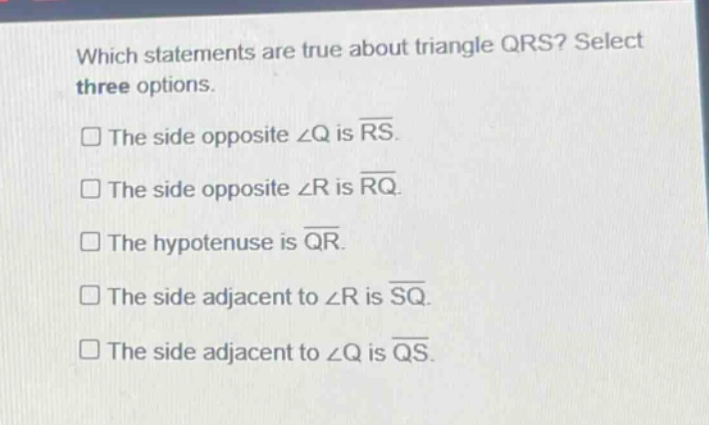
which statements are true about triangle qrs? select three options. the side opposite ∠q is \\(\overline{rs}\\). the side opposite ∠r is \\(\overline{rq}\\). the hypotenuse is \\(\overline{qr}\\). the side adjacent to ∠r is \\(\overline{sq}\\). the side adjacent to ∠q is \\(\overline{qs}\\).
To solve this, we analyze each statement about triangle \( QRS \) (assuming it's a right - triangle, though the diagram is not shown, typical for such questions):
Step 1: Analyze "The side opposite \( \angle Q \) is \( \overline{RS} \)"
In a triangle, the side opposite an angle is the side that does not form the angle. For \( \angle Q \) in \( \triangle QRS \), the sides forming \( \angle Q \) are \( \overline{QS} \) and \( \overline{QR} \). So the side opposite \( \angle Q \) is \( \overline{RS} \). This statement is true.
Step 2: Analyze "The side opposite \( \angle R \) is \( \overline{RQ} \)"
For \( \angle R \) in \( \triangle QRS \), the sides forming \( \angle R \) are \( \overline{RS} \) and \( \overline{RQ} \). The side opposite \( \angle R \) should be \( \overline{QS} \), not \( \overline{RQ} \). This statement is false.
Step 3: Analyze "The hypotenuse is \( \overline{QR} \)"
In a right - triangle, the hypotenuse is the side opposite the right angle and is the longest side. If we assume the right angle is at \( S \) (a common configuration for \( \triangle QRS \) in such problems), then the hypotenuse would be the side opposite the right angle, which is \( \overline{QR} \). This statement is true.
Step 4: Analyze "The side adjacent to \( \angle R \) is \( \overline{SQ} \)"
The sides adjacent to an angle are the sides that form the angle. For \( \angle R \), the sides forming it are \( \overline{RS} \) and \( \overline{RQ} \). \( \overline{SQ} \) is opposite \( \angle R \), not adjacent. This statement is false.
Step 5: Analyze "The side adjacent to \( \angle Q \) is \( \overline{QS} \)"
For \( \angle Q \), the sides forming it are \( \overline{QS} \) and \( \overline{QR} \). So \( \overline{QS} \) is adjacent to \( \angle Q \). This statement is true.
The three true statements are:
- The side opposite \( \angle Q \) is \( \overline{RS} \)
- The hypotenuse is \( \overline{QR} \)
- The side adjacent to \( \angle Q \) is \( \overline{QS} \)
So the answer is:
- The side opposite \( \angle Q \) is \( \overline{RS} \)
- The hypotenuse is \( \overline{QR} \)
- The side adjacent to \( \angle Q \) is \( \overline{QS} \) (corresponding to the first, third, and fifth options in the given choices)

Snap & solve any problem in the app
Get step-by-step solutions on Sovi AI
Photo-based solutions with guided steps
Explore more problems and detailed explanations
To solve this, we analyze each statement about triangle \( QRS \) (assuming it's a right - triangle, though the diagram is not shown, typical for such questions):
Step 1: Analyze "The side opposite \( \angle Q \) is \( \overline{RS} \)"
In a triangle, the side opposite an angle is the side that does not form the angle. For \( \angle Q \) in \( \triangle QRS \), the sides forming \( \angle Q \) are \( \overline{QS} \) and \( \overline{QR} \). So the side opposite \( \angle Q \) is \( \overline{RS} \). This statement is true.
Step 2: Analyze "The side opposite \( \angle R \) is \( \overline{RQ} \)"
For \( \angle R \) in \( \triangle QRS \), the sides forming \( \angle R \) are \( \overline{RS} \) and \( \overline{RQ} \). The side opposite \( \angle R \) should be \( \overline{QS} \), not \( \overline{RQ} \). This statement is false.
Step 3: Analyze "The hypotenuse is \( \overline{QR} \)"
In a right - triangle, the hypotenuse is the side opposite the right angle and is the longest side. If we assume the right angle is at \( S \) (a common configuration for \( \triangle QRS \) in such problems), then the hypotenuse would be the side opposite the right angle, which is \( \overline{QR} \). This statement is true.
Step 4: Analyze "The side adjacent to \( \angle R \) is \( \overline{SQ} \)"
The sides adjacent to an angle are the sides that form the angle. For \( \angle R \), the sides forming it are \( \overline{RS} \) and \( \overline{RQ} \). \( \overline{SQ} \) is opposite \( \angle R \), not adjacent. This statement is false.
Step 5: Analyze "The side adjacent to \( \angle Q \) is \( \overline{QS} \)"
For \( \angle Q \), the sides forming it are \( \overline{QS} \) and \( \overline{QR} \). So \( \overline{QS} \) is adjacent to \( \angle Q \). This statement is true.
The three true statements are:
- The side opposite \( \angle Q \) is \( \overline{RS} \)
- The hypotenuse is \( \overline{QR} \)
- The side adjacent to \( \angle Q \) is \( \overline{QS} \)
So the answer is:
- The side opposite \( \angle Q \) is \( \overline{RS} \)
- The hypotenuse is \( \overline{QR} \)
- The side adjacent to \( \angle Q \) is \( \overline{QS} \) (corresponding to the first, third, and fifth options in the given choices)