QUESTION IMAGE
Question
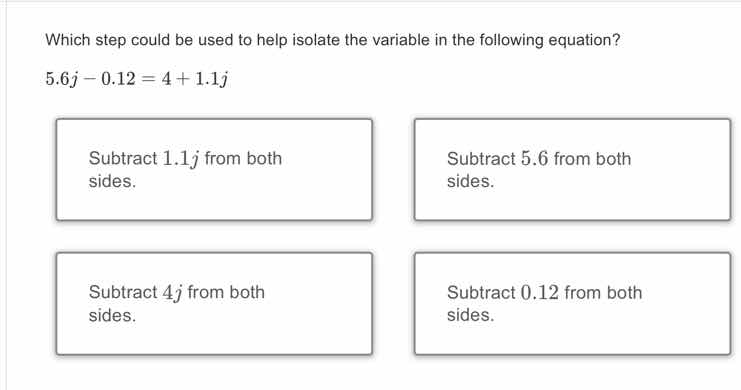
which step could be used to help isolate the variable in the following equation?
$5.6j - 0.12 = 4 + 1.1j$
subtract $1.1j$ from both sides.
subtract $5.6$ from both sides.
subtract $4j$ from both sides.
subtract $0.12$ from both sides.
Step1: Recall variable isolation
To isolate the variable \( j \), we want to get all terms with \( j \) on one side. The equation is \( 5.6j - 0.12 = 4 + 1.1j \).
Step2: Analyze each option
- Subtracting \( 1.1j \) from both sides: \( 5.6j - 1.1j - 0.12 = 4 + 1.1j - 1.1j \), which simplifies to \( 4.5j - 0.12 = 4 \). This helps group \( j \)-terms.
- Subtracting \( 5.6 \) (not \( 5.6j \)) from both sides would not help isolate \( j \), as \( 5.6 \) is a coefficient, not a term with \( j \) on the left.
- Subtracting \( 4j \) (not in the equation) from both sides is incorrect, as the equation has \( 5.6j \) and \( 1.1j \), not \( 4j \).
- Subtracting \( 0.12 \) from both sides: \( 5.6j - 0.12 - 0.12 = 4 + 1.1j - 0.12 \), which doesn't group \( j \)-terms.

Snap & solve any problem in the app
Get step-by-step solutions on Sovi AI
Photo-based solutions with guided steps
Explore more problems and detailed explanations
Subtract \( 1.1j \) from both sides.