QUESTION IMAGE
Question
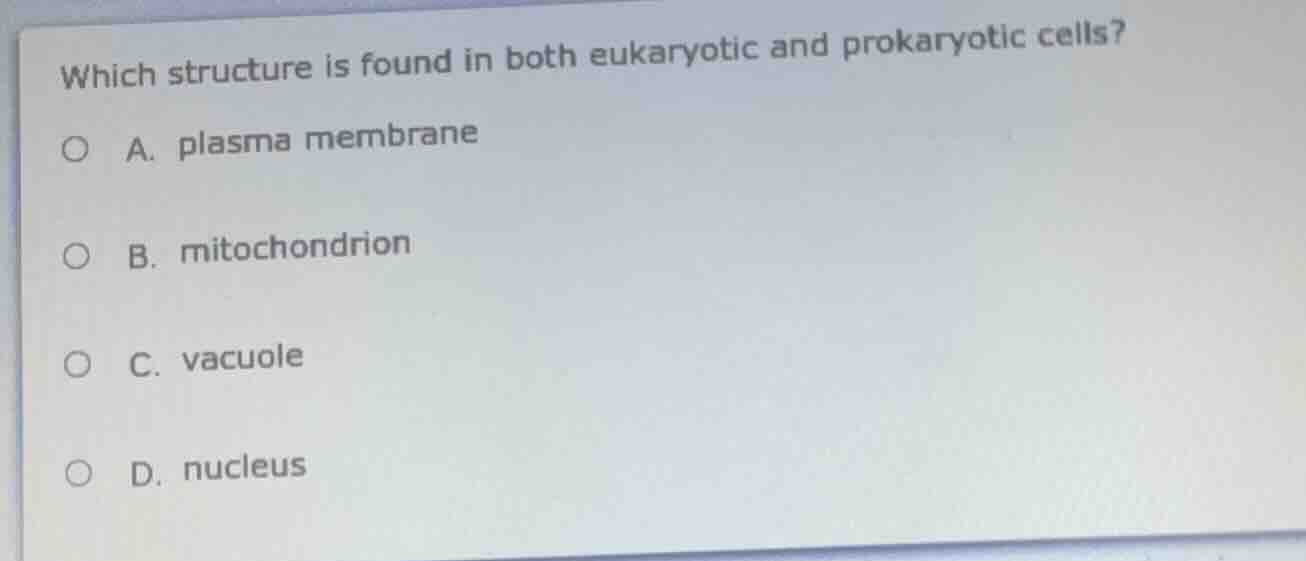
which structure is found in both eukaryotic and prokaryotic cells?
a. plasma membrane
b. mitochondrion
c. vacuole
d. nucleus
Brief Explanations
To solve this, we analyze each option:
- Option A: Plasma membrane (cell membrane) is a structure that encloses the cell, regulating what enters and exits. Both eukaryotic (like animal, plant cells) and prokaryotic (like bacteria) cells have a plasma membrane to separate the cell from its environment.
- Option B: Mitochondria are organelles responsible for energy production (cellular respiration) and are only found in eukaryotic cells. Prokaryotes lack membrane - bound organelles like mitochondria.
- Option C: Vacuoles are membrane - bound sacs, and while they are present in many eukaryotic cells (e.g., plant cells have large central vacuoles), prokaryotic cells do not have vacuoles.
- Option D: The nucleus is a membrane - bound organelle that contains the genetic material. Prokaryotic cells do not have a nucleus (their genetic material is in a region called the nucleoid, without a nuclear membrane), while eukaryotic cells have a well - defined nucleus.
So, the structure found in both eukaryotic and prokaryotic cells is the plasma membrane.

Snap & solve any problem in the app
Get step-by-step solutions on Sovi AI
Photo-based solutions with guided steps
Explore more problems and detailed explanations
A. plasma membrane