QUESTION IMAGE
Question
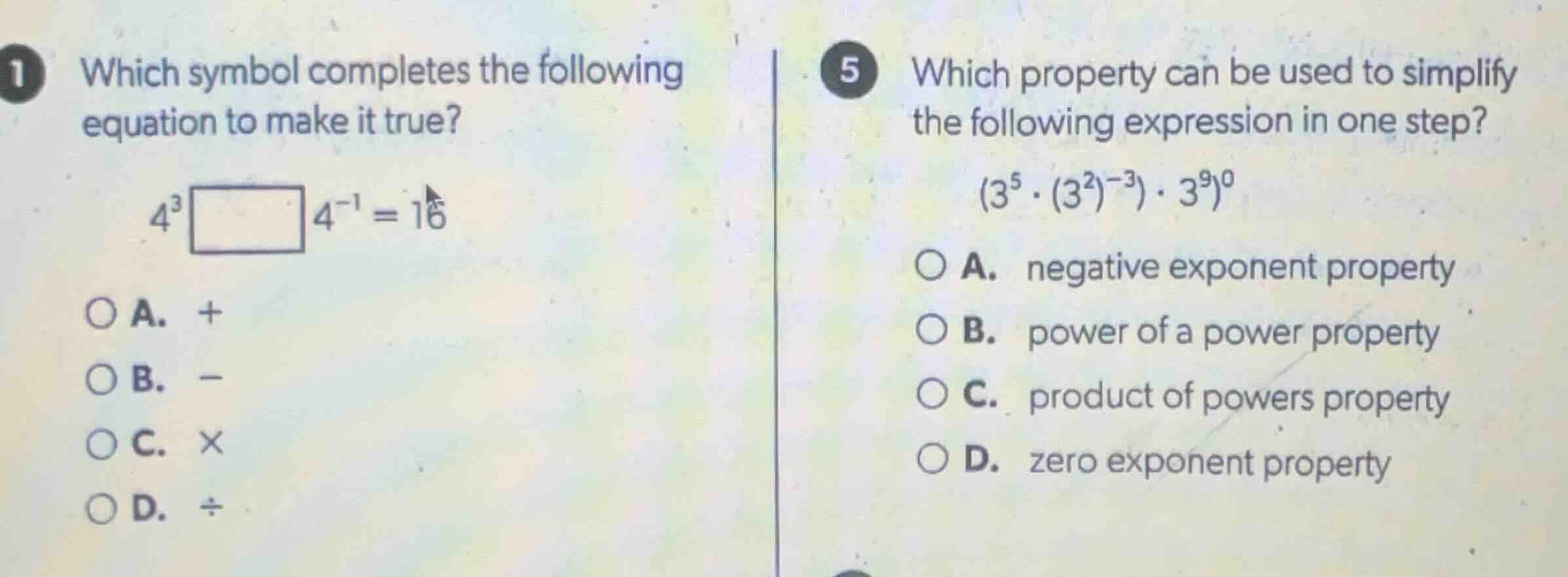
1 which symbol completes the following equation to make it true?
$4^3 \square 4^{-1} = 16$
a. $+$
b. $-$
c. $\times$
d. $\div$
5 which property can be used to simplify the following expression in one step?
$(3^5 \cdot (3^2)^{-3}) \cdot 3^9)^0$
a. negative exponent property
b. power of a power property
c. product of powers property
d. zero exponent property
For Question 1:
Step1: Rewrite 16 as power of 4
$16 = 4^2$
Step2: Test each operation
Test Option A (+):
$4^3 + 4^{-1} = 64 + \frac{1}{4} = 64.25
eq 4^2$
Test Option B (-):
$4^3 - 4^{-1} = 64 - \frac{1}{4} = 63.75
eq 4^2$
Test Option C (×):
$4^3 \times 4^{-1} = 4^{3+(-1)} = 4^2 = 16$
Test Option D (÷):
$4^3 \div 4^{-1} = 4^{3-(-1)} = 4^4 = 256
eq 4^2$
Step1: Recall exponent properties
- Zero exponent property: Any non-zero number raised to the power of 0 equals 1, i.e., $a^0 = 1$ for $a
eq 0$.
- The base inside the parentheses $(3^5 \cdot (3^2)^{-3} \cdot 3^9)$ is a non-zero value (since 3 is non-zero, all its powers are non-zero, and their product is non-zero).
Step2: Apply the property
Using the zero exponent property directly simplifies $(3^5 \cdot (3^2)^{-3} \cdot 3^9)^0$ to 1 in one step, without needing to simplify the base first.

Snap & solve any problem in the app
Get step-by-step solutions on Sovi AI
Photo-based solutions with guided steps
Explore more problems and detailed explanations
C. $\times$
---