QUESTION IMAGE
Question
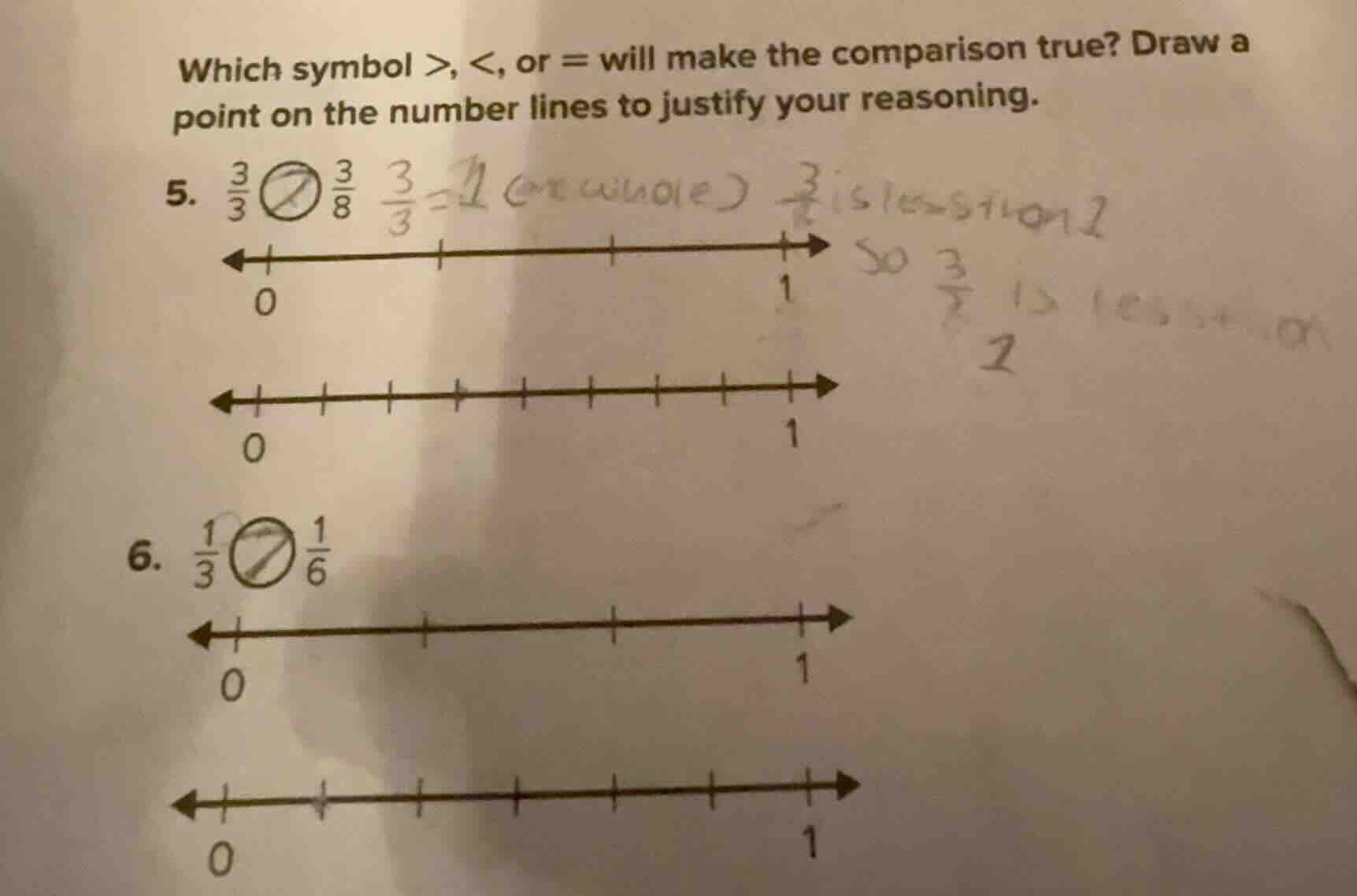
which symbol >, <, or = will make the comparison true? draw a point on the number lines to justify your reasoning. 5. \\(\frac{3}{3} \bigcirc \frac{3}{8}\\) 0 1 0 1 6. \\(\frac{1}{3} \bigcirc \frac{1}{6}\\) 0 1 0 1
Problem 5:
Step 1: Simplify \(\frac{3}{3}\)
\(\frac{3}{3} = 1\) (since a number divided by itself is 1).
Step 2: Analyze \(\frac{3}{8}\)
\(\frac{3}{8}\) is a fraction less than 1 (because the numerator 3 is less than the denominator 8).
Step 3: Compare the two values
Since \(1>\frac{3}{8}\), we have \(\frac{3}{3}>\frac{3}{8}\).
To justify on the number line:
- For \(\frac{3}{3} = 1\), mark a point at 1 on the first number line (which has marks at 0 and 1).
- For \(\frac{3}{8}\), on the second number line (divided into 8 equal parts between 0 and 1), mark a point at the 3rd division (since \(\frac{3}{8}\) means 3 out of 8 equal parts from 0). We can see that 1 (where \(\frac{3}{3}\) is) is to the right of \(\frac{3}{8}\) on the number line, confirming \(\frac{3}{3}>\frac{3}{8}\).
Step 1: Recall the rule for comparing unit fractions
For unit fractions (fractions with numerator 1), the larger the denominator, the smaller the fraction. This is because if a whole is divided into more parts, each part is smaller.
Step 2: Compare \(\frac{1}{3}\) and \(\frac{1}{6}\)
Here, the denominators are 3 and 6. Since \(3 < 6\), \(\frac{1}{3}>\frac{1}{6}\) (because dividing a whole into 3 parts gives larger parts than dividing it into 6 parts, so one - third of a whole is larger than one - sixth of a whole).
To justify on the number line:
- For \(\frac{1}{3}\), on a number line divided into 3 equal parts between 0 and 1, mark a point at the 1st division (since \(\frac{1}{3}\) is 1 out of 3 equal parts from 0).
- For \(\frac{1}{6}\), on a number line divided into 6 equal parts between 0 and 1, mark a point at the 1st division (since \(\frac{1}{6}\) is 1 out of 6 equal parts from 0). We can see that \(\frac{1}{3}\) (the mark for \(\frac{1}{3}\)) is to the right of \(\frac{1}{6}\) (the mark for \(\frac{1}{6}\)) on the number line, confirming \(\frac{1}{3}>\frac{1}{6}\).

Snap & solve any problem in the app
Get step-by-step solutions on Sovi AI
Photo-based solutions with guided steps
Explore more problems and detailed explanations
\(\boldsymbol{>}\)