QUESTION IMAGE
Question
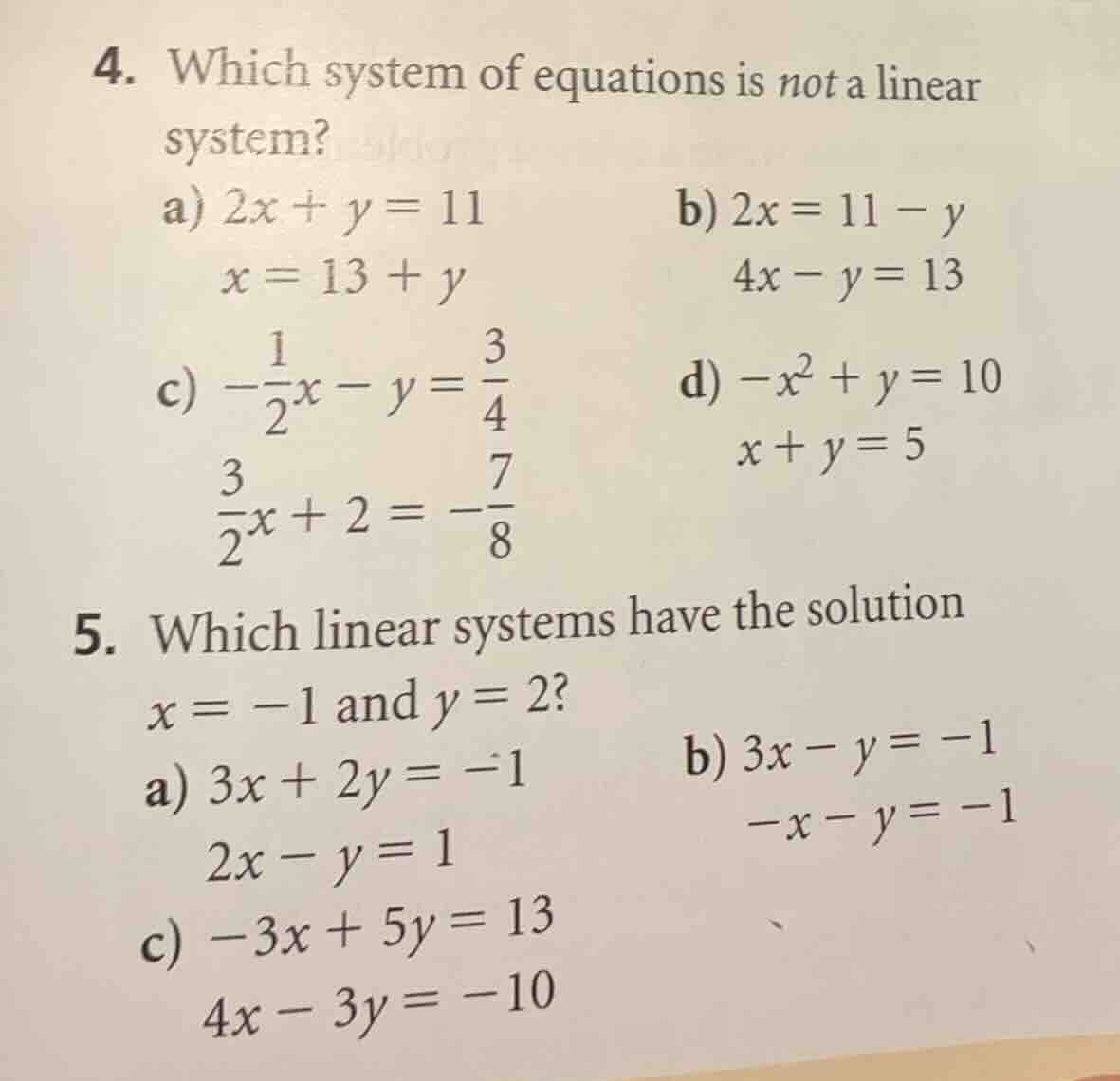
- which system of equations is not a linear system?
a) $2x + y = 11$
$x = 13 + y$
b) $2x = 11 - y$
$4x - y = 13$
c) $-\frac{1}{2}x - y = \frac{3}{4}$
$\frac{3}{2}x + 2 = -\frac{7}{8}$
d) $-x^2 + y = 10$
$x + y = 5$
- which linear systems have the solution $x = -1$ and $y = 2$?
a) $3x + 2y = -1$
$2x - y = 1$
b) $3x - y = -1$
$-x - y = -1$
c) $-3x + 5y = 13$
$4x - 3y = -10$
Question 4
Step1: Recall linear system definition
A linear system of equations consists of equations where each equation is linear, i.e., the highest power of any variable is 1.
Step2: Analyze Option a
Equations: \(2x + y = 11\) (degree 1) and \(x = 13 + y\) (degree 1). Both are linear.
Step3: Analyze Option b
Rewrite \(2x = 11 - y\) as \(2x + y = 11\) (degree 1), and \(4x - y = 13\) (degree 1). Both linear.
Step4: Analyze Option c
Equations: \(-\frac{1}{2}x - y = \frac{3}{4}\) (degree 1) and \(\frac{3}{2}x + 2 = -\frac{7}{8}\) (degree 1, only \(x\)). Both linear.
Step5: Analyze Option d
First equation: \(-x^2 + y = 10\) has \(x^2\) (degree 2), so it's non - linear. The second equation \(x + y = 5\) is linear, but the system is non - linear because of the first equation.
Step1: Substitute \(x=-1,y = 2\) into each system
For a system to have \(x=-1,y = 2\) as a solution, substituting these values into both equations of the system should satisfy them.
Step2: Analyze Option a
First equation: \(3x+2y=3(-1)+2(2)=-3 + 4 = 1
eq - 1\). So, this system does not have the solution.
Step3: Analyze Option b
First equation: \(3x - y=3(-1)-2=-3 - 2=-5
eq - 1\). So, this system does not have the solution.
Step4: Analyze Option c
First equation: \(-3x + 5y=-3(-1)+5(2)=3 + 10 = 13\) (satisfies). Second equation: \(4x-3y=4(-1)-3(2)=-4 - 6=-10\) (satisfies).

Snap & solve any problem in the app
Get step-by-step solutions on Sovi AI
Photo-based solutions with guided steps
Explore more problems and detailed explanations
d) \(-x^{2}+y = 10\)
\(x + y = 5\)