QUESTION IMAGE
Question
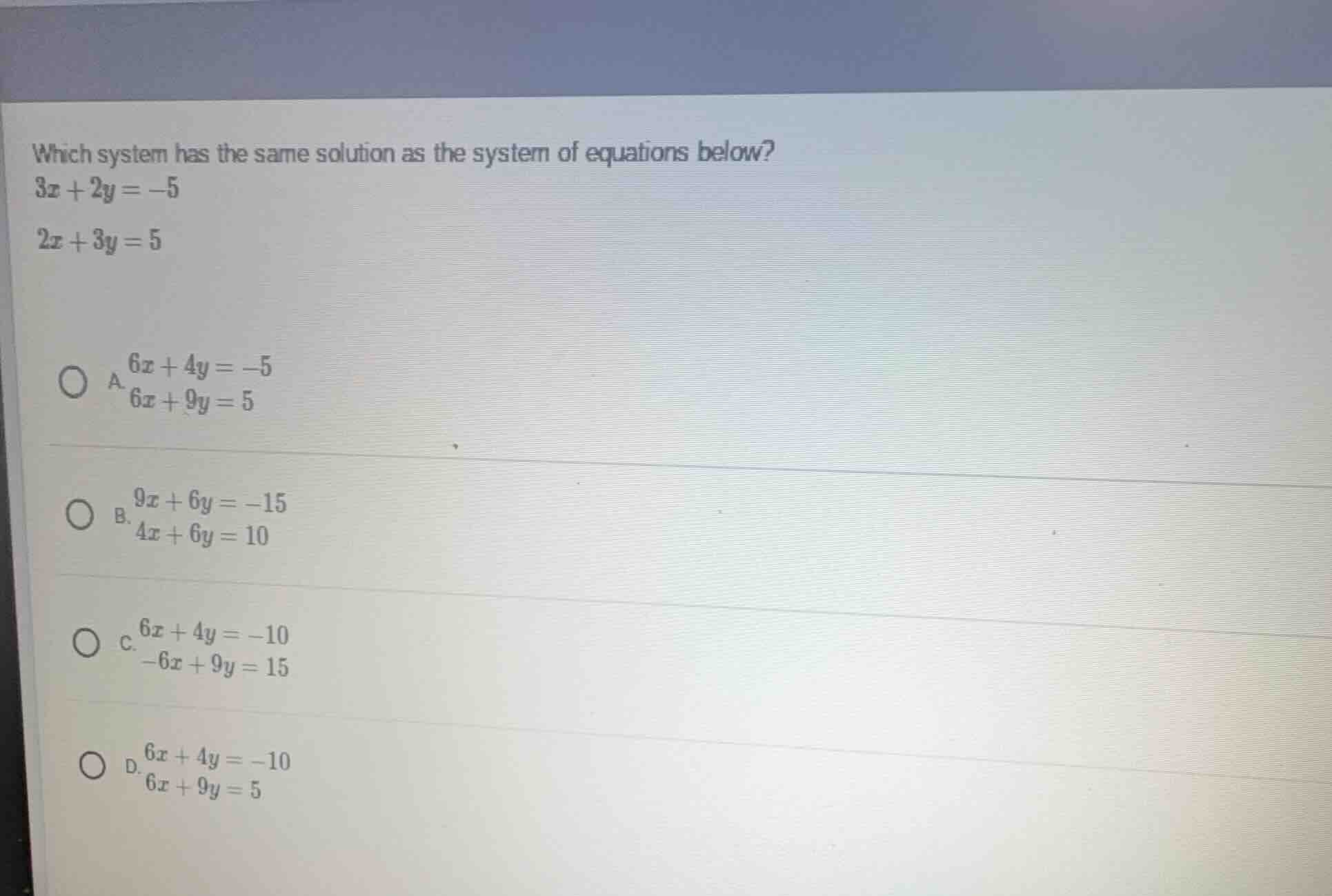
which system has the same solution as the system of equations below?
$3x + 2y = -5$
$2x + 3y = 5$
a. $\
$
b. $\
$
c. $\
$
d. $\
$
Step1: Recall the property of linear systems
To find a system with the same solution, we can multiply each equation in the original system by a non - zero constant (this is based on the property that if we multiply both sides of an equation \(ax + by=c\) by a non - zero number \(k\), we get \(kax + kby = kc\), and the solution of the new equation is the same as the original equation). The original system is \(
\)
Step2: Analyze option B
- For the first equation of the original system \(3x + 2y=-5\), if we multiply both sides by \(3\), we have:
\(3\times(3x + 2y)=3\times(-5)\)
Using the distributive property \(a(b + c)=ab+ac\), we get \(9x+6y=-15\)
- For the second equation of the original system \(2x + 3y = 5\), if we multiply both sides by \(2\), we have:
\(2\times(2x + 3y)=2\times5\)
Using the distributive property, we get \(4x + 6y = 10\)
So the system \(
\) (which is option B) is obtained by multiplying the original equations by non - zero constants, and thus has the same solution as the original system.
We can also check other options:
- Option A: For the first equation \(3x + 2y=-5\), multiplying by \(2\) gives \(6x + 4y=-10
eq - 5\), so this system is not equivalent.
- Option C: The second equation \(2x + 3y = 5\) multiplied by \(3\) gives \(6x+9y = 15\), but the first equation transformation and the sign of the second equation in option C are incorrect.
- Option D: For the first equation \(3x + 2y=-5\), multiplying by \(2\) gives \(6x + 4y=-10\) (correct for the first part), but for the second equation \(2x + 3y = 5\), multiplying by \(3\) gives \(6x+9y = 15
eq5\), so this system is not equivalent.

Snap & solve any problem in the app
Get step-by-step solutions on Sovi AI
Photo-based solutions with guided steps
Explore more problems and detailed explanations
B. \(
\)