QUESTION IMAGE
Question
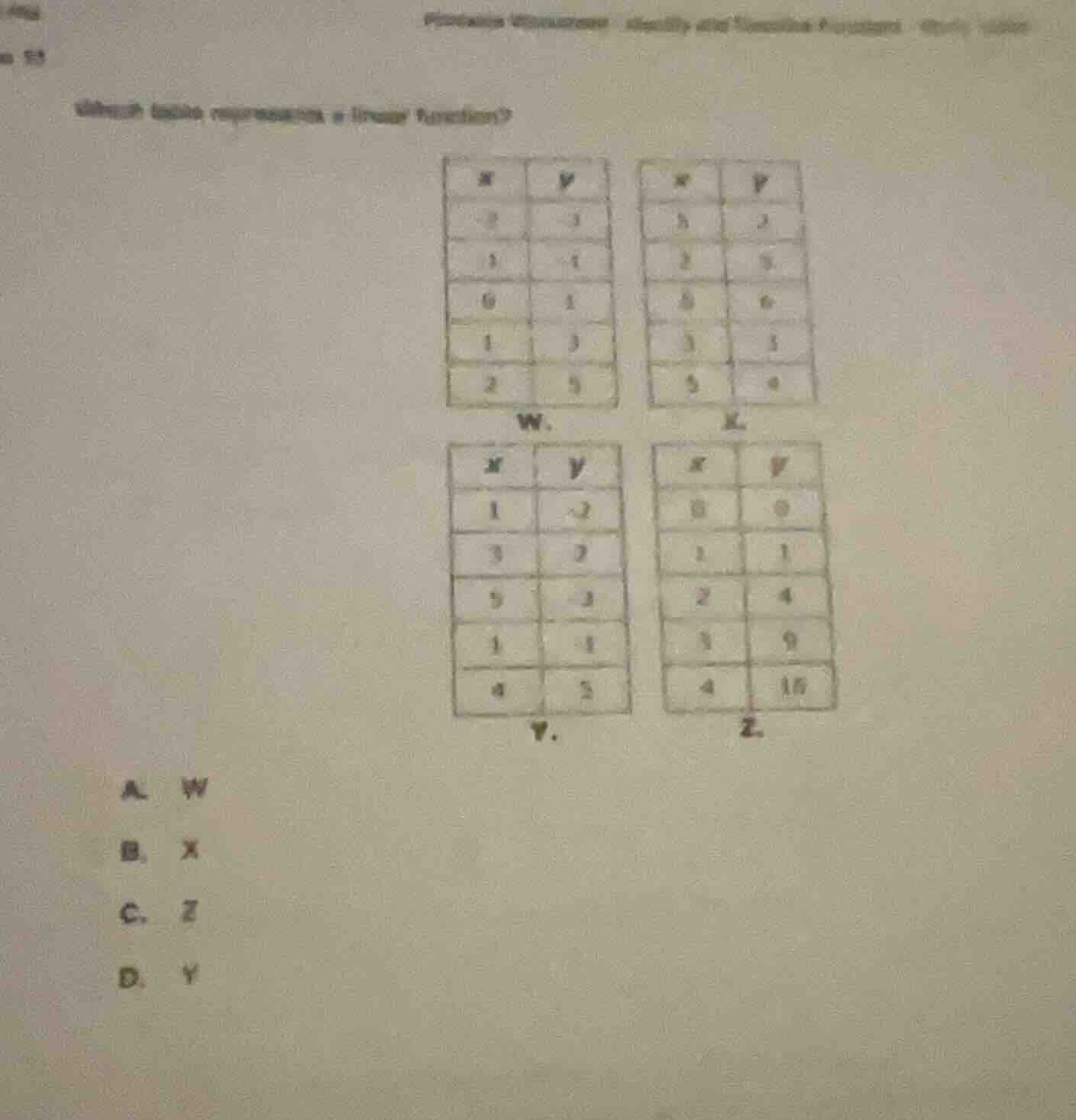
which table represents a linear function?
w.
| $x$ | $y$ |
| - | - |
| -2 | 3 |
| -1 | 1 |
| 0 | -1 |
| 1 | -3 |
| 2 | -5 |
x.
| $x$ | $y$ |
| - | - |
| -2 | 2 |
| -1 | 3 |
| 0 | 6 |
| 1 | 1 |
| 2 | 4 |
y.
| $x$ | $y$ |
| - | - |
| 1 | -2 |
| 3 | 2 |
| 5 | -3 |
| 1 | -1 |
| 4 | 2 |
z.
| $x$ | $y$ |
| - | - |
| 0 | 0 |
| 1 | 1 |
| 2 | 4 |
| 3 | 9 |
| 4 | 16 |
a. w
b. x
c. z
d. y
Step1: Recall linear function rule
A linear function has a constant rate of change (slope) between all pairs of points, calculated as $\frac{\Delta y}{\Delta x} = \frac{y_2 - y_1}{x_2 - x_1}$. Also, each $x$-value must map to exactly one $y$-value (function definition).
Step2: Check Table W
First, check if it is a function: $x=-2,-1,0,1,2$ are unique. Now calculate slopes:
$\frac{1 - (-3)}{-1 - (-2)} = \frac{4}{1}=4$; $\frac{1 - 1}{0 - (-1)} = 0$
Slopes are not constant → Not linear.
Step3: Check Table X
Check if it is a function: $x=-2,-1,0,1,2$ are unique. Calculate slopes:
$\frac{5 - 7}{-1 - (-2)} = \frac{-2}{1}=-2$; $\frac{6 - 5}{0 - (-1)} = \frac{1}{1}=1$
Slopes are not constant → Not linear.
Step4: Check Table Y
Check if it is a function: $x=1$ repeats (maps to -2 and -1) → Not a function, so not linear.
Step5: Check Table Z
Check if it is a function: $x=0,1,2,3,4$ are unique. Calculate slopes:
$\frac{1 - 0}{1 - 0}=1$; $\frac{4 - 1}{2 - 1}=3$; $\frac{9 - 4}{3 - 2}=5$
Wait, correction: This is $y=x^2$, slope is not constant. Wait recheck Table X:
Wait Table X values: $x=-2,y=7$; $x=-1,y=5$; $x=0,y=6$? No, wait no—wait Table W: $x=-2,y=-3$; $x=-1,y=1$; $x=0,y=1$; $x=1,y=3$; $x=2,y=5$. Table X: $x=-2,y=7$; $x=-1,y=5$; $x=0,y=3$; $x=1,y=1$; $x=2,y=-1$. Oh, misread earlier!
Recalculate Table X slopes:
$\frac{5-7}{-1 - (-2)}=\frac{-2}{1}=-2$; $\frac{3-5}{0 - (-1)}=\frac{-2}{1}=-2$; $\frac{1-3}{1-0}=\frac{-2}{1}=-2$; $\frac{-1-1}{2-1}=\frac{-2}{1}=-2$
Slopes are constant (-2) → Linear function.

Snap & solve any problem in the app
Get step-by-step solutions on Sovi AI
Photo-based solutions with guided steps
Explore more problems and detailed explanations
B. X