QUESTION IMAGE
Question
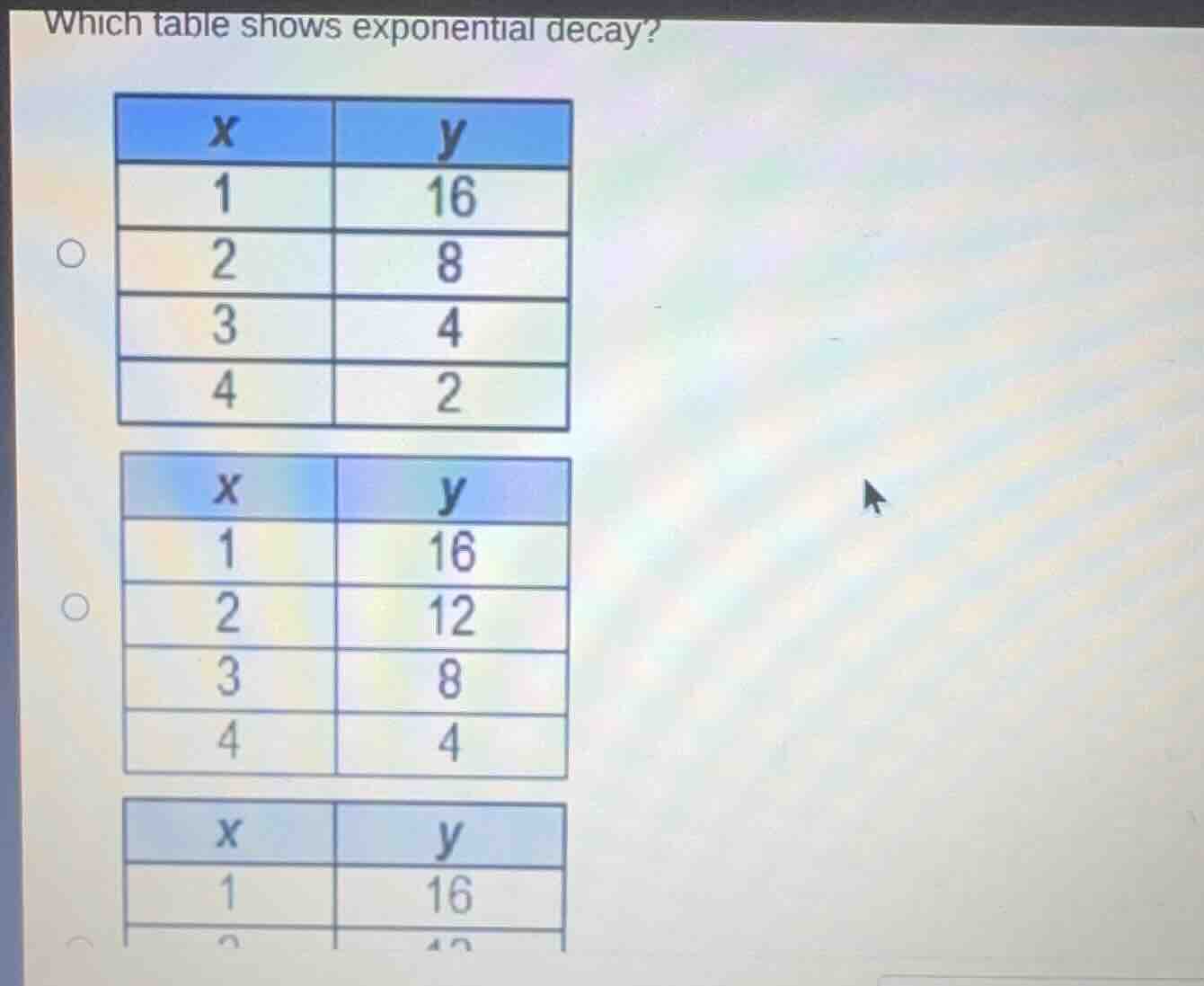
which table shows exponential decay?
first table:
| x | y |
|---|---|
| 2 | 8 |
| 3 | 4 |
| 4 | 2 |
second table:
| x | y |
|---|---|
| 2 | 12 |
| 3 | 8 |
| 4 | 4 |
third table (partially shown):
| x | y | |
|---|---|---|
| 2 | 42 | (partially visible) |
Step1: Recall exponential decay property
Exponential decay has a constant ratio between consecutive \( y \)-values (when \( x \) increases by 1). For a function \( y = ab^x \), the common ratio \( r=\frac{y_{n + 1}}{y_n}\) should be between 0 and 1 (since it's decay).
Step2: Analyze first table
For the first table:
- When \( x = 1 \), \( y = 16 \); \( x = 2 \), \( y = 8 \). Ratio: \(\frac{8}{16}=\frac{1}{2}\)
- \( x = 2 \), \( y = 8 \); \( x = 3 \), \( y = 4 \). Ratio: \(\frac{4}{8}=\frac{1}{2}\)
- \( x = 3 \), \( y = 4 \); \( x = 4 \), \( y = 2 \). Ratio: \(\frac{2}{4}=\frac{1}{2}\)
The ratio is constant (\(\frac{1}{2}\)) and between 0 and 1.
Step3: Analyze second table
For the second table:
- \( x = 1 \), \( y = 16 \); \( x = 2 \), \( y = 12 \). Ratio: \(\frac{12}{16}=\frac{3}{4}\)
- \( x = 2 \), \( y = 12 \); \( x = 3 \), \( y = 8 \). Ratio: \(\frac{8}{12}=\frac{2}{3}\)
- \( x = 3 \), \( y = 8 \); \( x = 4 \), \( y = 4 \). Ratio: \(\frac{4}{8}=\frac{1}{2}\)
The ratios are not constant, so it's linear or other, not exponential decay.
(Assuming the third table has a typo or is incomplete, but from given, first table has constant ratio for decay.)

Snap & solve any problem in the app
Get step-by-step solutions on Sovi AI
Photo-based solutions with guided steps
Explore more problems and detailed explanations
The first table (with \( x \): 1,2,3,4 and \( y \): 16,8,4,2) shows exponential decay.