QUESTION IMAGE
Question
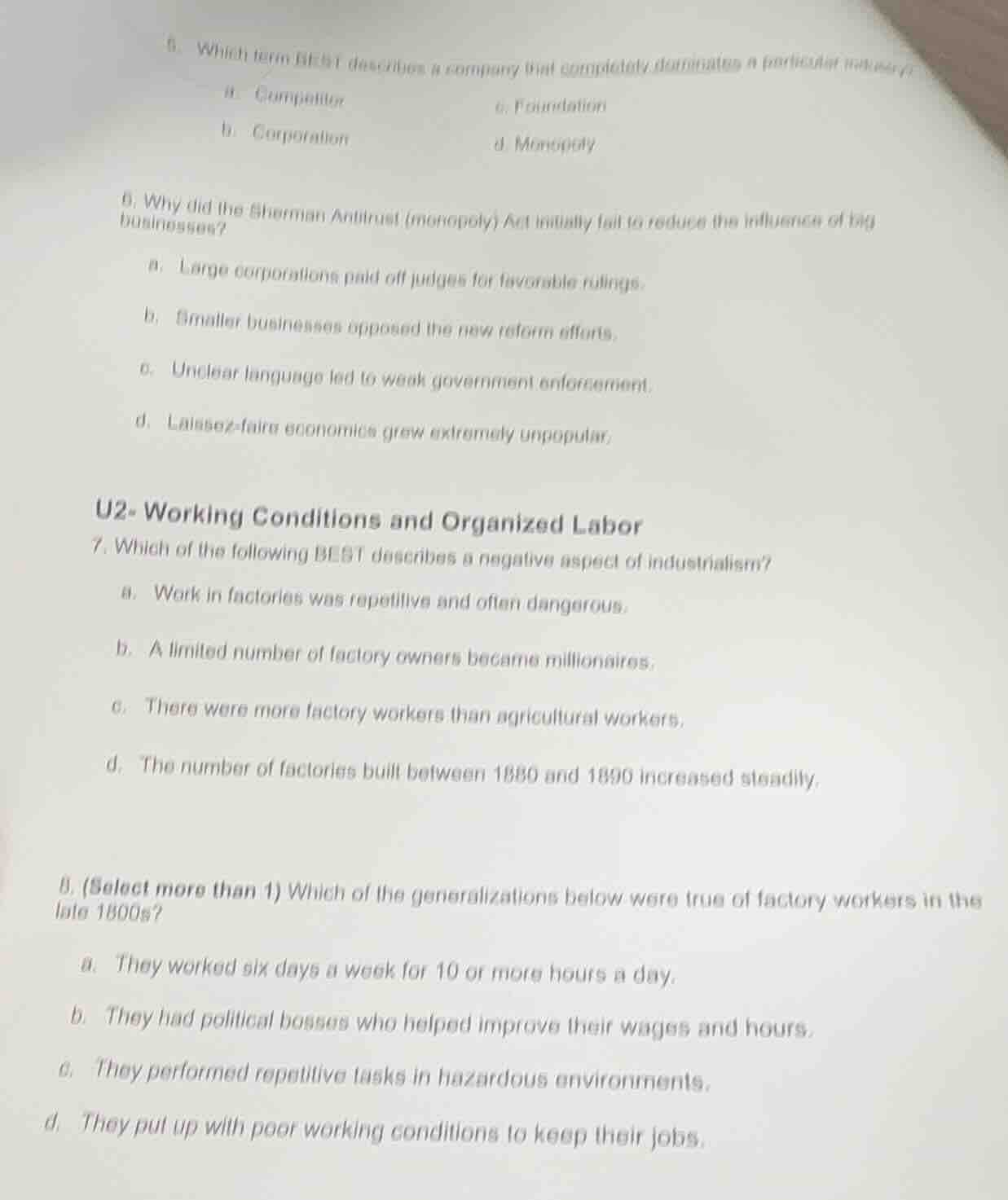
- which term best describes a company that completely dominates a particular industry?
a. competitor
c. foundation
b. corporation
d. monopoly
- why did the sherman antitrust (monopoly) act initially fail to reduce the influence of big businesses?
a. large corporations paid off judges for favorable rulings.
b. smaller businesses opposed the new reform efforts.
c. unclear language led to weak government enforcement.
d. laissez - faire economics grew extremely unpopular.
u2 - working conditions and organized labor
- which of the following best describes a negative aspect of industrialism?
a. work in factories was repetitive and often dangerous.
b. a limited number of factory owners became millionaires.
c. there were more factory workers than agricultural workers.
d. the number of factories built between 1880 and 1890 increased steadily.
- (select more than 1) which of the generalizations below were true of factory workers in the late 1800s?
a. they worked six days a week for 10 or more hours a day.
b. they had political bosses who helped improve their wages and hours.
c. they performed repetitive tasks in hazardous environments.
d. they put up with poor working conditions to keep their jobs.
- A company that completely controls a particular industry is defined as a monopoly.
- The Sherman Antitrust Act initially failed because its vague wording made effective government enforcement difficult.
- A key negative of industrialism was the repetitive, dangerous factory work environment for laborers.
- In the late 1800s, factory workers endured long 6-day workweeks, repetitive/hazardous tasks, and tolerated poor conditions to retain employment; political bosses did not typically improve their wages/hours.

Snap & solve any problem in the app
Get step-by-step solutions on Sovi AI
Photo-based solutions with guided steps
Explore more problems and detailed explanations
- d. Monopoly
- c. Unclear language led to weak government enforcement.
- a. Work in factories was repetitive and often dangerous.
- a. They worked six days a week for 10 or more hours a day.
c. They performed repetitive tasks in hazardous environments.
d. They put up with poor working conditions to keep their jobs.