QUESTION IMAGE
Question
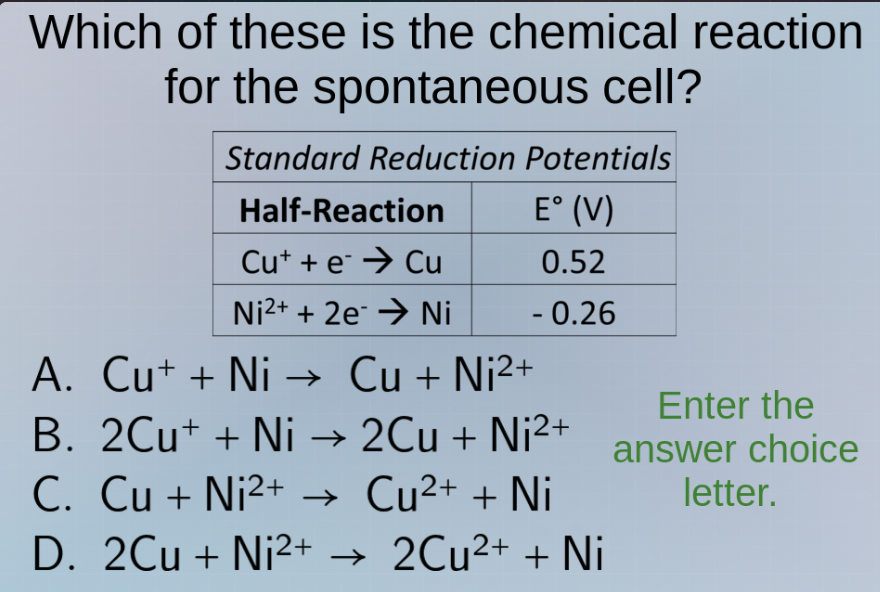
which of these is the chemical reaction for the spontaneous cell?
standard reduction potentials
half-reaction | e° (v)
cu⁺ + e⁻ → cu | 0.52
ni²⁺ + 2e⁻ → ni | - 0.26
a. cu⁺ + ni → cu + ni²⁺
b. 2cu⁺ + ni → 2cu + ni²⁺
c. cu + ni²⁺ → cu²⁺ + ni
d. 2cu + ni²⁺ → 2cu²⁺ + ni
enter the answer choice letter.
To determine the spontaneous cell reaction, we use the standard reduction potentials. For a spontaneous reaction, the cell potential \( E^{\circ}_{cell} = E^{\circ}_{cathode} - E^{\circ}_{anode} \) (or \( E^{\circ}_{reduction} - E^{\circ}_{oxidation} \)) must be positive.
- Identify reduction and oxidation:
- The half - reaction with the more positive \( E^{\circ} \) is the reduction (cathode). \( \text{Cu}^+ + e^-
ightarrow \text{Cu} \) has \( E^{\circ}=0.52\ V \), and \( \text{Ni}^{2+}+2e^-
ightarrow \text{Ni} \) has \( E^{\circ}=- 0.26\ V \). So, \( \text{Cu}^+ \) is reduced (cathode), and \( \text{Ni} \) is oxidized (anode, reverse of \( \text{Ni}^{2+}+2e^-
ightarrow \text{Ni} \), so oxidation half - reaction: \( \text{Ni}
ightarrow\text{Ni}^{2+}+2e^- \)).
- Balance electrons:
- Reduction: \( \text{Cu}^+ + e^-
ightarrow \text{Cu} \) (multiply by 2 to balance electrons with oxidation: \( 2\text{Cu}^+ + 2e^-
ightarrow 2\text{Cu} \))
- Oxidation: \( \text{Ni}
ightarrow\text{Ni}^{2+}+2e^- \)
- Add the two half - reactions: \( 2\text{Cu}^+ + \text{Ni}
ightarrow2\text{Cu}+\text{Ni}^{2+} \)
- For option A, the number of electrons is not balanced (reduction has 1e⁻, oxidation has 2e⁻). For option C and D, the cell potential would be negative (since we would be using \( \text{Ni}^{2+} \) reduction and \( \text{Cu} \) oxidation, which would give \( E^{\circ}_{cell}=-0.26 - 0.52=- 0.78\ V \), non - spontaneous).

Snap & solve any problem in the app
Get step-by-step solutions on Sovi AI
Photo-based solutions with guided steps
Explore more problems and detailed explanations
B. \( 2\text{Cu}^+ + \text{Ni}
ightarrow 2\text{Cu}+\text{Ni}^{2+} \)