QUESTION IMAGE
Question
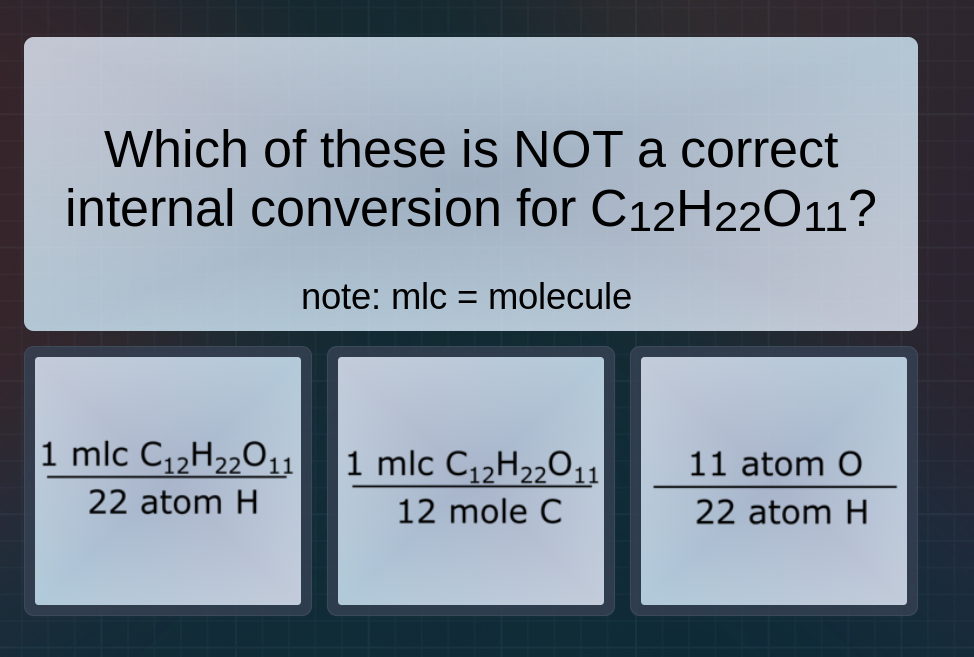
which of these is not a correct internal conversion for c₁₂h₂₂o₁₁?
note: mlc = molecule
1 mlc c₁₂h₂₂o₁₁ / 22 atom h
1 mlc c₁₂h₂₂o₁₁ / 12 mole c
11 atom o / 22 atom h
To determine the incorrect conversion, we analyze each option using the molecular formula \( \text{C}_{12}\text{H}_{22}\text{O}_{11} \):
- First Option (\( \frac{1\ \text{mlc}\ \text{C}_{12}\text{H}_{22}\text{O}_{11}}{22\ \text{atom}\ \text{H}} \)):
One molecule of \( \text{C}_{12}\text{H}_{22}\text{O}_{11} \) contains 22 H atoms. Thus, the ratio \( \frac{1\ \text{molecule}}{22\ \text{H atoms}} \) is valid (e.g., \( 1\ \text{molecule} = 22\ \text{H atoms} \) in terms of stoichiometry).
- Second Option (\( \frac{1\ \text{mlc}\ \text{C}_{12}\text{H}_{22}\text{O}_{11}}{12\ \text{mole}\ \text{C}} \)):
One molecule of \( \text{C}_{12}\text{H}_{22}\text{O}_{11} \) contains 12 atoms of C, not 12 moles of C. Moles are a macroscopic unit (for Avogadro’s number of particles), while molecules are microscopic. The ratio incorrectly equates 1 molecule to 12 moles of C (a mole of C contains \( 6.022 \times 10^{23} \) atoms, so 12 moles of C is vastly larger than 12 atoms in one molecule).
- Third Option (\( \frac{11\ \text{atom}\ \text{O}}{22\ \text{atom}\ \text{H}} \)):
One molecule has 11 O atoms and 22 H atoms. Thus, the ratio \( \frac{11\ \text{O atoms}}{22\ \text{H atoms}} \) is valid (simplifies to \( \frac{1}{2} \), consistent with the formula).

Snap & solve any problem in the app
Get step-by-step solutions on Sovi AI
Photo-based solutions with guided steps
Explore more problems and detailed explanations
B. \( \frac{1\ \text{mlc}\ \text{C}_{12}\text{H}_{22}\text{O}_{11}}{12\ \text{mole}\ \text{C}} \)