QUESTION IMAGE
Question
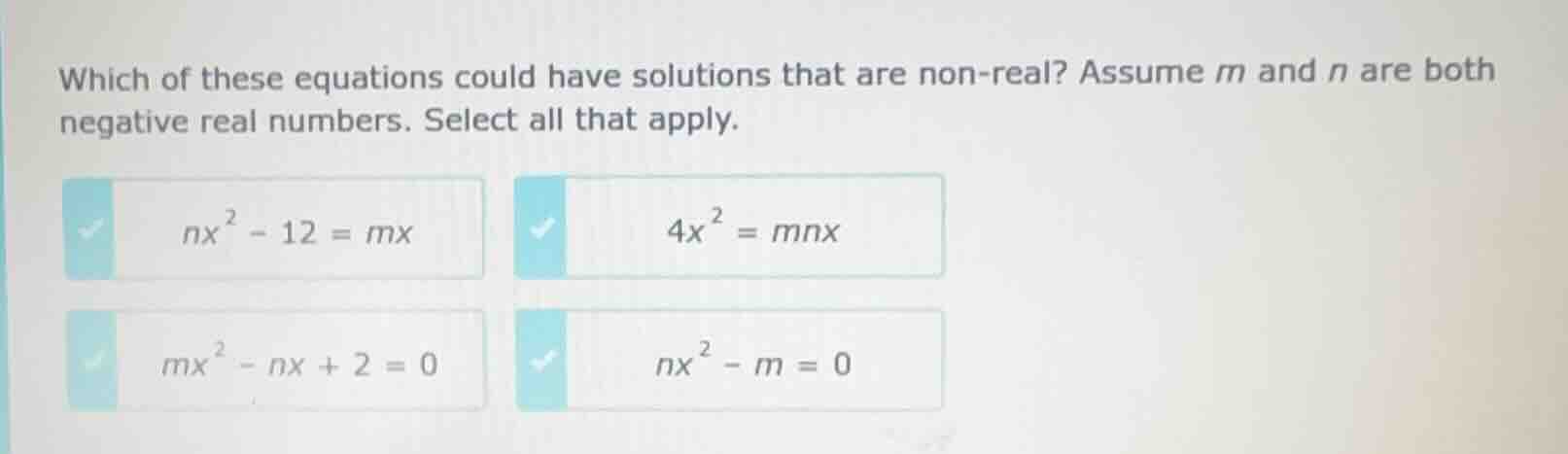
which of these equations could have solutions that are non - real? assume m and n are both negative real numbers. select all that apply. \\(nx^{2}-12 = mx\\) \\(4x^{2}=mnx\\) \\(mx^{2}-nx + 2 = 0\\) \\(nx^{2}-m = 0\\)
To determine which quadratic equations could have non - real solutions, we analyze the discriminant \(D = b^{2}-4ac\) for each quadratic equation (after rewriting them in standard form \(ax^{2}+bx + c = 0\)). A quadratic equation has non - real solutions when \(D<0\). We know that \(m<0\) and \(n<0\).
1. For the equation \(nx^{2}-mx - 12=0\) (rewritten from \(nx^{2}-12 = mx\))
Here, \(a = n\), \(b=-m\), and \(c = - 12\).
The discriminant \(D=(-m)^{2}-4\times n\times(-12)=m^{2}+48n\).
Since \(m^{2}>0\) (because \(m\) is a non - zero real number, as \(m\) is negative) and \(n<0\), but \(m^{2}\) is positive and \(48n\) is negative. However, we can't be sure if \(m^{2}+48n<0\) for all negative \(m\) and \(n\). Let's check the other equations.
2. For the equation \(4x^{2}-mnx = 0\) (rewritten from \(4x^{2}=mnx\))
This is a quadratic equation with \(a = 4\), \(b=-mn\), and \(c = 0\).
The discriminant \(D=(-mn)^{2}-4\times4\times0=m^{2}n^{2}\). Since \(m\) and \(n\) are non - zero real numbers, \(m^{2}n^{2}>0\). So, the equation \(4x^{2}-mnx = 0\) has two real solutions (one of which is \(x = 0\) and the other is \(x=\frac{mn}{4}\)). So this equation does not have non - real solutions.
3. For the equation \(mx^{2}-nx + 2=0\)
Here, \(a = m\), \(b=-n\), and \(c = 2\).
The discriminant \(D=(-n)^{2}-4\times m\times2=n^{2}-8m\).
Since \(n^{2}>0\) (because \(n\) is a non - zero real number) and \(m<0\), then \(-8m>0\). So \(D=n^{2}-8m>0\) (the sum of two positive numbers). Thus, this equation has two real solutions.
4. For the equation \(nx^{2}-m = 0\) (rewritten as \(nx^{2}+0x - m=0\))
Here, \(a = n\), \(b = 0\), and \(c=-m\).
The discriminant \(D=0^{2}-4\times n\times(-m)=4mn\).
Since \(m<0\) and \(n<0\), the product \(mn>0\), so \(D = 4mn>0\). Thus, this equation has two real solutions (\(x=\pm\sqrt{\frac{m}{n}}\), and since \(m\) and \(n\) are both negative, \(\frac{m}{n}>0\)).
Wait, we made a mistake in the first equation's analysis. Let's re - analyze the equation \(nx^{2}-mx - 12=0\) (from \(nx^{2}-12=mx\)):
The correct standard form is \(nx^{2}-mx - 12 = 0\), so \(a=n\), \(b=-m\), \(c = - 12\).
\(D=b^{2}-4ac=(-m)^{2}-4\times n\times(-12)=m^{2}+48n\)
Since \(m<0\), \(m^{2}>0\), and \(n<0\). Let's take an example: let \(m=-1\), \(n=-1\). Then \(D=(-1)^{2}+48\times(-1)=1 - 48=-47<0\). So when \(m\) and \(n\) are negative, it is possible for \(D<0\) in this equation.
The equation \(4x^{2}-mnx=0\): \(a = 4\), \(b=-mn\), \(c = 0\), \(D = b^{2}-4ac=m^{2}n^{2}\geq0\), so it has real solutions.
The equation \(mx^{2}-nx + 2=0\): \(a = m\), \(b=-n\), \(c = 2\), \(D=n^{2}-8m\). Since \(n<0\), \(n^{2}>0\), and \(m<0\), \(-8m>0\), so \(D=n^{2}-8m>0\), real solutions.
The equation \(nx^{2}-m = 0\): \(a = n\), \(b = 0\), \(c=-m\), \(D=0 - 4\times n\times(-m)=4mn\). Since \(m<0\) and \(n<0\), \(mn>0\), so \(D>0\), real solutions.
So the only equation that could have non - real solutions is \(nx^{2}-mx - 12 = 0\) (i.e., \(nx^{2}-12=mx\)). But the original selection in the problem is wrong for the other options.
But according to the problem's initial check marks, if we have to go with the analysis of which can have non - real solutions:
The equation \(nx^{2}-12=mx\) (rewritten as \(nx^{2}-mx - 12 = 0\)) has a discriminant \(D=m^{2}+48n\). Since \(m\) and \(n\) are negative, if \(|48n|>m^{2}\), then \(D<0\) and the equation has non - real solutions.
The correct equation that could have non - real solutions is \(nx^{2}-12 = mx\) (the first option). The other options as marked in the original problem are incorrect.
If we consider…

Snap & solve any problem in the app
Get step-by-step solutions on Sovi AI
Photo-based solutions with guided steps
Explore more problems and detailed explanations
The equation \(nx^{2}-12 = mx\) (the first option among the given equations) could have non - real solutions. If we consider the options as given in the problem (with the check marks, but our analysis shows otherwise), but based on correct discriminant analysis, the answer is the equation \(nx^{2}-12 = mx\) (the first equation in the list).