QUESTION IMAGE
Question
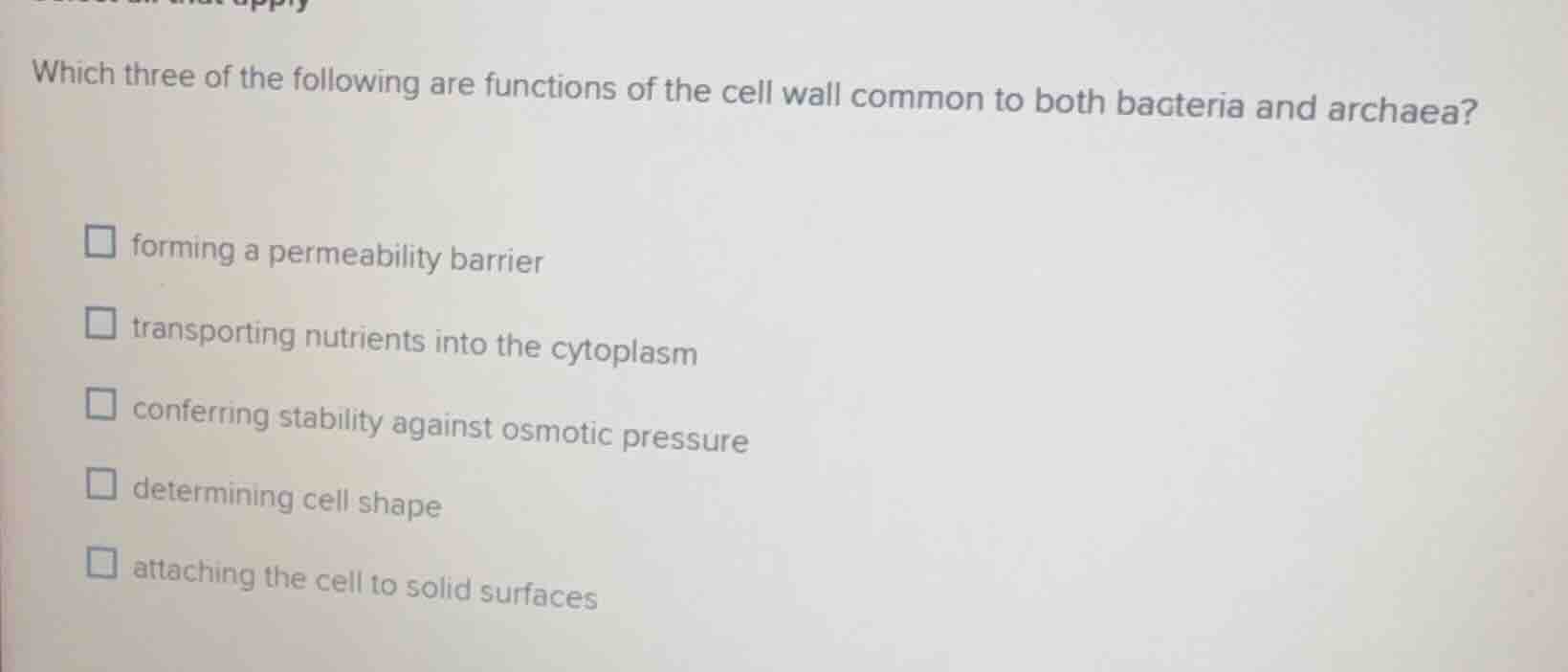
which three of the following are functions of the cell wall common to both bacteria and archaea?
□ forming a permeability barrier
□ transporting nutrients into the cytoplasm
□ conferring stability against osmotic pressure
□ determining cell shape
□ attaching the cell to solid surfaces
Brief Explanations
- Forming a permeability barrier: The cell wall (along with the cell membrane) helps regulate what enters and exits the cell, acting as a permeability barrier for both bacteria and archaea.
- Conferring stability against osmotic pressure: Both bacterial and archaeal cell walls protect the cell from bursting or shrinking due to osmotic pressure differences between the cell's interior and its environment.
- Determining cell shape: The cell wall provides structural support that dictates the overall shape of the cell (e.g., spherical, rod - shaped) in both bacteria and archaea.
- Transporting nutrients into the cytoplasm is mainly the function of membrane - associated transporters, not the cell wall.
- Attaching the cell to solid surfaces is often the role of structures like pili or specific surface proteins, not a universal function of the cell wall for both bacteria and archaea.

Snap & solve any problem in the app
Get step-by-step solutions on Sovi AI
Photo-based solutions with guided steps
Explore more problems and detailed explanations
- conferring stability against osmotic pressure
- determining cell shape
- forming a permeability barrier