QUESTION IMAGE
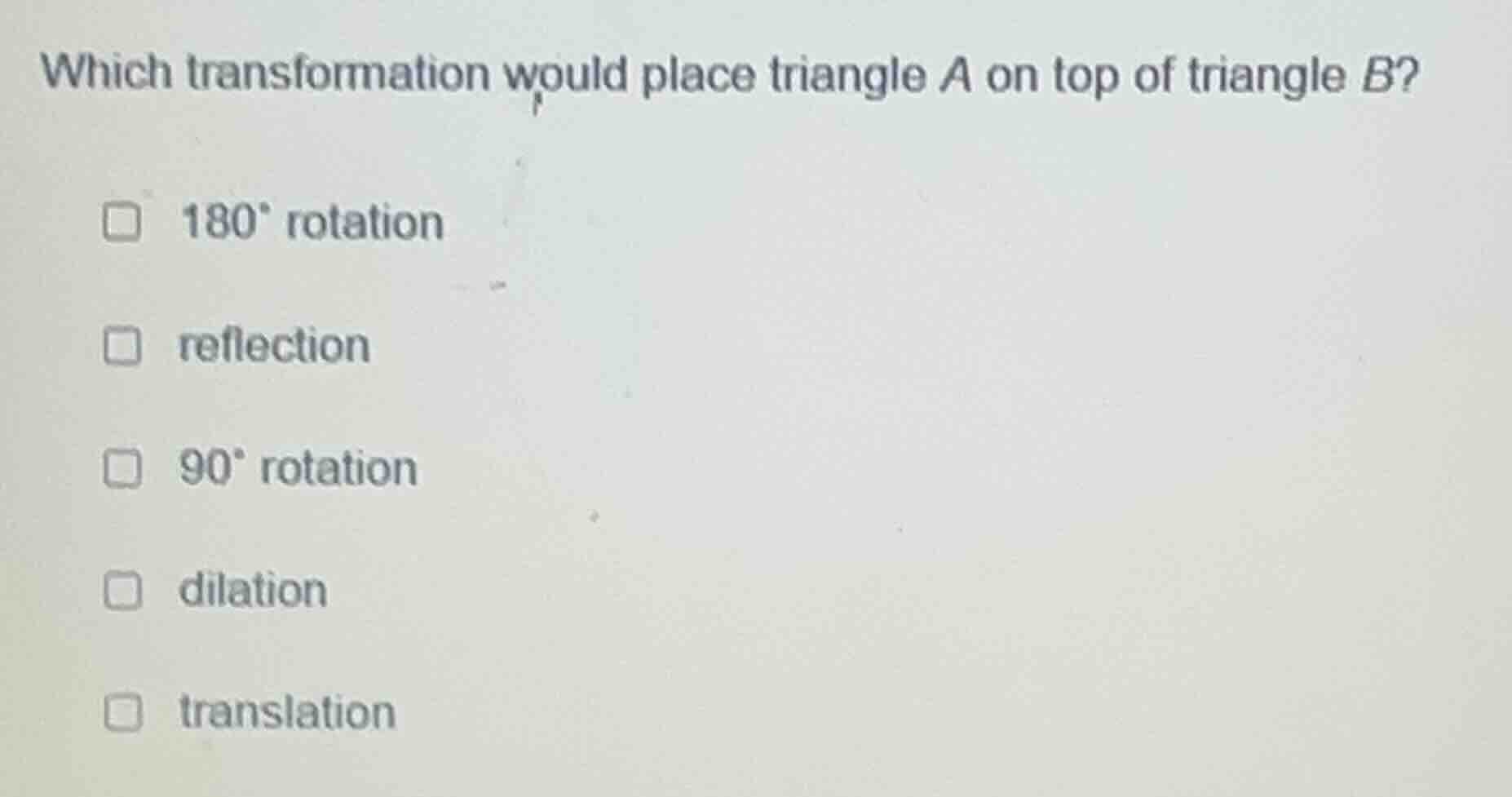
Question
which transformation would place triangle a on top of triangle b?
□ 180° rotation
□ reflection
□ 90° rotation
□ dilation
□ translation
To determine the transformation that places triangle A on triangle B, we analyze each option:
- A \(180^\circ\) rotation flips the figure over a point, but it's less likely if the triangles are congruent and aligned for reflection/translation.
- Reflection: A reflection over a line (like a mirror) can map triangle A to B if they are mirror images.
- A \(90^\circ\) rotation changes orientation too much.
- Dilation changes size, which isn't needed (triangles are congruent).
- Translation (sliding) moves the figure without rotation/reflection, which is common for congruent figures in the same orientation. Assuming the triangles are congruent and can be slid (translated) to overlap, or reflected. But typically, if they are in the same orientation (not rotated), translation is key. Wait, no—wait, the common case: if triangle A and B are congruent and in the same orientation, translation (sliding) works. But maybe reflection. Wait, the question is about placing A on B. If they are congruent, translation (moving without rotating/reflection) would work. But let's recall:
- Translation: moves the figure (slide) without changing shape, size, or orientation.
- Reflection: flips over a line.
- Rotation: turns around a point.
- Dilation: resizes.
If triangle A and B are congruent and in the same position (just shifted), translation works. But maybe the intended answer is translation. Wait, no—wait, the options: the correct answer is usually translation (if they are in the same orientation) or reflection (if mirror images). But in typical problems, if the triangles are congruent and can be moved by sliding (translation), that's the answer. Alternatively, if they are mirror images, reflection. But since the problem is about "placing on top", and assuming they are congruent, translation (sliding) is the most probable, or reflection. Wait, no—wait, the standard problem: if triangle A and B are congruent and in the same orientation (same direction), translation. If they are mirror images, reflection. But the options include translation. Let's re-express:
- \(180^\circ\) rotation: turns the figure 180°, which would invert it, not align unless symmetric.
- Reflection: flips over a line, so if A and B are mirror images, reflection works.
- \(90^\circ\) rotation: turns 90°, changing orientation.
- Dilation: changes size, so no.
- Translation: moves the figure (slide) to the new position.
In most basic transformation problems, if two congruent figures are in the same orientation (same up/down, left/right), translation is the answer. So the correct answer is translation. Wait, but maybe the intended answer is translation. Alternatively, if they are mirror images, reflection. But the problem is likely designed for translation. Wait, no—let's check the options. The correct answer is translation (or reflection, but more likely translation). Wait, no—wait, the standard problem: when you have two congruent triangles, and you need to place one on the other, translation (sliding) is the transformation that moves it without rotating or reflecting. So the answer is translation.

Snap & solve any problem in the app
Get step-by-step solutions on Sovi AI
Photo-based solutions with guided steps
Explore more problems and detailed explanations
translation (the option with the checkbox next to "translation")