QUESTION IMAGE
Question
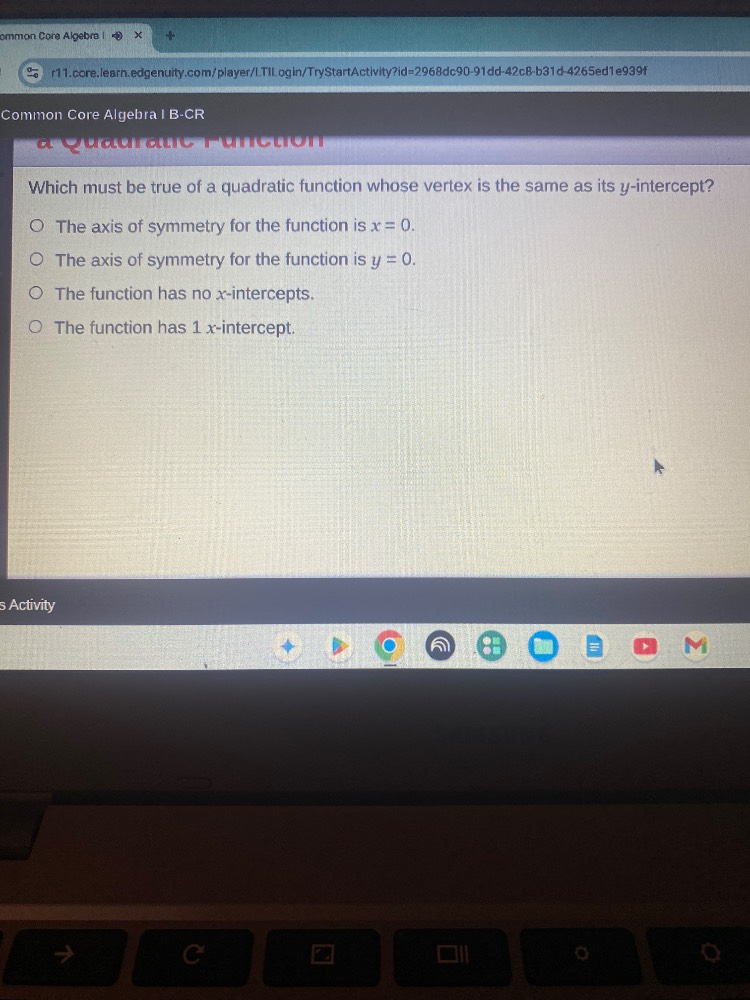
which must be true of a quadratic function whose vertex is the same as its y - intercept?
the axis of symmetry for the function is x = 0.
the axis of symmetry for the function is y = 0.
the function has no x - intercepts.
the function has 1 x - intercept.
Brief Explanations
- Recall the properties of a quadratic function \( y = ax^2 + bx + c \). The y - intercept occurs when \( x = 0 \), so the y - intercept is \( (0,c) \). The vertex of a quadratic function \( y=ax^{2}+bx + c \) has an x - coordinate given by \( x=-\frac{b}{2a} \).
- If the vertex is the same as the y - intercept, then the x - coordinate of the vertex is 0. So, \( -\frac{b}{2a}=0 \), which implies \( b = 0 \). The axis of symmetry of a quadratic function \( y = ax^{2}+bx + c \) is given by the formula \( x=-\frac{b}{2a} \). Since \( b = 0 \), the axis of symmetry is \( x = 0 \).
- Analyze the other options:
- The axis of symmetry of a quadratic function is a vertical line (of the form \( x = k \)), not a horizontal line \( y = 0 \), so the option "The axis of symmetry for the function is \( y = 0 \)" is incorrect.
- Just because the vertex is the y - intercept, we cannot conclude that the function has no x - intercepts. For example, the function \( y=x^{2}\) has a vertex at \( (0,0) \) (which is also the y - intercept) and has one x - intercept, and the function \( y=-x^{2}+1\) has a vertex at \( (0,1) \) (y - intercept) and has two x - intercepts. So the option "The function has no x - intercepts" is incorrect.
- We also cannot conclude that the function has exactly 1 x - intercept. For example, \( y=-x^{2}+1\) has a vertex at \( (0,1) \) (y - intercept) and two x - intercepts (\( x = 1\) and \( x=-1\)). So the option "The function has 1 x - intercept" is incorrect.

Snap & solve any problem in the app
Get step-by-step solutions on Sovi AI
Photo-based solutions with guided steps
Explore more problems and detailed explanations
The axis of symmetry for the function is \( x = 0 \).