QUESTION IMAGE
Question
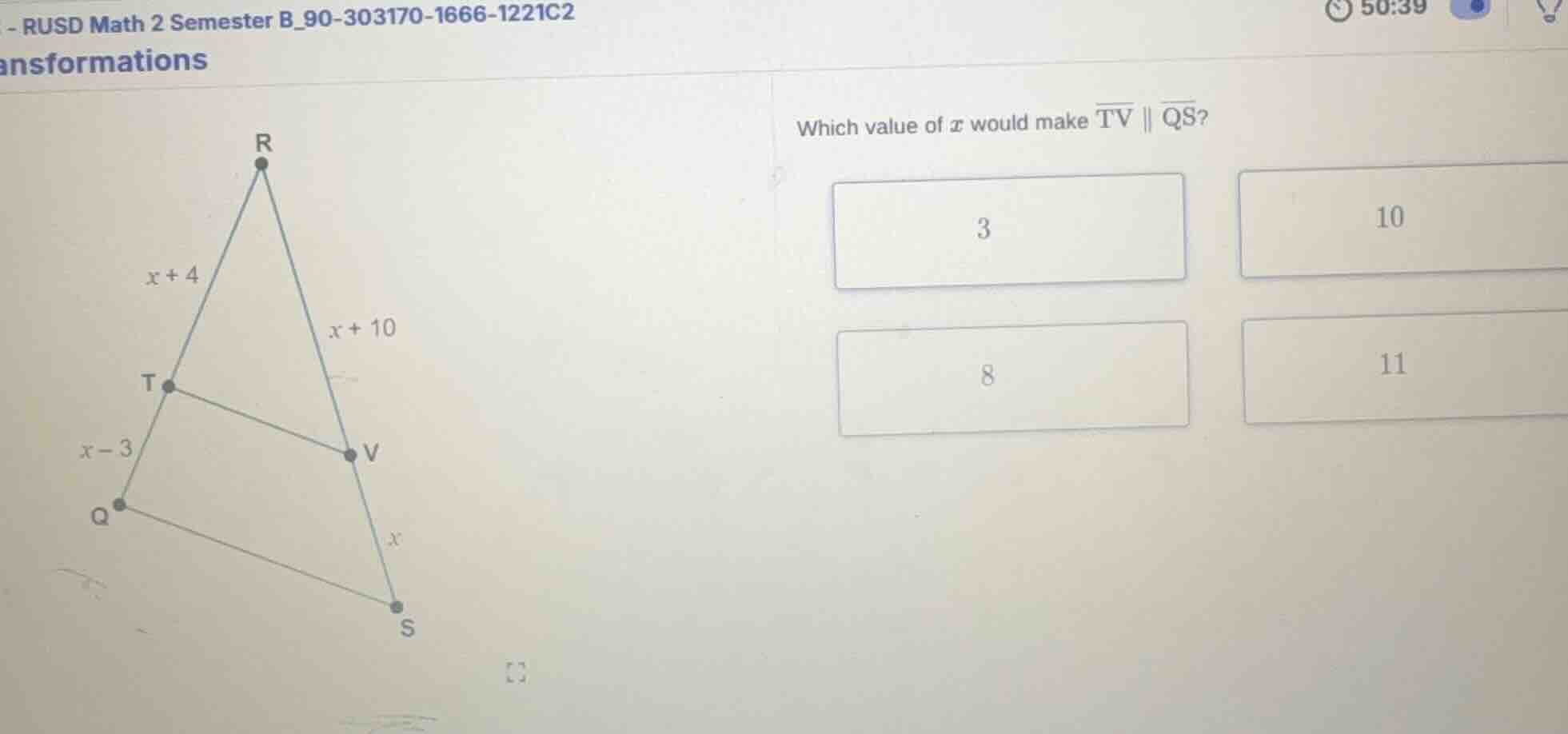
which value of ( x ) would make ( overline{tv} parallel overline{qs} )?
options: 3, 10, 8, 11
(image shows a triangle ( rqs ) with points ( t ) on ( rq ) and ( v ) on ( rs ), with segment lengths: ( rt = x + 4 ), ( tq = x - 3 ), ( rv = x + 10 ), ( vs = x ))
Step1: Apply the Basic Proportionality Theorem (Thales' theorem)
If \( \overline{TV} \parallel \overline{QS} \), then by the Basic Proportionality Theorem, \( \frac{RT}{TQ} = \frac{RV}{VS} \).
Given \( RT = x + 4 \), \( TQ = x - 3 \), \( RV = x + 10 \), and \( VS = x \). So we set up the proportion:
\[
\frac{x + 4}{x - 3} = \frac{x + 10}{x}
\]
Step2: Cross - multiply to solve for \( x \)
Cross - multiplying gives \( x(x + 4)=(x - 3)(x + 10) \).
Expand both sides:
Left side: \( x^{2}+4x \)
Right side: \( x^{2}+10x-3x - 30=x^{2}+7x - 30 \)
So the equation becomes \( x^{2}+4x=x^{2}+7x - 30 \).
Subtract \( x^{2} \) from both sides: \( 4x = 7x-30 \).
Subtract \( 7x \) from both sides: \( 4x-7x=-30 \), which simplifies to \( - 3x=-30 \).
Divide both sides by \( - 3 \): \( x = 10 \).

Snap & solve any problem in the app
Get step-by-step solutions on Sovi AI
Photo-based solutions with guided steps
Explore more problems and detailed explanations
10