QUESTION IMAGE
Question
while reading chapter three
name
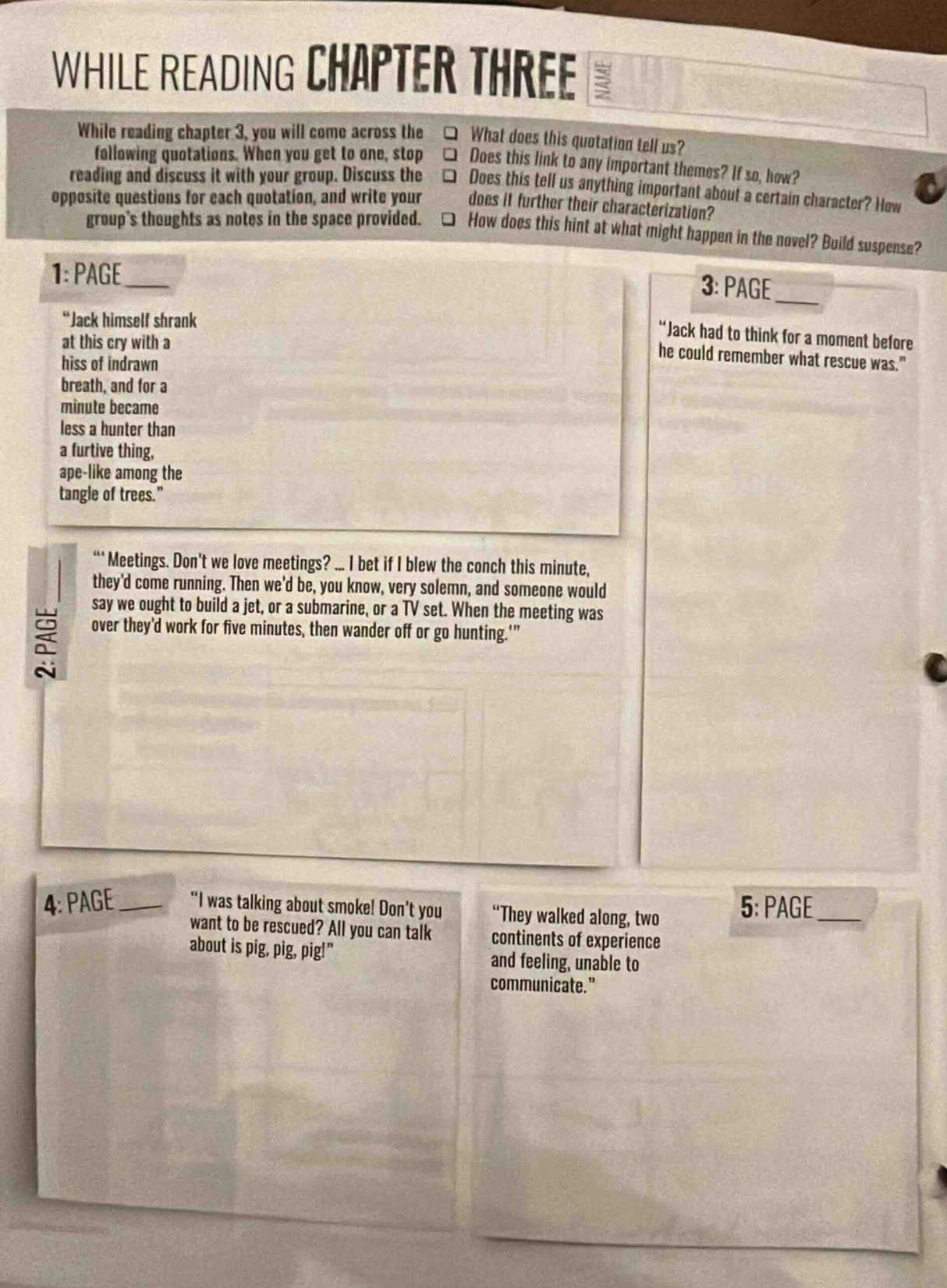
while reading chapter 3, you will come across the following quotations. when you get to one, stop reading and discuss it with your group. discuss the opposite questions for each quotation, and write your group’s thoughts as notes in the space provided.
what does this quotation tell us?
does this link to any important themes? if so, how?
does this tell us anything important about a certain character? how does it further their characterization?
how does this hint at what might happen in the novel? build suspense?
1: page ____
“jack himself shrank
at this cry with a
hiss of indrawn
breath, and for a
minute became
less a hunter than
a furtive thing,
ape - like among the
tangle of trees.”
2: page ____
“‘meetings. don’t we love meetings? ... i bet if i blew the conch this minute,
they’d come running. then we’d be, you know, very solemn, and someone would
say we ought to build a jet, or a submarine, or a tv set. when the meeting was
over they’d work for five minutes, then wander off or go hunting.’”
3: page ____
“jack had to think for a moment before
he could remember what rescue was.”
4: page ____
“i was talking about smoke! don’t you
want to be rescued? all you can talk
about is pig, pig, pig!”
“they walked along, two
continents of experience
and feeling, unable to
communicate.”
5: page ____
To solve this, we analyze each quotation from Lord of the Flies by exploring their meaning, themes, characterization, and suspense - building aspects:
Quotation 1: "Jack himself shrank at this cry with a hiss of indrawn breath, and for a minute became less a hunter than a furtive thing, ape - like among the tangle of trees."
- What does this quotation tell us? It shows Jack's reaction to a cry. His physical reaction (shrinking, hissing breath) and the description of him as "furtive" and "ape - like" suggest a moment of fear or unease, and a regression to a more primitive state.
- Does this link to any important themes? If so, how? It links to the theme of the loss of civilization and the emergence of savagery. Jack, who is a symbol of the move towards savagery, is here depicted in a primitive, almost animal - like way, showing how the boys' situation on the island is eroding their civilized behavior.
- Does this tell us anything important about a certain character? How does it further their characterization? For Jack, it shows that beneath his bravado as a hunter, there is a sense of fear. It also shows his regression into a more primitive state, which is a key part of his character development as he moves away from civilization.
- How does this hint at what might happen in the novel? Build suspense? It hints that the boys' hold on civilization is tenuous, and that more primitive and savage behavior will likely become more common. The image of Jack as "ape - like" creates a sense of unease, as it shows a loss of humanity, and makes the reader wonder how far the boys will fall into savagery.
Quotation 2: "‘Meetings. Don’t we love meetings? … I bet if I blew the conch this minute, they’d come running. Then we’d be, you know, very solemn, and someone would say we ought to build a jet, or a submarine, or a TV set. When the meeting was over they’d work for five minutes, then wander off or go hunting.’"
- What does this quotation tell us? It is a sarcastic comment about the meetings the boys have. It suggests that the meetings are not productive. The idea of building a jet, submarine, or TV set on a desert island is absurd, and the fact that the boys would only work for five minutes shows the lack of commitment to any kind of civilized or productive activity.
- Does this link to any important themes? If so, how? It links to the theme of the failure of democracy and order. The conch is a symbol of order and democracy in the novel. The sarcastic tone about the meetings and the boys' lack of follow - through shows how the democratic process (the meetings) is breaking down and is ineffective in maintaining order or achieving anything productive.
- Does this tell us anything important about a certain character? How does it further their characterization? The speaker (likely a boy who is disillusioned with the meetings) shows a sense of cynicism about the group's attempts at maintaining order. It could be a character who is starting to see the futility of their civilized pretenses.
- How does this hint at what might happen in the novel? Build suspense? It hints that the boys' attempts to create a civilized society (through meetings and the conch) are going to fail. The lack of productivity and the absurdity of their plans suggest that chaos and savagery will likely take over, building suspense as we wonder how the breakdown of order will play out.
Quotation 3: "Jack had to think for a moment before he could remember what rescue was."
- What does this quotation tell us? It shows that Jack is ha…

Snap & solve any problem in the app
Get step-by-step solutions on Sovi AI
Photo-based solutions with guided steps
Explore more problems and detailed explanations
To solve this, we analyze each quotation from Lord of the Flies by exploring their meaning, themes, characterization, and suspense - building aspects:
Quotation 1: "Jack himself shrank at this cry with a hiss of indrawn breath, and for a minute became less a hunter than a furtive thing, ape - like among the tangle of trees."
- What does this quotation tell us? It shows Jack's reaction to a cry. His physical reaction (shrinking, hissing breath) and the description of him as "furtive" and "ape - like" suggest a moment of fear or unease, and a regression to a more primitive state.
- Does this link to any important themes? If so, how? It links to the theme of the loss of civilization and the emergence of savagery. Jack, who is a symbol of the move towards savagery, is here depicted in a primitive, almost animal - like way, showing how the boys' situation on the island is eroding their civilized behavior.
- Does this tell us anything important about a certain character? How does it further their characterization? For Jack, it shows that beneath his bravado as a hunter, there is a sense of fear. It also shows his regression into a more primitive state, which is a key part of his character development as he moves away from civilization.
- How does this hint at what might happen in the novel? Build suspense? It hints that the boys' hold on civilization is tenuous, and that more primitive and savage behavior will likely become more common. The image of Jack as "ape - like" creates a sense of unease, as it shows a loss of humanity, and makes the reader wonder how far the boys will fall into savagery.
Quotation 2: "‘Meetings. Don’t we love meetings? … I bet if I blew the conch this minute, they’d come running. Then we’d be, you know, very solemn, and someone would say we ought to build a jet, or a submarine, or a TV set. When the meeting was over they’d work for five minutes, then wander off or go hunting.’"
- What does this quotation tell us? It is a sarcastic comment about the meetings the boys have. It suggests that the meetings are not productive. The idea of building a jet, submarine, or TV set on a desert island is absurd, and the fact that the boys would only work for five minutes shows the lack of commitment to any kind of civilized or productive activity.
- Does this link to any important themes? If so, how? It links to the theme of the failure of democracy and order. The conch is a symbol of order and democracy in the novel. The sarcastic tone about the meetings and the boys' lack of follow - through shows how the democratic process (the meetings) is breaking down and is ineffective in maintaining order or achieving anything productive.
- Does this tell us anything important about a certain character? How does it further their characterization? The speaker (likely a boy who is disillusioned with the meetings) shows a sense of cynicism about the group's attempts at maintaining order. It could be a character who is starting to see the futility of their civilized pretenses.
- How does this hint at what might happen in the novel? Build suspense? It hints that the boys' attempts to create a civilized society (through meetings and the conch) are going to fail. The lack of productivity and the absurdity of their plans suggest that chaos and savagery will likely take over, building suspense as we wonder how the breakdown of order will play out.
Quotation 3: "Jack had to think for a moment before he could remember what rescue was."
- What does this quotation tell us? It shows that Jack is having difficulty recalling the concept of "rescue". This implies that his focus and priorities are shifting away from being rescued and returning to civilization.
- Does this link to any important themes? If so, how? It links to the theme of the loss of civilization and the embrace of savagery. As Jack forgets about rescue, it shows that the island is changing the boys' goals and values, moving them away from civilization.
- Does this tell us anything important about a certain character? How does it further their characterization? For Jack, it shows his increasing immersion in the island's savage lifestyle. His forgetfulness of rescue shows that he is becoming more focused on the immediate concerns of survival (and hunting) on the island, rather than on getting back to the civilized world.
- How does this hint at what might happen in the novel? Build suspense? It hints that the boys may become so immersed in their island life that they will forget about being rescued altogether. This builds suspense as it makes the reader wonder if they will ever be rescued, and how the loss of the desire for rescue will affect their behavior.
Quotation 4: "I was talking about smoke! Don’t you want to be rescued? All you can talk about is pig, pig, pig!"
- What does this quotation tell us? It is a confrontation, likely between a character who wants to focus on being rescued (by making smoke to signal ships) and Jack (who is focused on hunting pigs). It shows a conflict between the goals of rescue and the pursuit of hunting.
- Does this link to any important themes? If so, how? It links to the theme of conflicting priorities on the island. The conflict between those who want to maintain a link to civilization (through rescue) and those who are becoming more focused on the primitive act of hunting shows the struggle between civilization and savagery.
- Does this tell us anything important about a certain character? How does it further their characterization? If we assume it's Ralph (the one focused on smoke and rescue) speaking, it shows his frustration with the boys' (especially Jack's) lack of focus on rescue. For Jack (the one focused on pigs), it shows his growing obsession with hunting, which is a part of his move towards savagery.
- How does this hint at what might happen in the novel? Build suspense? It hints at a growing rift between the boys with different priorities. This rift will likely lead to more conflict, and it makes the reader wonder which side will win out - the side of civilization (rescue) or savagery (hunting and power).
Quotation 5: "They walked along, two continents of experience and feeling, unable to communicate."
- What does this quotation tell us? It describes two characters walking together but being unable to communicate. This suggests a deep emotional and experiential divide between them.
- Does this link to any important themes? If so, how? It links to the theme of the breakdown of communication and relationships. As the boys' experiences on the island diverge (some towards civilization, some towards savagery), they are unable to understand each other, which is a sign of the breakdown of the group.
- Does this tell us anything important about a certain character? How does it further their characterization? If we consider the two characters (likely Ralph and Jack or other key figures), it shows how far apart they have become in terms of their values and experiences. This inability to communicate shows the depth of the rift between them.
- How does this hint at what might happen in the novel? Build suspense? It hints that the lack of communication will lead to more isolation and conflict among the boys. It makes the reader wonder how this breakdown in communication will escalate and what the consequences will be for the group.