QUESTION IMAGE
Question
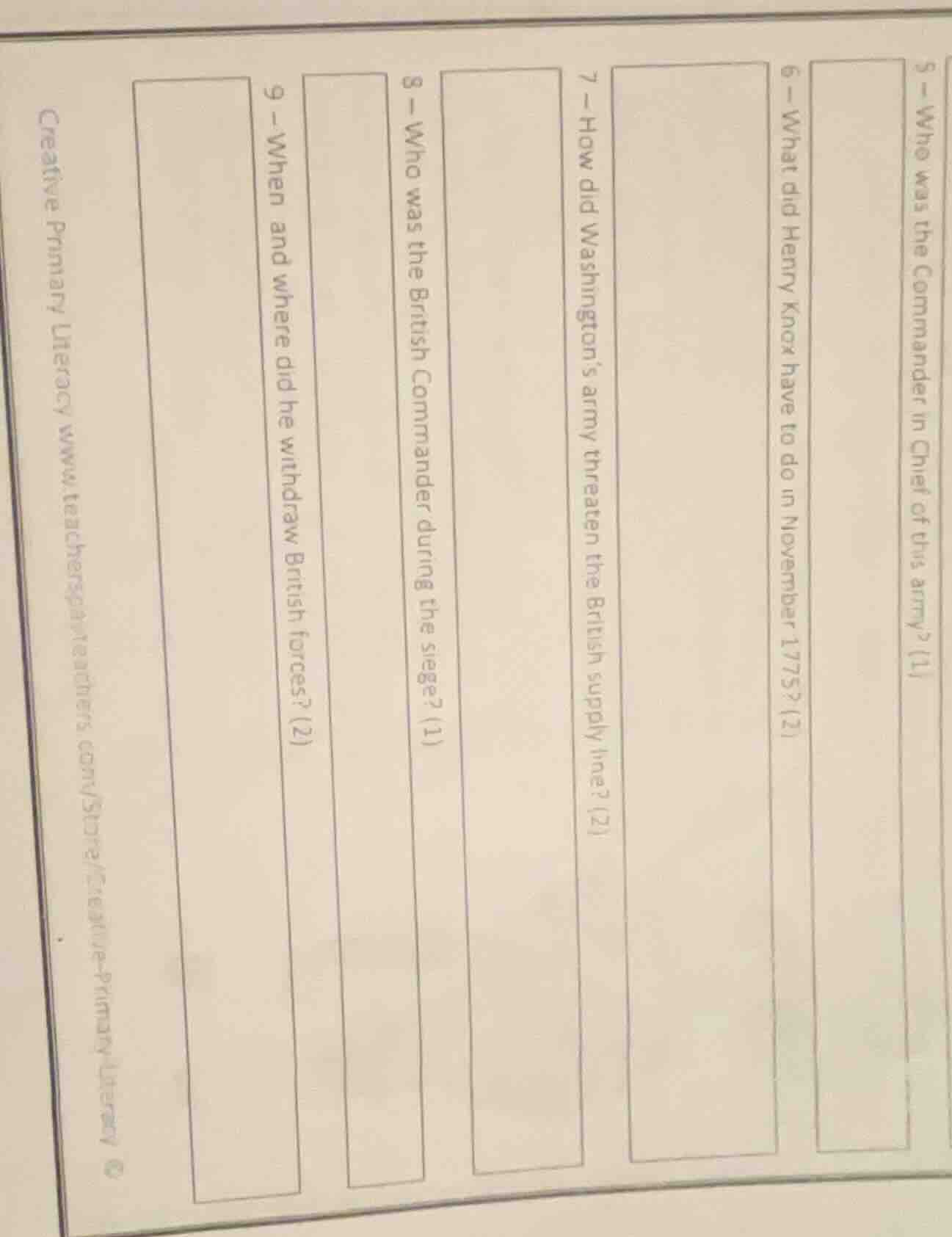
5 – who was the commander in chief of this army? (1)
6 – what did henry knox have to do in november 1775? (2)
7 – how did washington’s army threaten the british supply line? (2)
8 – who was the british commander during the siege? (1)
9 – when and where did he withdraw british forces? (2)
Brief Explanations
These questions relate to the early American Revolutionary War, specifically the Siege of Boston.
- For question 5: The Commander in Chief of the Continental Army (the relevant army here) was George Washington, appointed in 1775.
- For question 6: In November 1775, Henry Knox led an expedition to transport heavy cannons captured at Fort Ticonderoga (in upstate New York) to Boston, over rough terrain and winter conditions.
- For question 7: Washington's army positioned the newly arrived cannons on Dorchester Heights, a high ground overlooking Boston Harbor and the British-held city, which would have allowed them to fire on British supply ships and the city itself, threatening their supply line and position.
- For question 8: The British Commander during the Siege of Boston was General William Howe, who took over from Thomas Gage in late 1775.
- For question 9: General Howe withdrew British forces on March 17, 1776, evacuating the city of Boston and sailing to Halifax, Nova Scotia, to regroup, after being threatened by the American artillery on Dorchester Heights.

Snap & solve any problem in the app
Get step-by-step solutions on Sovi AI
Photo-based solutions with guided steps
Explore more problems and detailed explanations
- George Washington
- He led an expedition to transport heavy cannons from Fort Ticonderoga to Boston.
- They occupied Dorchester Heights and positioned artillery there, which could fire on British supply ships in Boston Harbor.
- General William Howe
- He withdrew British forces on March 17, 1776, evacuating Boston and sailing to Halifax, Nova Scotia.