QUESTION IMAGE
Question
3 who first formulated the law of conservation of matter?
a isaac newton
b albert einstein
c antoine lavoisier
d marie curie
4 what did lavoisier’s experiments demonstrate about mass during chemical reactions?
a mass can be lost.
b mass can be gained.
c mass remains constant
d mass is irrelevant.
5 when ice melts into water, what change occurs according to the law of conservation of matter?
a the ice disappears completely.
b the molecules change state but remain present
c the water gains mass
d the water loses energy
6 how does the law of conservation of matter contribute to our understanding of chemical reactions?
a it shows that reactions create matter.
b it indicates that reactions change the mass of substances.
c it emphasizes the rearrangement of atoms rather than their creation or destruction
d it states that matter can be lost during reactions
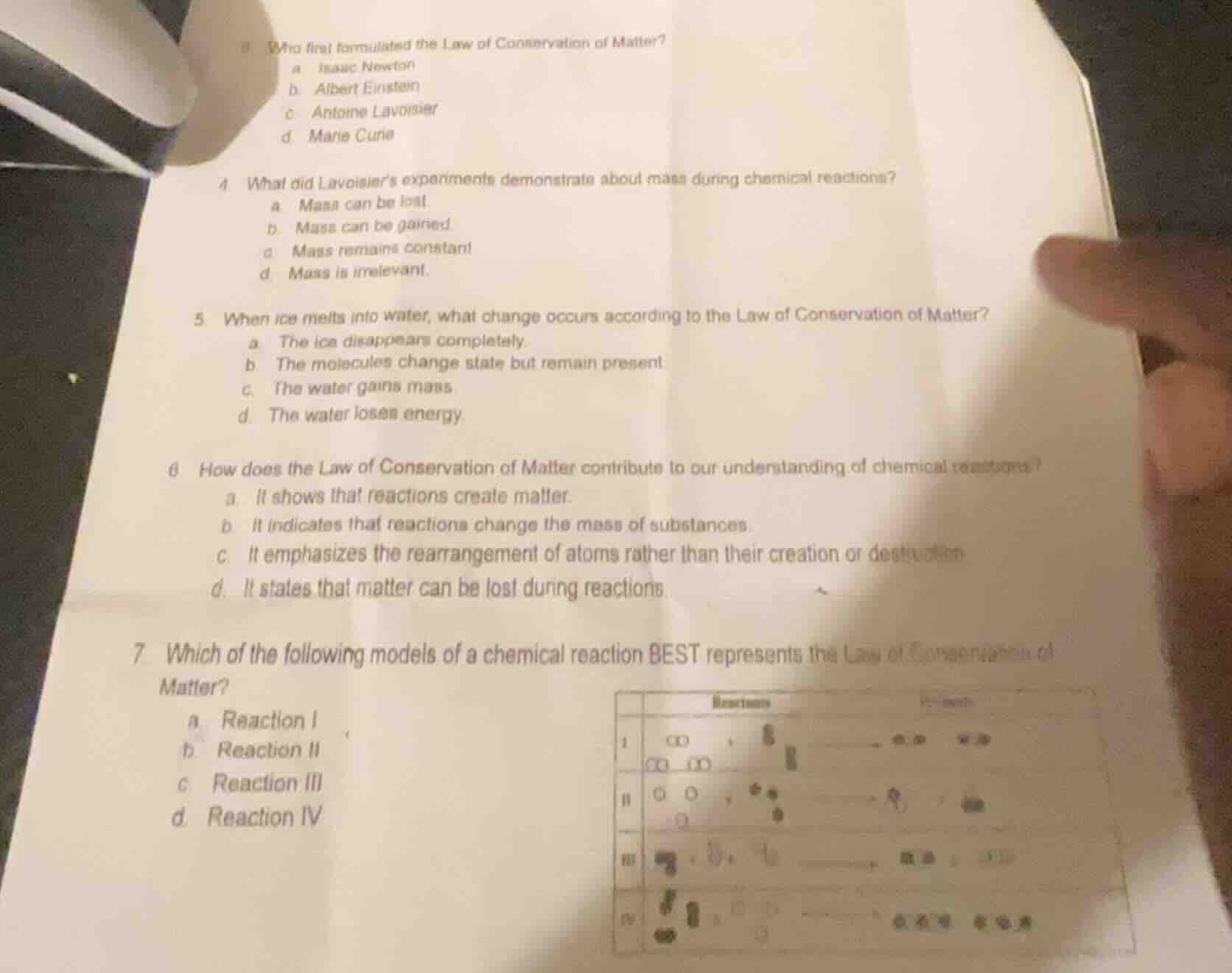
7 which of the following models of a chemical reaction best represents the law of conservation of matter?
a reaction i
b reaction ii
c reaction iii
d reaction iv
(chart with reactants and products for each reaction)
- Antoine Lavoisier is known as the founder of modern chemistry and first formulated the Law of Conservation of Matter.
- Lavoisier's experiments proved that the total mass of reactants equals the total mass of products in chemical reactions, so mass stays constant.
- The Law of Conservation of Matter states matter is not created or destroyed; when ice melts, it only changes state from solid to liquid, and its molecules remain present.
- The law explains that chemical reactions only rearrange atoms, no new atoms are created or existing ones destroyed.
- Reaction IV has the same number and type of atoms in reactants and products, which matches the Law of Conservation of Matter (atoms are just rearranged, no net gain/loss).

Snap & solve any problem in the app
Get step-by-step solutions on Sovi AI
Photo-based solutions with guided steps
Explore more problems and detailed explanations
- c. Antoine Lavoisier
- c. Mass remains constant
- b. The molecules change state but remain present
- c. It emphasizes the rearrangement of atoms rather than their creation or destruction
- d. Reaction IV