QUESTION IMAGE
Question
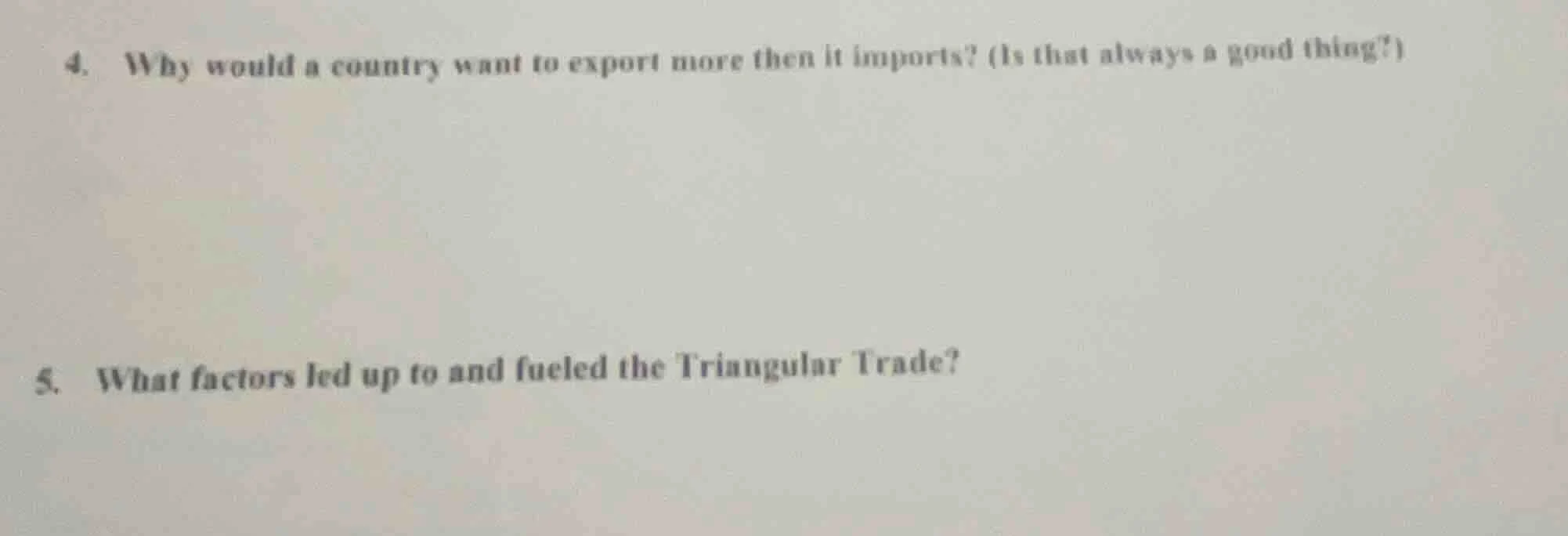
- why would a country want to export more then it imports? (is that always a good thing?)
- what factors led up to and fueled the triangular trade?
Brief Explanations
For Question 4:
- Reasons for seeking a trade surplus:
- Boost domestic production and employment: Higher exports mean local factories and farms produce more, creating jobs.
- Build foreign currency reserves: Exports earn foreign money, which stabilizes the domestic currency and pays for critical imports like energy or technology.
- Reduce foreign debt: A surplus can be used to pay down money owed to other countries.
- Support strategic industries: Protecting domestic producers via a surplus can help grow industries seen as vital for national security or long-term growth.
- Why it is not always good:
- Retaliatory tariffs: Trading partners may impose taxes on the country's goods, harming exports long-term.
- Reduced consumer choice/ higher costs: Limiting imports means consumers have fewer products and may pay more for goods the country is not efficient at making.
- Currency appreciation: A large surplus can make the domestic currency more expensive, making future exports less competitive.
- Trade tensions: Persistent surpluses can lead to diplomatic conflicts with other nations.
For Question 5:
- Economic factors:
- European demand for raw materials (like sugar, tobacco, cotton) from the Americas that could not be grown in Europe.
- American colonies' need for cheap labor to work on plantations, as indigenous populations were decimated by disease and conflict.
- African kingdoms' willingness to trade enslaved people for European manufactured goods (guns, textiles, rum) to build their own power and wealth.
- Geographic/technological factors:
- Improved shipbuilding and navigation technology made long-distance transatlantic travel feasible and profitable.
- The triangular route itself was logistically efficient: ships could carry different goods between Europe, Africa, and the Americas without sailing empty.
- Social/political factors:
- European colonial systems that relied on extractive economies in the Americas, which depended on forced labor.
- Racist ideologies that justified the enslavement of African people as a "necessary" part of economic growth.

Snap & solve any problem in the app
Get step-by-step solutions on Sovi AI
Photo-based solutions with guided steps
Explore more problems and detailed explanations
Question 4:
A country may seek to export more than it imports to boost domestic employment, build foreign currency reserves, reduce foreign debt, and support strategic industries. However, this is not always a good thing: it can trigger retaliatory trade barriers, limit consumer choice and raise costs, lead to currency appreciation that hurts future exports, and cause diplomatic trade tensions.
Question 5:
The Triangular Trade was driven by:
- Economic demands: European desire for American raw materials, colonial need for enslaved labor, and African kingdoms' demand for European manufactured goods.
- Technological/geographic shifts: Improved shipbuilding and navigation that enabled transatlantic travel, plus the efficient triangular route that avoided empty voyages.
- Social/political systems: European colonial extractive economies, and racist ideologies that normalized the enslavement of African people.