QUESTION IMAGE
Question
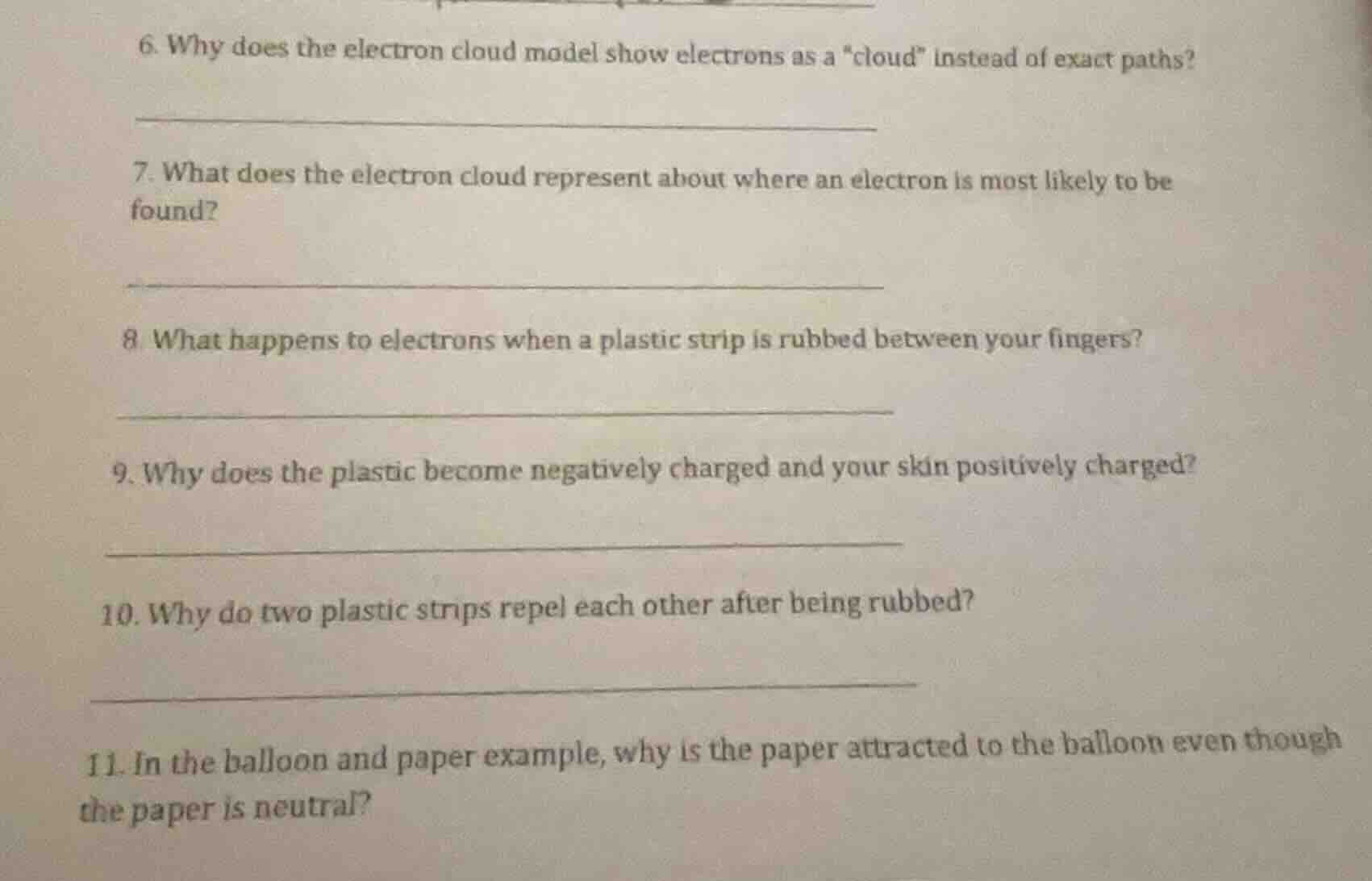
- why does the electron cloud model show electrons as a \cloud\ instead of exact paths?
- what does the electron cloud represent about where an electron is most likely to be found?
- what happens to electrons when a plastic strip is rubbed between your fingers?
- why does the plastic become negatively charged and your skin positively charged?
- why do two plastic strips repel each other after being rubbed?
- in the balloon and paper example, why is the paper attracted to the balloon even though the paper is neutral?
Question 6
According to quantum mechanics, electrons do not follow fixed, predictable paths (unlike the Bohr model's orbits). The electron cloud model is based on the Heisenberg uncertainty principle, which states that we cannot simultaneously know an electron's exact position and momentum. So, instead of exact paths, we represent the region where electrons are likely to be found as a "cloud" to show the probability distribution of electron positions.
The electron cloud represents the region around the nucleus where an electron is most likely to be found. The density of the cloud (how "thick" it is in a particular area) corresponds to the probability of finding the electron there. Areas with a higher - density cloud have a greater probability of containing the electron.
When a plastic strip is rubbed between fingers, a process called triboelectric charging occurs. The plastic strip and the skin (fingers) have different electron - affinities. The plastic strip has a relatively high electron - affinity, so electrons from the skin (fingers) are transferred to the plastic strip.

Snap & solve any problem in the app
Get step-by-step solutions on Sovi AI
Photo-based solutions with guided steps
Explore more problems and detailed explanations
Because electrons' positions and momenta can't be precisely known (Heisenberg uncertainty principle), so their locations are shown as a probability - based cloud rather than exact paths.