QUESTION IMAGE
Question
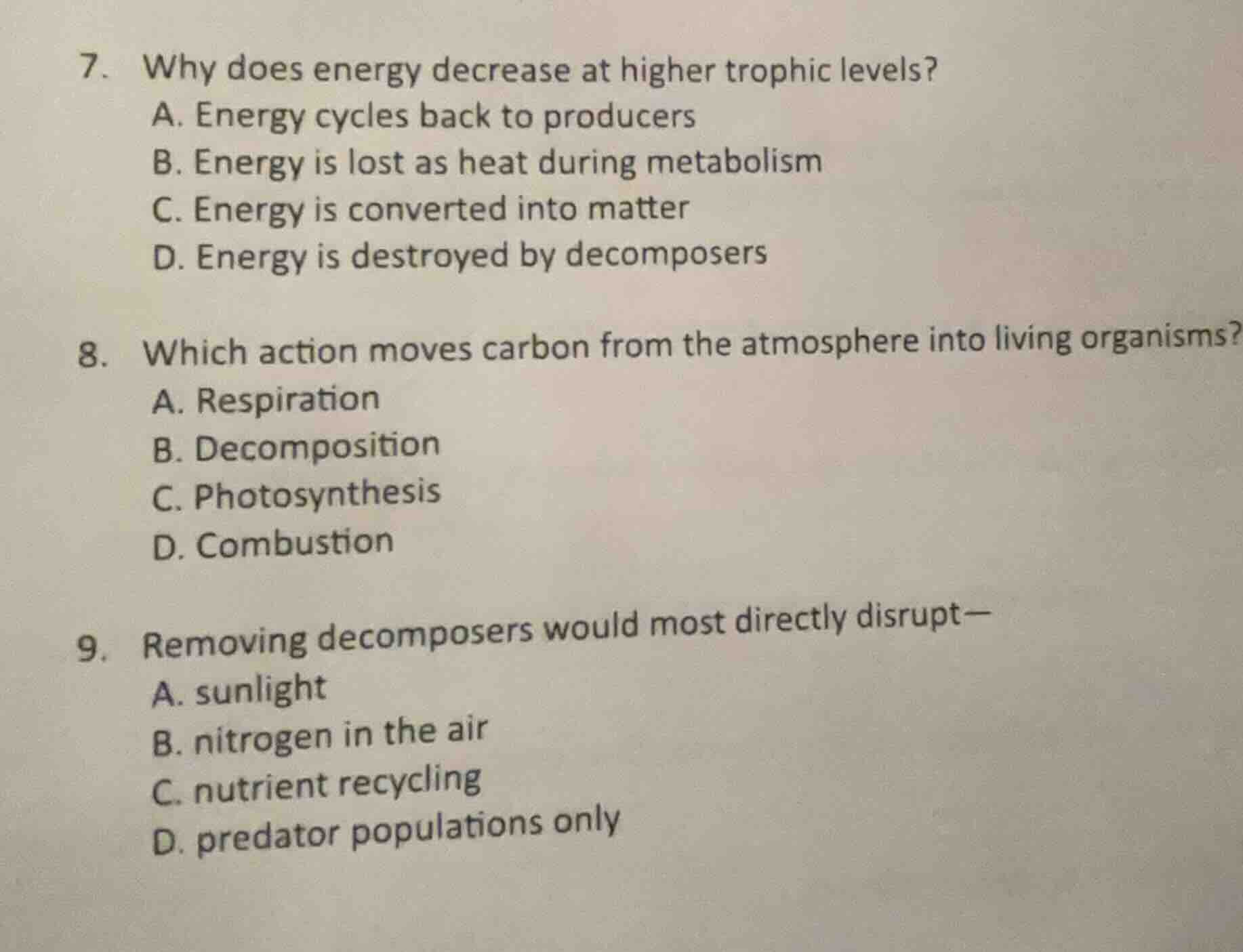
- why does energy decrease at higher trophic levels?
a. energy cycles back to producers
b. energy is lost as heat during metabolism
c. energy is converted into matter
d. energy is destroyed by decomposers
- which action moves carbon from the atmosphere into living organisms?
a. respiration
b. decomposition
c. photosynthesis
d. combustion
- removing decomposers would most directly disrupt—
a. sunlight
b. nitrogen in the air
c. nutrient recycling
d. predator populations only
Response
Question 7
Brief Explanations
- Option A: Energy does not cycle back to producers in the way described; energy flow is unidirectional.
- Option B: In ecosystems, as organisms metabolize (perform life processes), energy is lost as heat. This is why energy decreases at higher trophic levels (only about 10% is transferred between levels, with most lost as heat).
- Option C: Energy is not converted into matter in a way that explains energy decrease at trophic levels.
- Option D: Decomposers break down matter, not destroy energy (energy is conserved, just transformed).
Brief Explanations
- Option A: Respiration releases carbon (as CO₂) into the atmosphere, not take it in.
- Option B: Decomposition releases carbon from dead organisms into the environment, not take it into living organisms.
- Option C: Photosynthesis is the process by which plants (and some other organisms) take in CO₂ from the atmosphere and use it to make organic compounds (storing carbon in living tissue).
- Option D: Combustion (like burning fossil fuels) releases carbon into the atmosphere.
Brief Explanations
- Option A: Decomposers have no direct role in sunlight availability.
- Option B: Decomposers are more involved in nutrient (like nitrogen) cycling from organic matter to inorganic forms, but the most direct disruption from removing them is nutrient recycling (breaking down dead matter to release nutrients back into the ecosystem). The nitrogen in air is mostly fixed by other organisms (like bacteria), so this is not the most direct.
- Option C: Decomposers break down dead organisms and waste, releasing nutrients (like carbon, nitrogen, phosphorus) back into the soil/water, which are then reused by producers. Removing them would stop this recycling of nutrients.
- Option D: Decomposers don’t directly affect only predator populations; their role is broader in nutrient cycling.

Snap & solve any problem in the app
Get step-by-step solutions on Sovi AI
Photo-based solutions with guided steps
Explore more problems and detailed explanations
B. Energy is lost as heat during metabolism