QUESTION IMAGE
Question
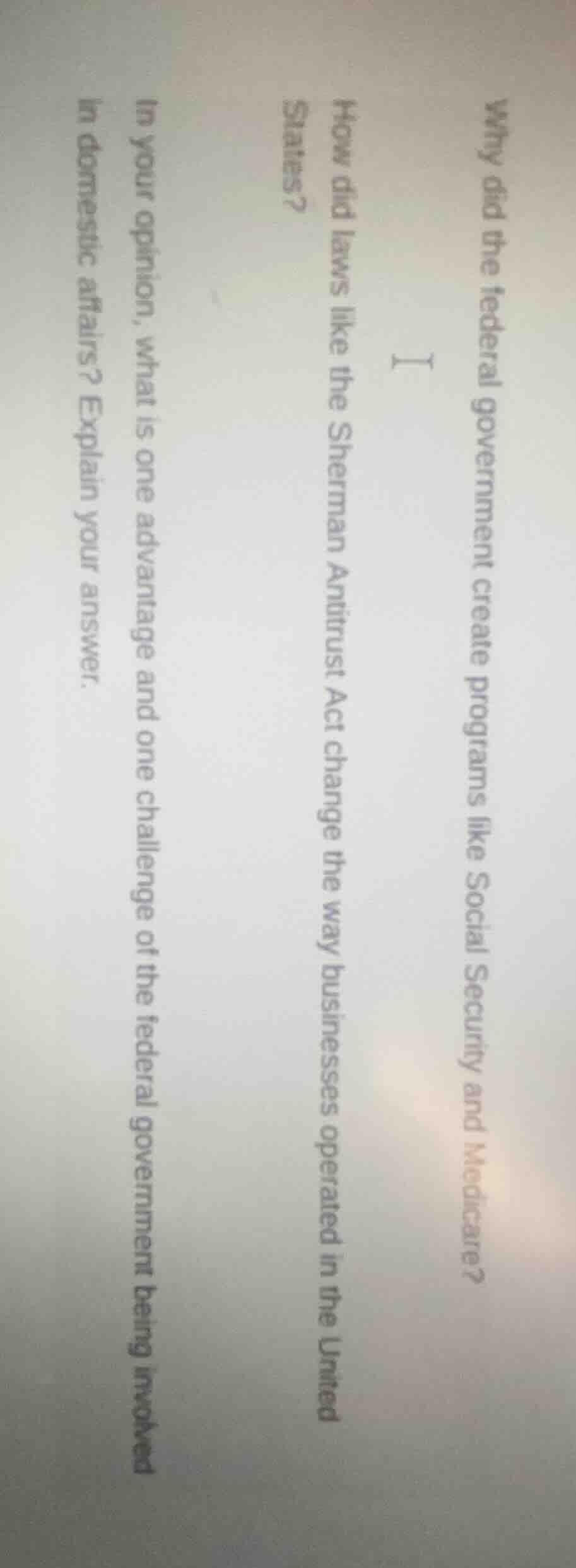
why did the federal government create programs like social security and medicare?
how did laws like the sherman antitrust act change the way businesses operated in the united states?
in your opinion, what is one advantage and one challenge of the federal government being involved in domestic affairs? explain your answer.
Brief Explanations
- For the first question: These programs were created to address widespread economic insecurity during the Great Depression (Social Security, 1935) and to provide health coverage for elderly Americans (Medicare, 1965), filling gaps where state and private systems failed to support vulnerable populations.
- For the second question: The Sherman Antitrust Act (1890) prohibited monopolies and anti-competitive business practices, forcing large corporations to end monopolistic control, promote fair market competition, and prevent price-fixing or anti-competitive mergers.
- For the third question: Advantage: The federal government can set uniform national standards (e.g., minimum wage) that ensure consistent protections for citizens across all states, avoiding a patchwork of inconsistent state rules. Challenge: Federal domestic policies may not align with local needs and cultural norms of individual states, leading to tensions over states' rights and reduced local autonomy in addressing unique regional issues.

Snap & solve any problem in the app
Get step-by-step solutions on Sovi AI
Photo-based solutions with guided steps
Explore more problems and detailed explanations
- The federal government created Social Security (1935) to mitigate widespread poverty among elderly and unemployed Americans during the Great Depression, as state and private support systems collapsed. Medicare (1965) was established to address the lack of affordable health insurance for the elderly population, who faced high medical costs and limited access to coverage.
- The Sherman Antitrust Act restricted monopolies, cartels, and anti-competitive business practices. It forced large corporations to abandon monopolistic control of markets, required fair competition, and allowed the government to break up dominant companies, fundamentally altering how businesses operated by limiting their ability to stifle competition.
- Advantage: Uniform national standards for protections (e.g., labor rights, safety) ensure consistent support for all citizens, regardless of their state of residence.
Challenge: Federal policies may not account for regional cultural, economic, or social differences, leading to misalignment with local needs and tensions over states' rights to govern their own domestic affairs.