QUESTION IMAGE
Question
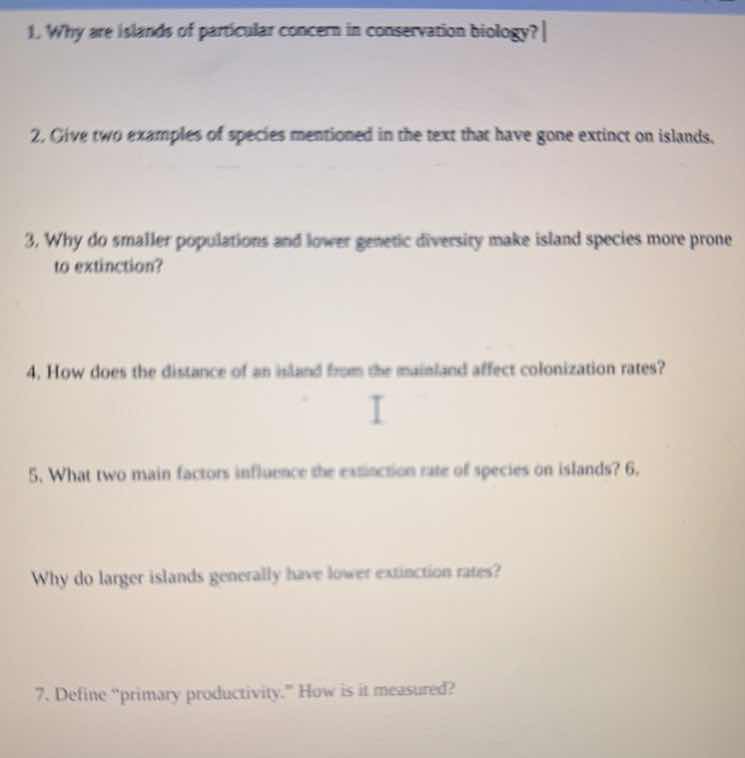
- why are islands of particular concern in conservation biology?
- give two examples of species mentioned in the text that have gone extinct on islands.
- why do smaller populations and lower genetic diversity make island species more prone to extinction?
- how does the distance of an island from the mainland affect colonization rates?
- what two main factors influence the extinction rate of species on islands? 6.
why do larger islands generally have lower extinction rates?
- define \primary productivity.\ how is it measured?
Brief Explanations
- Islands have isolated ecosystems with unique, often endemic species that evolved with limited predators/competition, making them highly vulnerable to disturbances like invasive species, habitat loss, and climate change. They also have small population sizes and limited genetic diversity, increasing extinction risk.
- Common examples from conservation biology texts include the Dodo (Raphus cucullatus, from Mauritius) and the Moa (various species from New Zealand).
- Smaller populations face higher risk of random demographic/genetic events (e.g., inbreeding depression, stochastic mortality). Lower genetic diversity reduces ability to adapt to environmental changes (e.g., new diseases, climate shifts).
- Islands farther from the mainland have lower colonization rates: fewer species can disperse across greater distances, so fewer new organisms reach and establish populations there.
- The two main factors are island size (smaller islands have higher extinction rates) and the number/size of resident populations (smaller populations are more at risk).
- Larger islands have more available habitat and resources, supporting larger, more stable populations. They also have greater habitat diversity, reducing competition and providing refuges from disturbances.
- Primary productivity is the rate at which autotrophs (plants, algae, cyanobacteria) convert inorganic carbon (via photosynthesis or chemosynthesis) into organic biomass. It is typically measured as:
- Gross Primary Productivity (GPP): Total carbon fixed by autotrophs, measured in units like $\frac{gC}{m^2 \cdot year}$ or $\frac{kg biomass}{m^2 \cdot year}$.
- Net Primary Productivity (NPP): GPP minus the energy autotrophs use for respiration (NPP = GPP - R), representing the biomass available to other trophic levels.

Snap & solve any problem in the app
Get step-by-step solutions on Sovi AI
Photo-based solutions with guided steps
Explore more problems and detailed explanations
- Islands have isolated, endemic-rich ecosystems with small, vulnerable populations, making them highly susceptible to extinction threats.
- A. Dodo (Raphus cucullatus, Mauritius), B. Moa (New Zealand species)
- Small populations face stochastic risks; low genetic diversity limits adaptive capacity.
- Farther islands have lower colonization rates due to limited dispersal ability of species.
- A. Island size, B. Size of resident species populations
- Larger islands have more habitat/resources, supporting larger, more stable populations.
- Primary productivity is the rate autotrophs produce organic biomass. It is measured as gross (total carbon fixed) or net (biomass available to consumers) productivity, in units like $\frac{gC}{m^2 \cdot year}$ or $\frac{kg biomass}{m^2 \cdot year}$.