QUESTION IMAGE
Question
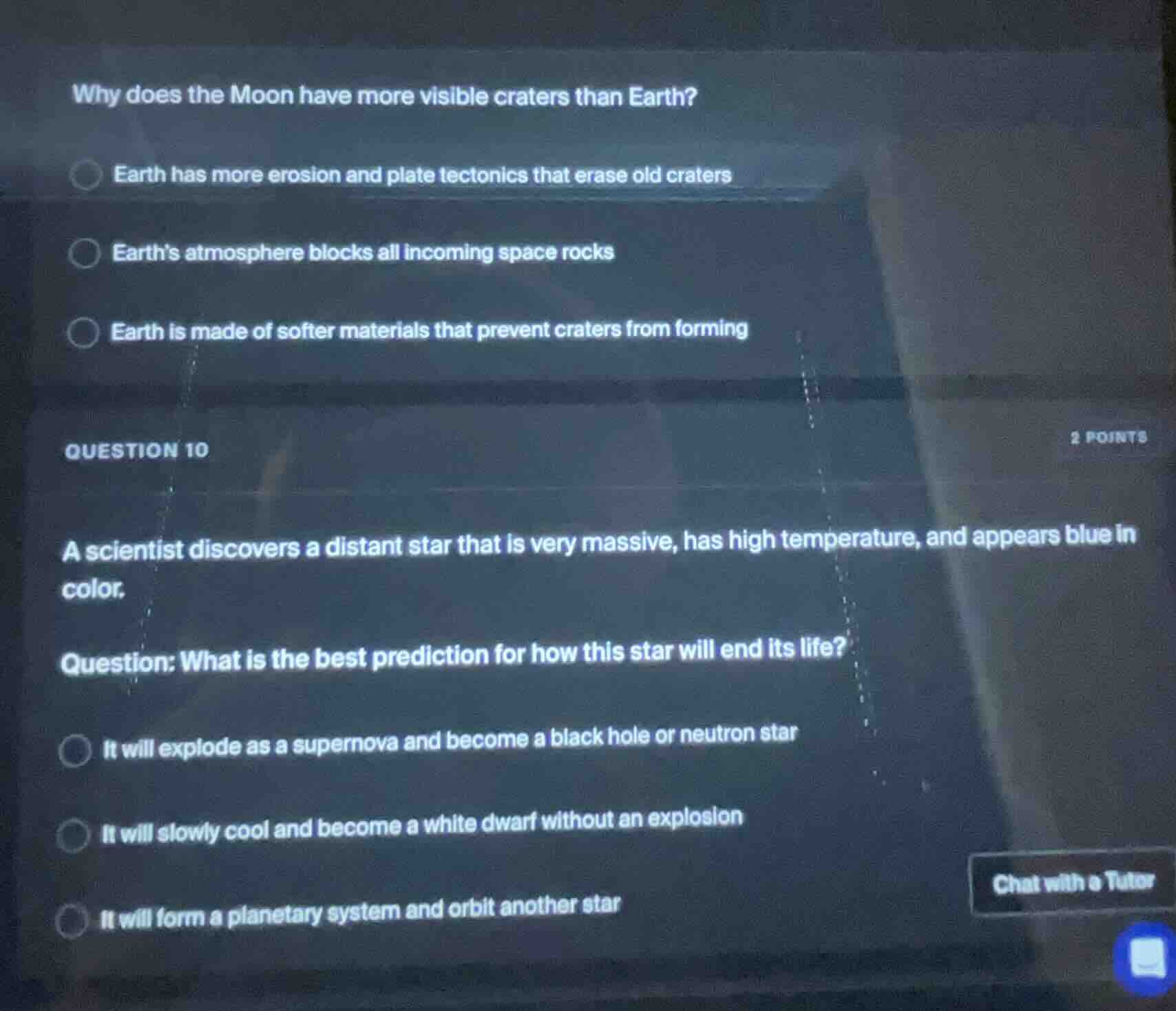
why does the moon have more visible craters than earth? \
earth has more erosion and plate tectonics that erase old craters \
earths atmosphere blocks all incoming space rocks \
earth is made of softer materials that prevent craters from forming \
question 10 \
a scientist discovers a distant star that is very massive, has high temperature, and appears blue in color. \
question: what is the best prediction for how this star will end its life? \
it will explode as a supernova and become a black hole or neutron star \
it will slowly cool and become a white dwarf without an explosion \
it will form a planetary system and orbit another star
First Question (Moon craters vs Earth):
- Option 1: Earth has erosion (wind, water) and plate tectonics (continental drift, mountain - building) that reshape the surface, erasing old craters. Moon lacks these processes, so craters remain visible.
- Option 2: Earth's atmosphere doesn't block all incoming space rocks (e.g., meteorites still hit Earth).
- Option 3: Earth's crust is not made of "softer materials" that prevent crater formation; impacts can still form craters, but they get erased over time.
- A very massive, high - temperature, blue star is a massive star. Massive stars end their lives in a supernova explosion. After the supernova, depending on the remaining mass, they can become a black hole or a neutron star.
- Option 2: Slow cooling into a white dwarf is the fate of low - mass stars (like the Sun), not massive blue stars.
- Option 3: A star cannot form a planetary system and orbit another star as it reaches the end of its life; stars are the central objects in planetary systems.

Snap & solve any problem in the app
Get step-by-step solutions on Sovi AI
Photo-based solutions with guided steps
Explore more problems and detailed explanations
A. Earth has more erosion and plate tectonics that erase old craters