QUESTION IMAGE
Question
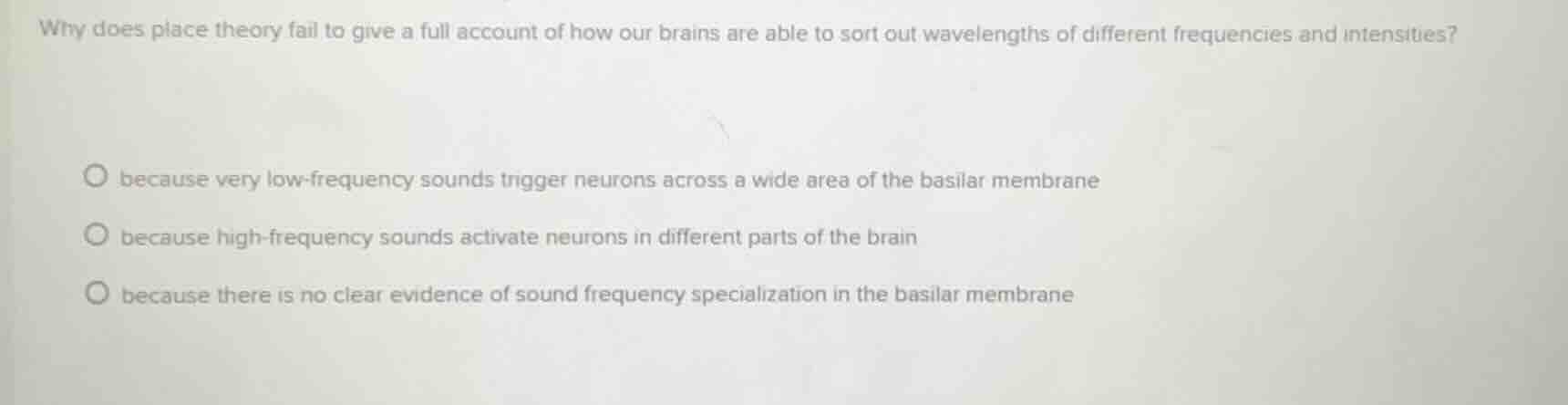
why does place theory fail to give a full account of how our brains are able to sort out wavelengths of different frequencies and intensities?
○ because very low - frequency sounds trigger neurons across a wide area of the basilar membrane
○ because high - frequency sounds activate neurons in different parts of the brain
○ because there is no clear evidence of sound frequency specialization in the basilar membrane
Place theory posits that different sound frequencies are detected by specific locations on the basilar membrane. However, it fails to fully explain auditory processing because very low-frequency sounds do not activate a narrow, specific region of the basilar membrane—instead, they stimulate neurons across a wide area of this structure, which contradicts the core premise of place theory. The other options are incorrect: high-frequency sounds do follow place theory's localization on the basilar membrane, and there is clear evidence of frequency specialization on the basilar membrane for most sound ranges.

Snap & solve any problem in the app
Get step-by-step solutions on Sovi AI
Photo-based solutions with guided steps
Explore more problems and detailed explanations
because very low-frequency sounds trigger neurons across a wide area of the basilar membrane