QUESTION IMAGE
Question
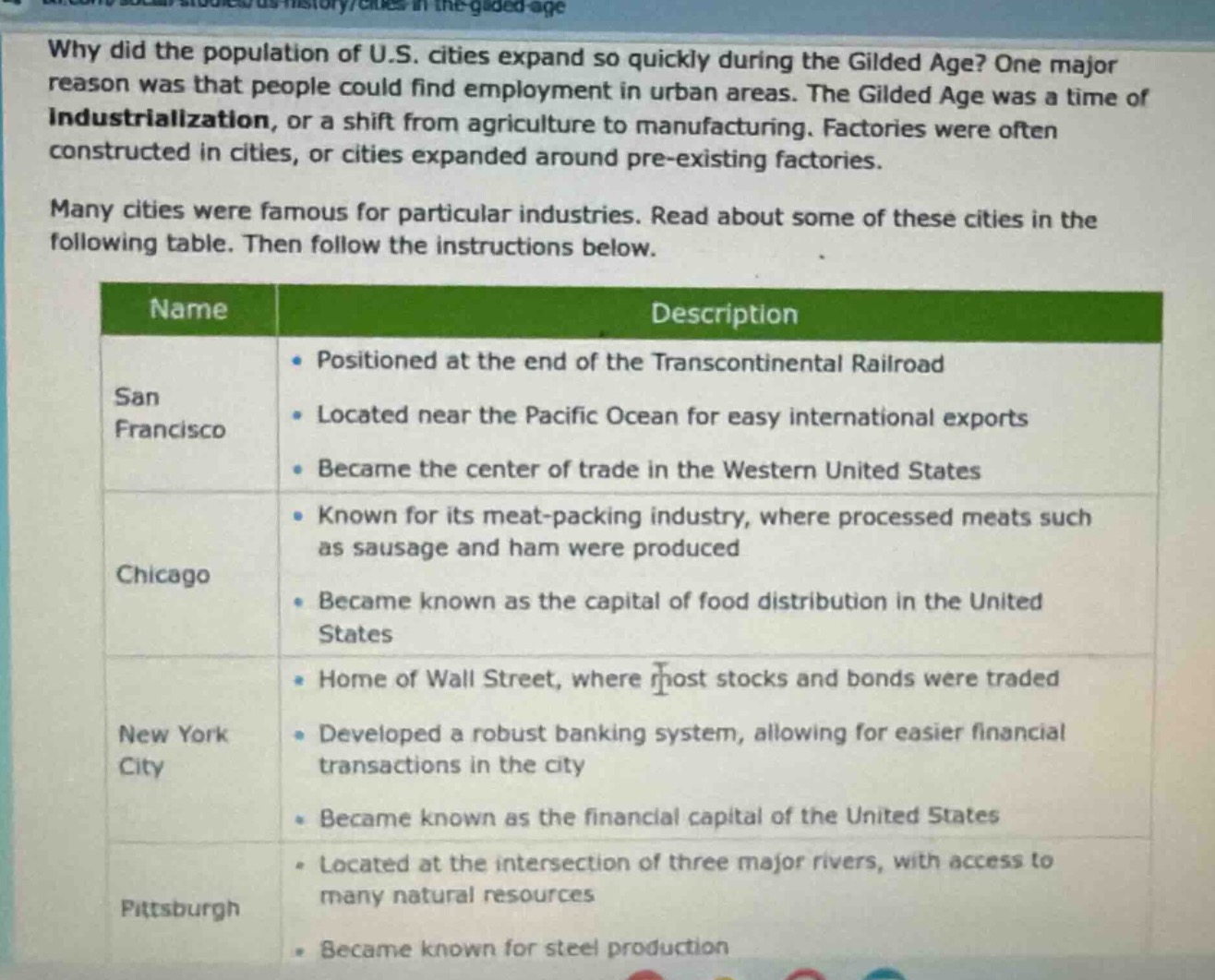
why did the population of u.s. cities expand so quickly during the gilded age? one major reason was that people could find employment in urban areas. the gilded age was a time of industrialization, or a shift from agriculture to manufacturing. factories were often constructed in cities, or cities expanded around pre - existing factories.
many cities were famous for particular industries. read about some of these cities in the following table. then follow the instructions below.
| name | description |
|---|---|
| chicago | - known for its meat - packing industry, where processed meats such as sausage and ham were produced<br>- became known as the capital of food distribution in the united states |
| new york city | - home of wall street, where most stocks and bonds were traded<br>- developed a robust banking system, allowing for easier financial transactions in the city<br>- became known as the financial capital of the united states |
| pittsburgh | - located at the intersection of three major rivers, with access to many natural resources<br>- became known for steel production |
Since the problem (the specific question related to this text isn't provided, but assuming a common question like identifying the reason for city population growth or city industry details), here's a general approach:
For a question like "Why did U.S. city populations grow in the Gilded Age?"
The Gilded Age saw industrialization (shift from agriculture to manufacturing). Factories were built in cities (or cities expanded around factories), offering employment. People moved to cities for jobs, causing population growth. Also, cities specialized in industries (e.g., San Francisco in trade, Chicago in meat - packing, New York in finance, Pittsburgh in steel), attracting workers.
From the table, Chicago was known for its meat - packing industry (producing processed meats like sausage and ham) and became the capital of food distribution in the US.

Snap & solve any problem in the app
Get step-by-step solutions on Sovi AI
Photo-based solutions with guided steps
Explore more problems and detailed explanations
One major reason was industrialization (shift to manufacturing) with factories in cities offering employment. Cities' specialized industries also attracted workers.