QUESTION IMAGE
Question
why?
recognizing patterns allows us to predict future behavior. weather experts use patterns to predict danger-
ous storms so people can get their families to safety. political analysts use patterns to predict election out-
comes. similarly, chemists classify chemical equations according to their patterns to help predict products
of unknown but similar chemical reactions.
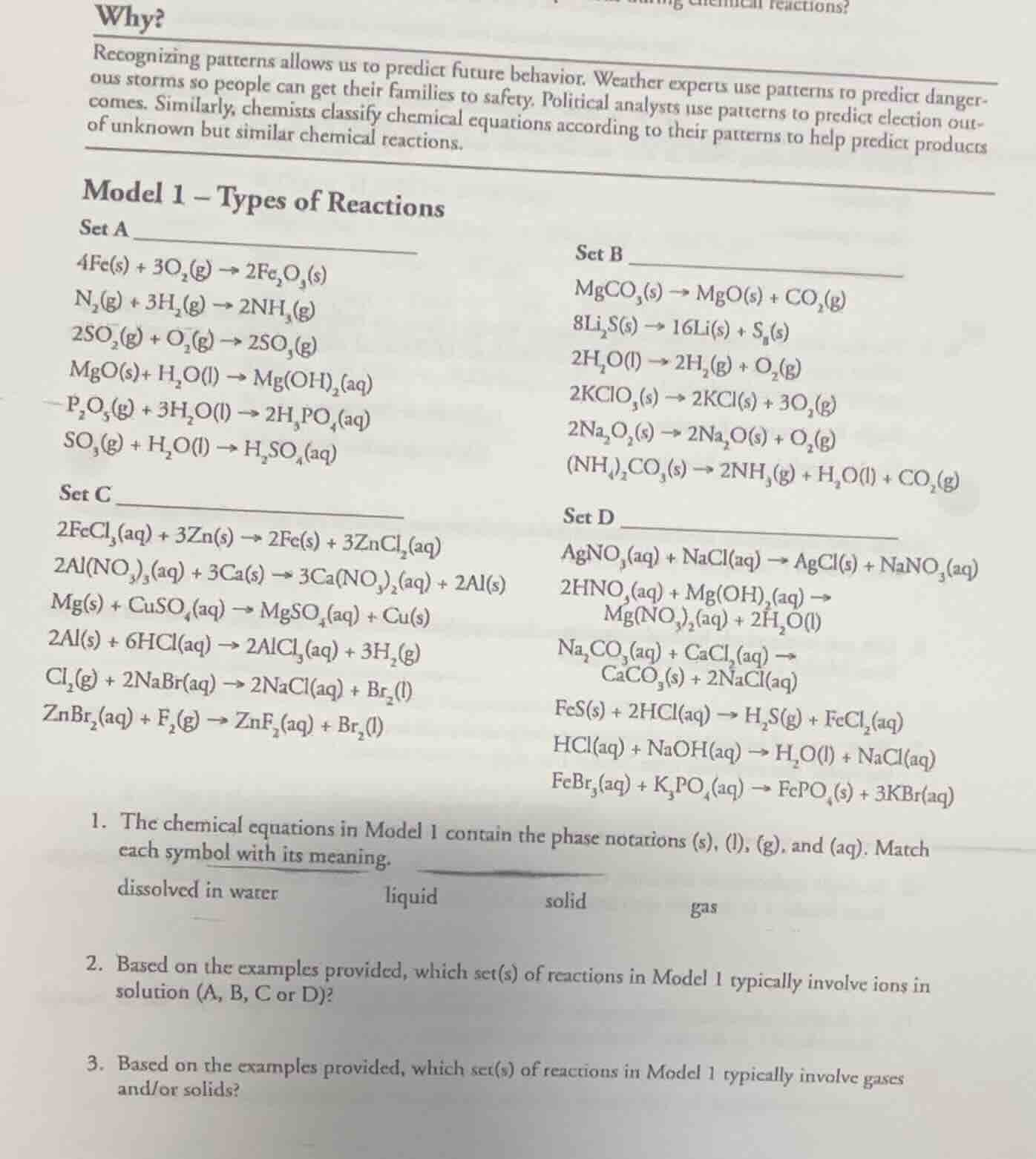
model 1 – types of reactions
set a
$4fe(s) + 3o_2(g) \
ightarrow 2fe_2o_3(s)$
$n_2(g) + 3h_2(g) \
ightarrow 2nh_3(g)$
$2so_2(g) + o_2(g) \
ightarrow 2so_3(g)$
$mgo(s)+ h_2o(l) \
ightarrow mg(oh)_2(aq)$
$p_2o_5(g) + 3h_2o(l) \
ightarrow 2h_3po_4(aq)$
$so_3(g) + h_2o(l) \
ightarrow h_2so_4(aq)$
set b
$mgco_3(s) \
ightarrow mgo(s) + co_2(g)$
$8li_2s(s) \
ightarrow 16li(s) + s_8(s)$
$2h_2o(l) \
ightarrow 2h_2(g) + o_2(g)$
$2kclo_3(s) \
ightarrow 2kcl(s) + 3o_2(g)$
$2na_2o_2(s) \
ightarrow 2na_2o(s) + o_2(g)$
$(nh_4)_2co_3(s) \
ightarrow 2nh_3(g) + h_2o(l) + co_2(g)$
set c
$2fecl_3(aq) + 3zn(s) \
ightarrow 2fe(s) + 3zncl_2(aq)$
$2al(no_3)_3(aq) + 3ca(s) \
ightarrow 3ca(no_3)_2(aq) + 2al(s)$
$mg(s) + cuso_4(aq) \
ightarrow mgso_4(aq) + cu(s)$
$2al(s) + 6hcl(aq) \
ightarrow 2alcl_3(aq) + 3h_2(g)$
$cl_2(g) + 2nabr(aq) \
ightarrow 2nacl(aq) + br_2(l)$
$znbr_2(aq) + f_2(g) \
ightarrow znf_2(aq) + br_2(l)$
set d
$agno_3(aq) + nacl(aq) \
ightarrow agcl(s) + nano_3(aq)$
$2hno_3(aq) + mg(oh)_2(aq) \
ightarrow mg(no_3)_2(aq) + 2h_2o(l)$
$na_2co_3(aq) + cacl_2(aq) \
ightarrow caco_3(s) + 2nacl(aq)$
$fes(s) + 2hcl(aq) \
ightarrow h_2s(g) + fecl_2(aq)$
$hcl(aq) + naoh(aq) \
ightarrow h_2o(l) + nacl(aq)$
$febr_3(aq) + k_3po_4(aq) \
ightarrow fepo_4(s) + 3kbr(aq)$
- the chemical equations in model 1 contain the phase notations (s), (l), (g), and (aq). match
each symbol with its meaning.
dissolved in water liquid solid gas
- based on the examples provided, which set(s) of reactions in model 1 typically involve ions in
solution (a, b, c or d)?
- based on the examples provided, which set(s) of reactions in model 1 typically involve gases
and/or solids?
Question 1
- (s) stands for solid, representing a substance in its solid state (e.g., Fe(s), MgO(s)).
- (l) stands for liquid, representing a substance in its liquid state (e.g., H₂O(l)).
- (g) stands for gas, representing a substance in its gaseous state (e.g., O₂(g), CO₂(g)).
- (aq) stands for aqueous, meaning the substance is dissolved in water (e.g., Mg(OH)₂(aq), AgNO₃(aq)).
- Set D has reactions with aqueous solutions (aq) like \( \text{AgNO}_3(\text{aq}) + \text{NaCl}(\text{aq})
ightarrow \text{AgCl}(\text{s}) + \text{NaNO}_3(\text{aq}) \), \( \text{HCl}(\text{aq}) + \text{NaOH}(\text{aq})
ightarrow \text{H}_2\text{O}(\text{l}) + \text{NaCl}(\text{aq}) \), etc. Set C also has aqueous reactants (e.g., \( 2\text{FeCl}_3(\text{aq}) + 3\text{Zn}(\text{s})
ightarrow 2\text{Fe}(\text{s}) + 3\text{ZnCl}_2(\text{aq}) \)) and involves ions in solution (redox or displacement reactions with ions).
- Set A and B have more solid/gas/liquid (non - aqueous ion - free or less ionic) reactions. So Sets C and D involve ions in solution.
- Set A: Reactions have solids (e.g., Fe(s), MgO(s)), gases (e.g., O₂(g), N₂(g)), and liquids (e.g., H₂O(l)). For example, \( 4\text{Fe}(\text{s}) + 3\text{O}_2(\text{g})
ightarrow 2\text{Fe}_2\text{O}_3(\text{s}) \), \( \text{N}_2(\text{g}) + 3\text{H}_2(\text{g})
ightarrow 2\text{NH}_3(\text{g}) \), \( \text{MgO}(\text{s})+\text{H}_2\text{O}(\text{l})
ightarrow \text{Mg(OH)}_2(\text{aq}) \).
- Set B: Reactions have solids (e.g., MgCO₃(s), Li₂S(s)) and gases (e.g., CO₂(g), O₂(g)). For example, \( \text{MgCO}_3(\text{s})
ightarrow \text{MgO}(\text{s}) + \text{CO}_2(\text{g}) \), \( 2\text{H}_2\text{O}(\text{l})
ightarrow 2\text{H}_2(\text{g}) + \text{O}_2(\text{g}) \).
- Set C: Reactions have solids (e.g., Zn(s), Al(s)) and aqueous solutions (but also products like Fe(s)). For example, \( 2\text{FeCl}_3(\text{aq}) + 3\text{Zn}(\text{s})
ightarrow 2\text{Fe}(\text{s}) + 3\text{ZnCl}_2(\text{aq}) \), \( \text{Cl}_2(\text{g}) + 2\text{NaBr}(\text{aq})
ightarrow 2\text{NaCl}(\text{aq}) + \text{Br}_2(\text{l}) \) (has gas and liquid).
- Set D: Reactions have solids (e.g., AgCl(s), CaCO₃(s)) and aqueous solutions. For example, \( \text{AgNO}_3(\text{aq}) + \text{NaCl}(\text{aq})
ightarrow \text{AgCl}(\text{s}) + \text{NaNO}_3(\text{aq}) \), \( \text{FeS}(\text{s}) + 2\text{HCl}(\text{aq})
ightarrow \text{H}_2\text{S}(\text{g}) + \text{FeCl}_2(\text{aq}) \) (has gas and solid). So all sets (A, B, C, D) involve gases and/or solids.

Snap & solve any problem in the app
Get step-by-step solutions on Sovi AI
Photo-based solutions with guided steps
Explore more problems and detailed explanations
- (s): solid
- (l): liquid
- (g): gas
- (aq): dissolved in water