QUESTION IMAGE
Question
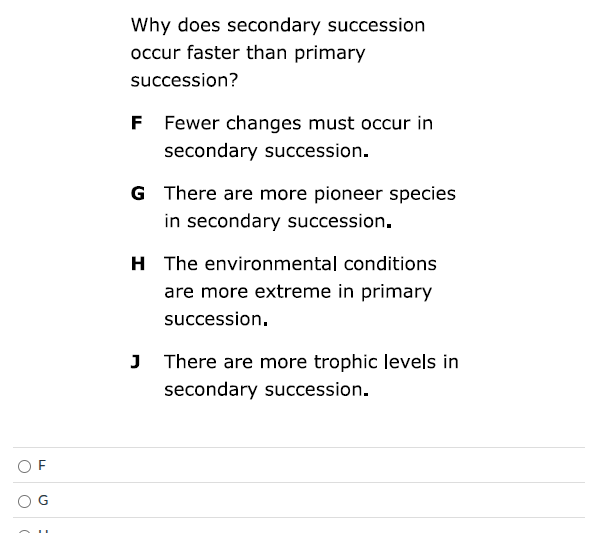
why does secondary succession
occur faster than primary
succession?
f fewer changes must occur in
secondary succession.
g there are more pioneer species
in secondary succession.
h the environmental conditions
are more extreme in primary
succession.
j there are more trophic levels in
secondary succession.
○ f
○ g
○ h
Brief Explanations
To determine why secondary succession is faster than primary succession, we analyze each option:
- Option F: Secondary succession starts on soil (from a disturbed area with existing soil), so fewer changes (like soil formation) are needed. Primary succession starts on bare rock, requiring more steps (e.g., lichens to break down rock into soil). This makes sense.
- Option G: Pioneer species are the first in succession. Primary succession has pioneer species (e.g., lichens), and secondary succession doesn't have "more" pioneer species; it starts with species that can use existing soil, so G is incorrect.
- Option H: Primary succession occurs in extreme, barren environments (e.g., after a volcano), but this explains why primary is slow, not why secondary is fast. It's a reason primary is slow, not a direct reason secondary is fast, so H is not the best.
- Option J: Trophic levels relate to energy flow in a community, not the speed of succession. Succession speed is about community development, not trophic levels, so J is incorrect.
So the correct answer is F.

Snap & solve any problem in the app
Get step-by-step solutions on Sovi AI
Photo-based solutions with guided steps
Explore more problems and detailed explanations
F. Fewer changes must occur in secondary succession.