QUESTION IMAGE
Question
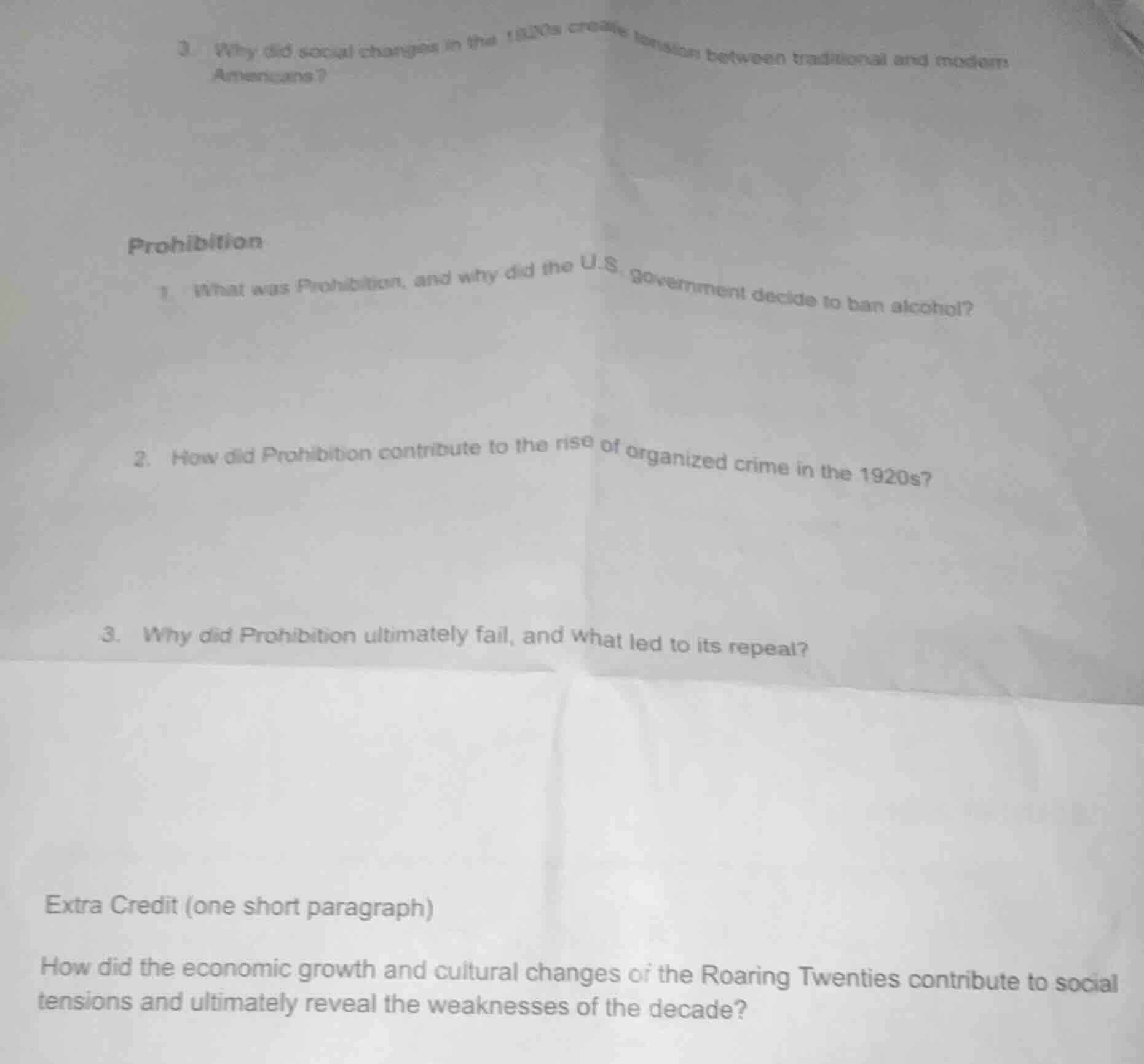
- why did social changes in the 1920s create tension between traditional and modern americans?
prohibition
- what was prohibition, and why did the u.s. government decide to ban alcohol?
- how did prohibition contribute to the rise of organized crime in the 1920s?
- why did prohibition ultimately fail, and what led to its repeal?
extra credit (one short paragraph)
how did the economic growth and cultural changes of the roaring twenties contribute to social tensions and ultimately reveal the weaknesses of the decade?
Question 3 (Top):
Modern Americans embraced urbanization, consumer culture, new social norms (like flapper culture, secularism), and technological change, while traditional Americans (often rural, religious, conservative) clung to agrarian values, strict moral codes, and traditional social structures. These clashing worldviews over issues like evolution, prohibition, and gender roles created tension.
Prohibition Question 1:
Prohibition was the nationwide ban on the production, sale, and transportation of alcoholic beverages in the U.S. (1920-1933, via the 18th Amendment). The government banned alcohol due to pressure from temperance groups, who argued alcohol caused family breakdown, poverty, crime, and workplace inefficiency; religious groups also viewed it as immoral.
Prohibition Question 2:
Prohibition created a huge illegal demand for alcohol. Criminal syndicates monopolized the production, smuggling, and sale of bootleg alcohol, using violence to eliminate rivals and control territories. Law enforcement was underfunded and outmatched, allowing organized crime networks to grow wealthy and powerful.
Prohibition Question 3:
Prohibition failed because it was widely ignored (many Americans drank illegally), it empowered organized crime, it lost public support over time, and it was impossible to enforce effectively. The Great Depression also played a role: repealing the 18th Amendment (via the 21st Amendment in 1933) allowed the government to tax alcohol, generating much-needed revenue, and eliminated the illegal alcohol market.
Extra Credit:
The economic boom of the 1920s created a wealthy urban middle class that embraced consumerism, jazz, and liberal social norms, while rural Americans were left behind, struggling with falling farm prices, fueling resentment between urban and rural populations. Cultural shifts like the rise of flappers, secularism, and immigration created clashes with conservative, traditional values, exposing a deep divide in American society. Additionally, the economic growth was built on credit and speculation, which led to the stock market crash of 1929, revealing the decade's underlying economic fragility and the emptiness of its superficial prosperity.

Snap & solve any problem in the app
Get step-by-step solutions on Sovi AI
Photo-based solutions with guided steps
Explore more problems and detailed explanations
Question 3 (Top):
Tension arose from clashing worldviews: modern Americans adopted urban, secular, consumer-focused norms, while traditional (largely rural, religious) Americans held to agrarian, conservative values, leading to conflicts over social, moral, and cultural issues.
Prohibition Question 1:
Prohibition was the 1920-1933 nationwide ban on alcohol production/sale/transport (18th Amendment). The U.S. government banned alcohol due to temperance and religious group pressure, citing alcohol's links to poverty, family breakdown, crime, and immorality.
Prohibition Question 2:
Prohibition created an illegal, high-demand market for alcohol. Organized crime groups monopolized bootlegging, smuggling, and speakeasies, using violence to control operations, and weak enforcement allowed these networks to grow wealthy and powerful.
Prohibition Question 3:
Prohibition failed due to widespread public disregard, rampant organized crime, and unenforceable rules. Its repeal (21st Amendment, 1933) was driven by lost public support and the Great Depression, as taxing alcohol would generate critical government revenue.
Extra Credit:
The 1920s' economic boom widened the gap between wealthy, liberal urbanites (embracing consumerism and cultural change) and struggling, conservative rural Americans, fueling social tension. The era's cultural shifts (like flapper culture, secularism) clashed with traditional values, exposing deep societal divides. Meanwhile, the prosperity was built on unstable credit and speculation, leading to the 1929 stock market crash, which laid bare the decade's economic weaknesses.