QUESTION IMAGE
Question
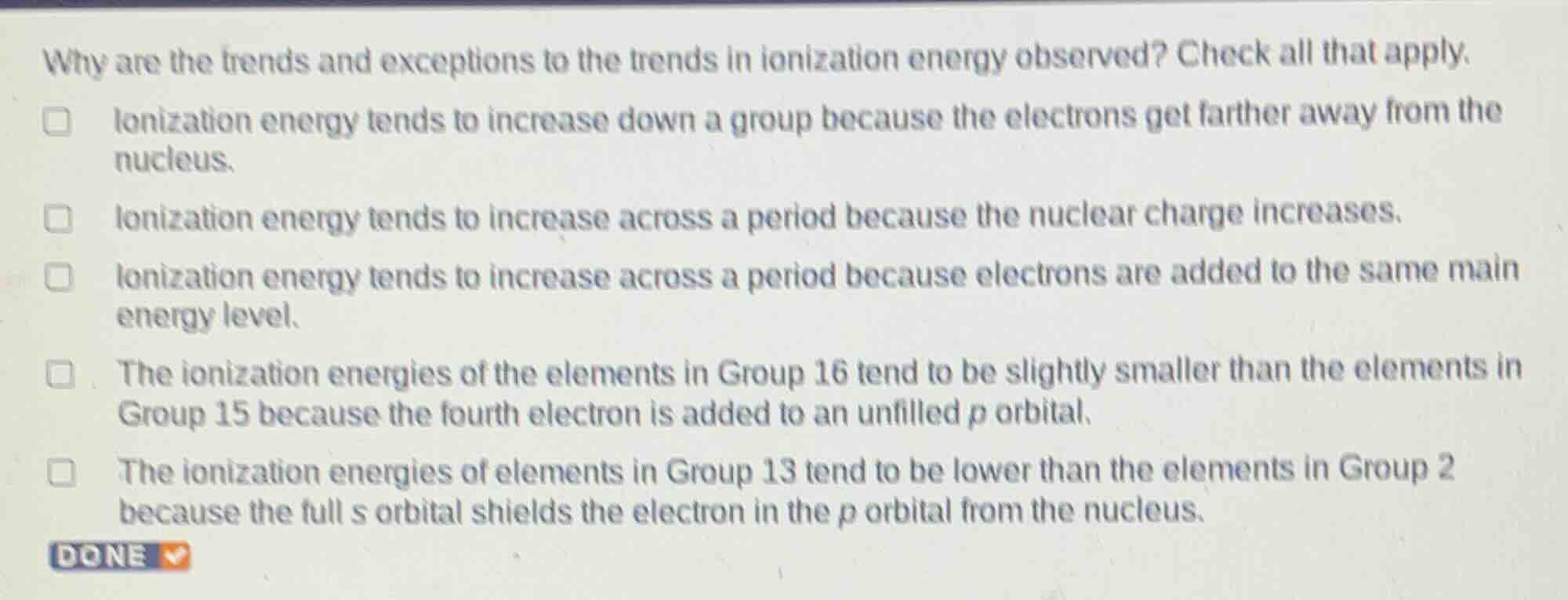
why are the trends and exceptions to the trends in ionization energy observed? check all that apply.
ionization energy tends to increase down a group because the electrons get farther away from the nucleus.
ionization energy tends to increase across a period because the nuclear charge increases.
ionization energy tends to increase across a period because electrons are added to the same main energy level.
the ionization energies of the elements in group 16 tend to be slightly smaller than the elements in group 15 because the fourth electron is added to an unfilled p orbital.
the ionization energies of elements in group 13 tend to be lower than the elements in group 2 because the full s orbital shields the electron in the p orbital from the nucleus.
- For group trends: Ionization energy decreases down a group, not increases, as electrons are farther from the nucleus (first option is wrong).
- Across a period: Increasing nuclear charge pulls electrons closer, raising ionization energy (second option is correct). Electrons in the same main level have minimal shielding, so this also supports the increase (third option is correct).
- Group 16 vs 15: Group 16 has a paired p-electron with repulsion, making ionization energy lower than Group 15 (the given reason for this option is incorrect, so this option is wrong).
- Group 13 vs 2: The full s orbital shields the single p-electron in Group 13, making its ionization energy lower than Group 2 (fifth option is correct).

Snap & solve any problem in the app
Get step-by-step solutions on Sovi AI
Photo-based solutions with guided steps
Explore more problems and detailed explanations
- Ionization energy tends to increase across a period because the nuclear charge increases.
- Ionization energy tends to increase across a period because electrons are added to the same main energy level.
- The ionization energies of elements in Group 13 tend to be lower than the elements in Group 2 because the full s orbital shields the electron in the p orbital from the nucleus.