QUESTION IMAGE
Question
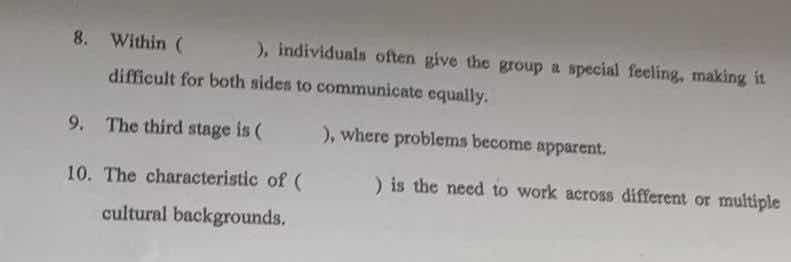
- within ( ), individuals often give the group a special feeling, making it difficult for both sides to communicate equally.
- the third stage is ( ), where problems become apparent.
- the characteristic of ( ) is the need to work across different or multiple cultural backgrounds.
These questions seem to be related to group dynamics or intercultural communication, which fall under the subfield of Psychology (within Social Science) as they deal with individual and group behaviors, and cultural interactions. Let's answer them:
Question 8
In group dynamics, "ingroups" (or sometimes "cliques" or "exclusive groups") can create a sense of exclusivity where individuals in the group have a special bond, making external communication unequal. A common term here is "ingroup" or "closed groups", but more precisely, "ingroup" (from social identity theory) where members feel a special connection, creating barriers to equal communication with outgroups.
In group development stages (like Tuckman's stages: forming, storming, norming, performing, adjourning), the "storming" stage is where conflicts and problems become apparent as group members struggle with roles, power, and goals.
"Intercultural communication" or "cross - cultural work" (related to intercultural competence) involves working across different cultural backgrounds. The key term here is "intercultural" work or "cross - cultural" collaboration, where the need to navigate multiple cultural contexts is essential.

Snap & solve any problem in the app
Get step-by-step solutions on Sovi AI
Photo-based solutions with guided steps
Explore more problems and detailed explanations
ingroup (or closed group / exclusive group)