QUESTION IMAGE
Question
the wood frog
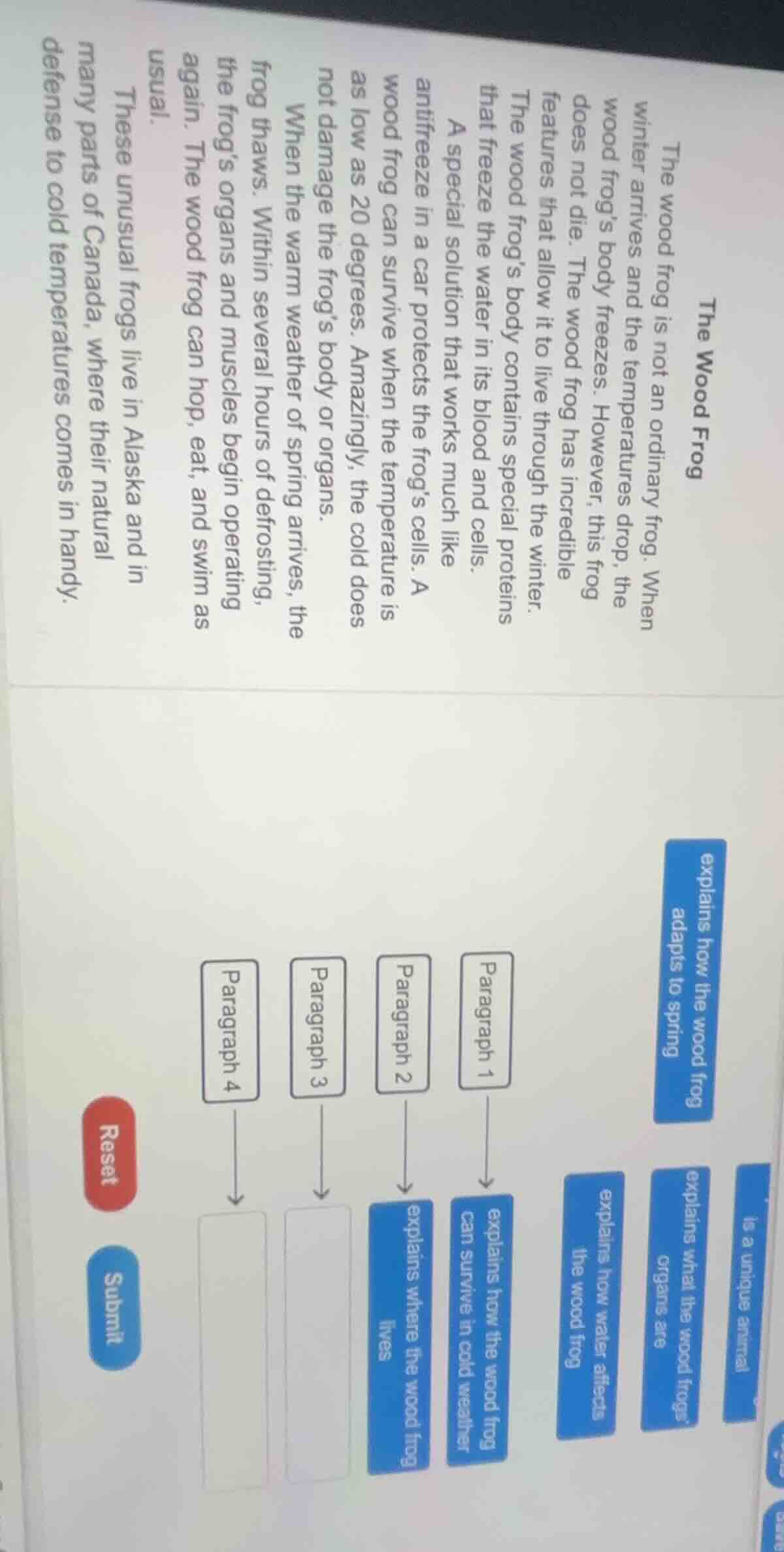
the wood frog is not an ordinary frog. when winter arrives and the temperatures drop, the wood frog’s body freezes. however, this frog does not die. the wood frog has incredible features that allow it to live through the winter.
the wood frog’s body contains special proteins that freeze the water in its blood and cells.
a special solution that works much like antifreeze in a car protects the frog’s cells. a wood frog can survive when the temperature is as low as 20 degrees. amazingly, the cold does not damage the frog’s body or organs.
when the warm weather of spring arrives, the frog thaws. within several hours of defrosting, the frog’s organs and muscles begin operating again. the wood frog can hop, eat, and swim as usual.
these unusual frogs live in alaska and in many parts of canada, where their natural defense to cold temperatures comes in handy.
there is a matching task image below, including options like explains how the wood frog adapts to spring, is a unique animal, explains what the wood frog’s organs are, explains how water affects the wood frog, explains how the wood frog can survive in cold weather, explains where the wood frog lives, and a reset and submit button.
To solve this problem, we analyze each paragraph and match it with the correct description:
Paragraph 1 Analysis:
The first paragraph introduces the wood frog as not ordinary (unique) and mentions it doesn’t die when its body freezes, hinting at its uniqueness. So it matches "is a unique animal".
Paragraph 2 Analysis:
Paragraph 2 explains the special solution (antifreeze - like) in the frog’s body that lets it survive freezing temperatures. Thus, it matches "explains how the wood frog can survive in cold weather".
Paragraph 3 Analysis:
Paragraph 3 describes what happens when the frog thaws in spring (organs start working again). So it matches "explains how the wood frog adapts to spring".
Paragraph 4 Analysis:
Paragraph 4 states the frog lives in Alaska and parts of Canada. So it matches "explains where the wood frog lives" (already used for Paragraph 2? Wait, no—wait, the blue box for Paragraph 2 is "explains where the wood frog lives"? Wait, no, re - read:
Wait, the blue boxes:
- "is a unique animal" → Paragraph 1 (introduces it as not ordinary).
- "explains how the wood frog can survive in cold weather" → Paragraph 2 (talks about the special proteins that prevent freezing damage).
- "explains how the wood frog adapts to spring" → Paragraph 3 (thawing, organs working again).
- "explains where the wood frog lives" → Paragraph 4 (Alaska, parts of Canada).
Now, the empty slots:
- Paragraph 1 should match "is a unique animal" (since it says "The wood frog is not an ordinary frog").
- Paragraph 3 should match "explains how the wood frog adapts to spring" (since it talks about thawing and organs working again).
- Paragraph 4 is already matched to "explains where the wood frog lives" (the blue box is there), wait no—wait the user’s image:
Looking at the image:
- Paragraph 2 is connected to "explains where the wood frog lives" (blue box).
- Paragraph 1: the blue boxes to the right—one is "is a unique animal" (matches Paragraph 1: "The wood frog is not an ordinary frog").
- Paragraph 3: the blue box "explains how the wood frog adapts to spring" (matches Paragraph 3: "When the warm weather of spring arrives... organs begin operating again").
- Paragraph 4: wait, no—Paragraph 4: "These unusual frogs live in Alaska and in many parts of Canada..." → but the blue box for Paragraph 2 is "explains where the wood frog lives"? Wait, maybe I misread. Let's re - align:
- Paragraph 1: "The wood frog is not an ordinary frog..." → matches "is a unique animal".
- Paragraph 3: "When the warm weather of spring arrives... organs begin operating again" → matches "explains how the wood frog adapts to spring".
- Paragraph 4: Wait, no—Paragraph 4: "These unusual frogs live in Alaska and in many parts of Canada..." but the blue box for Paragraph 2 is "explains where the wood frog lives"? Maybe the initial setup:
Wait, the user’s problem is to match the paragraphs to the blue boxes. Let's list:
Paragraph 1: "The wood frog is not an ordinary frog. When winter arrives... does not die." → "is a unique animal" (because it’s not ordinary).
Paragraph 3: "When the warm weather of spring arrives... organs begin operating again." → "explains how the wood frog adapts to spring".
Paragraph 4: "These unusual frogs live in Alaska and in many parts of Canada..." → but the blue box for Paragraph 2 is "explains where the wood frog lives"? Wait, no—maybe the blue box for Paragraph 2 is a distractor. Wait, the empty slots:
- Paragraph 1: connect to "is a unique animal".
- Paragraph 3: connect to "explains how the wood frog adapts to sp…
- Paragraph 1: The text says "The wood frog is not an ordinary frog", so it introduces the frog as unique, matching "is a unique animal".
- Paragraph 3: It describes the frog's behavior when spring arrives (thawing, organs working again), so it explains how the frog adapts to spring.
- Paragraph 4: It mentions the frog's habitats (Alaska, parts of Canada), so it explains where the wood frog lives.

Snap & solve any problem in the app
Get step-by-step solutions on Sovi AI
Photo-based solutions with guided steps
Explore more problems and detailed explanations
- Paragraph 1: is a unique animal
- Paragraph 3: explains how the wood frog adapts to spring
- Paragraph 4: explains where the wood frog lives