QUESTION IMAGE
Question
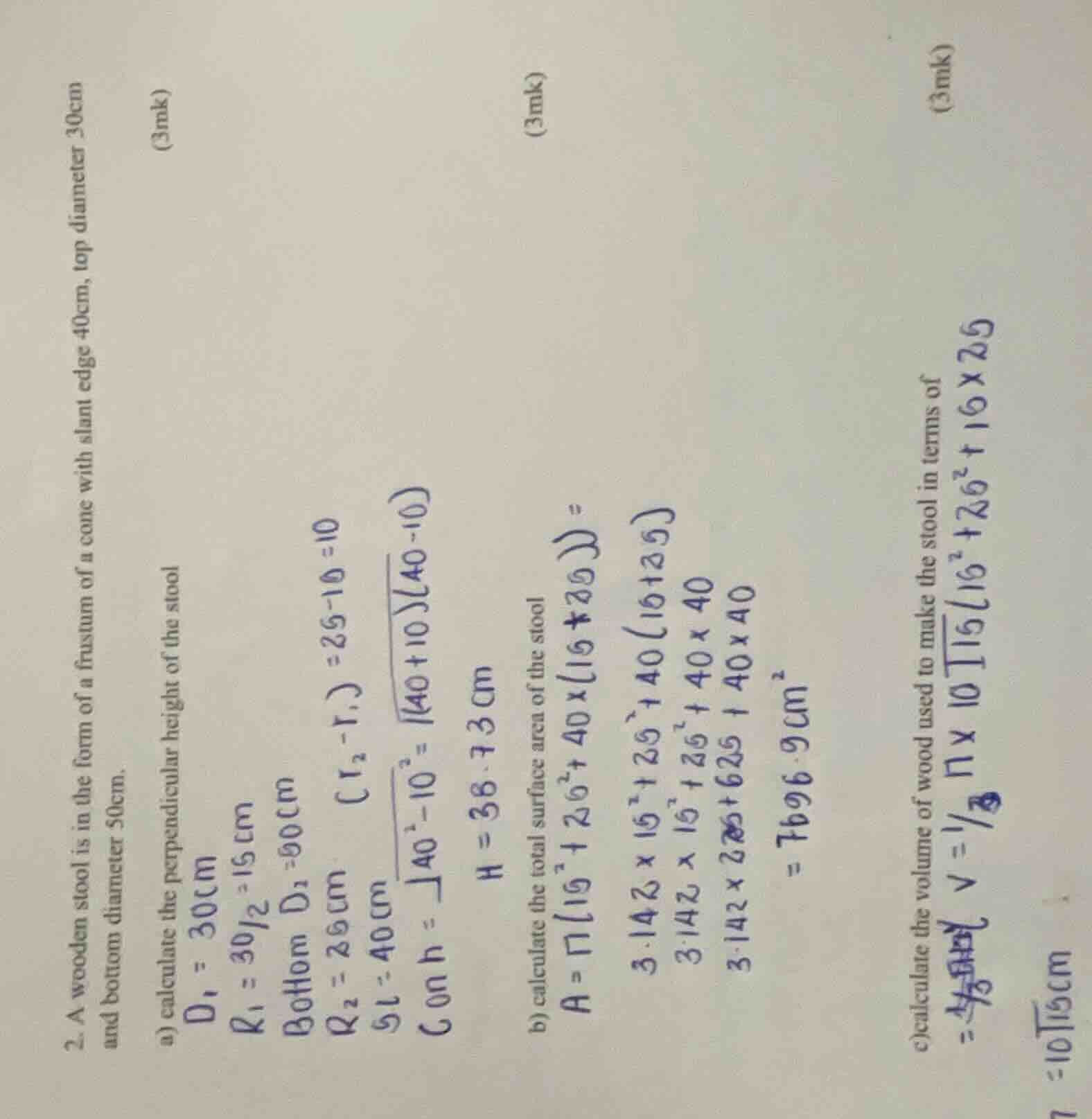
- a wooden stool is in the form of a frustum of a cone with slant edge 40cm, top diameter 30cm and bottom diameter 50cm.
(a) calculate the perpendicular height of the stool
d₁ = 30cm
r₁ = 30/2 =15 cm
bottom d₂ =50cm
r₂ = 25cm
sl = 40cm
con h = √40² - (25 - 15)² = √(1600 - 100) = √1500 ≈ 38.73 cm
(b) calculate the total surface area of the stool
a = π(15)² + (25)² + 40×(15 + 25)
= 3.142×(225 + 625 + 40×40)
= 3.142×(225 + 625 + 1600)
= 3.142×2450 ≈ 7696.9 cm²
(c) calculate the volume of wood used to make the stool in terms of π
v = (1/3)π×10×(15² + 25² + 15×25)
= (1/3)π×10×(225 + 625 + 375)
= (1/3)π×10×1225
= (12250/3)π ≈ 4083.33π cm³
Part (a): Calculate the perpendicular height of the stool
Step 1: Identify radii and slant height
The top diameter \( D_1 = 30 \, \text{cm} \), so top radius \( R_1=\frac{30}{2}=15 \, \text{cm} \). The bottom diameter (assuming the bottom radius \( R_2 \) is from the bottom diameter? Wait, the bottom diameter is 60 cm? Wait, the original problem: "top diameter 30cm and bottom diameter 60cm" (from the writing: \( D_2 = 60 \, \text{cm} \), so \( R_2=\frac{60}{2}=30 \, \text{cm} \)? Wait, the handwritten has \( R_2 = 25 \, \text{cm} \)? Wait, maybe a typo. Wait, the slant height \( l = 40 \, \text{cm} \). The formula for the height \( h \) of a frustum is \( h=\sqrt{l^{2}-(R_1 - R_2)^{2}} \) (if \( R_1 < R_2 \), else \( |R_1 - R_2| \)). Wait, the top radius \( R_1 = 15 \, \text{cm} \) (30/2), bottom radius \( R_2 = 30 \, \text{cm} \) (60/2)? But the handwritten has \( R_2 = 25 \, \text{cm} \). Wait, maybe the bottom diameter is 50 cm? Wait, the original problem: "top diameter 30cm and bottom diameter 50cm"? Wait, the handwritten says \( R_2 = 25 \, \text{cm} \) (since 50/2=25). Then slant height \( l = 40 \, \text{cm} \). Then the height \( h=\sqrt{l^{2}-(R_2 - R_1)^{2}}=\sqrt{40^{2}-(25 - 15)^{2}}=\sqrt{1600 - 100}=\sqrt{1500}\approx38.73 \, \text{cm} \), which matches the handwritten. So:
Step 1: Find radii
Top radius \( R_1=\frac{30}{2}=15 \, \text{cm} \), bottom radius \( R_2=\frac{50}{2}=25 \, \text{cm} \) (assuming bottom diameter 50 cm, since \( R_2 = 25 \)). Slant height \( l = 40 \, \text{cm} \).
Step 2: Apply frustum height formula
The height \( h \) of a frustum is given by \( h=\sqrt{l^{2}-(R_2 - R_1)^{2}} \) (since \( R_2 > R_1 \)). Substitute values: \( h=\sqrt{40^{2}-(25 - 15)^{2}}=\sqrt{1600 - 100}=\sqrt{1500}\approx38.73 \, \text{cm} \).

Snap & solve any problem in the app
Get step-by-step solutions on Sovi AI
Photo-based solutions with guided steps
Explore more problems and detailed explanations
(a): \( \approx38.73 \, \text{cm} \)
Part (b): Calculate total surface area of the stool
The total surface area (TSA) of a frustum of a cone is \( \pi(R_1^{2}+R_2^{2}+l(R_1 + R_2)) \), where \( l \) is slant height.
Step 1: Identify values
\( R_1 = 15 \, \text{cm} \), \( R_2 = 25 \, \text{cm} \), \( l = 40 \, \text{cm} \), \( \pi\approx3.142 \).
Step 2: Substitute into formula
\( \text{TSA}=\pi(15^{2}+25^{2}+40(15 + 25)) \)
Step 3: Calculate each term
\( 15^{2}=225 \), \( 25^{2}=625 \), \( 40(15 + 25)=40\times40 = 1600 \)
Step 4: Sum and multiply by \( \pi \)
\( \text{TSA}=3.142\times(225 + 625 + 1600)=3.142\times2450\approx7696.9 \, \text{cm}^2 \), which matches the handwritten.