QUESTION IMAGE
Question
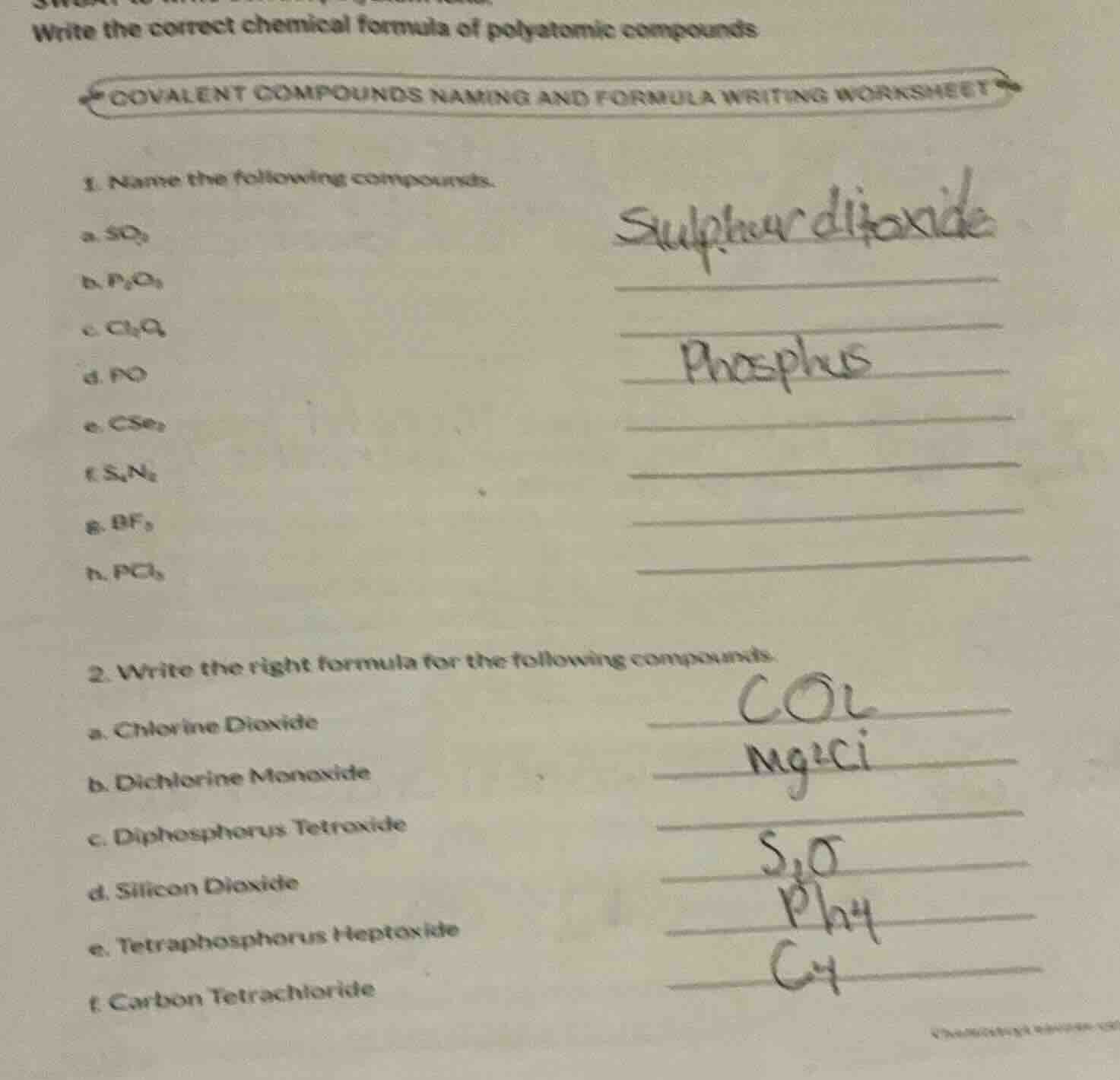
write the correct chemical formula of polyatomic compounds
covalent compounds naming and formula writing worksheet
- name the following compounds.
a. $so_2$ \t\tsulphur dioxide
b. $p_2o_5$ \t\t
c. $cl_2o$ \t\t
d. $no$ \t\tphosphus
e. $cse_2$ \t\t
f. $s_4n_2$ \t\t
g. $bf_3$ \t\t
h. $pcl_5$ \t\t
- write the right formula for the following compounds.
a. chlorine dioxide \t\t$col$
b. dichlorine monoxide \t\t$mgcl$
c. diphosphorus tetroxide \t\t
d. silicon dioxide \t\t$s_2o$
e. tetraphosphorus heptoxide \t\t$ph_4$
f. carbon tetrachloride \t\t$c_4$
Part 1: Naming Covalent Compounds (Question 1)
For covalent compounds, we use prefixes to indicate the number of atoms of each element. The prefixes are: 1 - mono, 2 - di, 3 - tri, 4 - tetra, 5 - penta, 6 - hexa, 7 - hepta, 8 - octa, 9 - nona, 10 - deca. The first element gets a prefix only if there is more than one atom, and the second element always gets a prefix and ends in -ide.
a. $\boldsymbol{SO_2}$
- Step 1: Identify the elements. S is sulfur, O is oxygen.
- Step 2: Determine the number of atoms. 1 S (no prefix needed for the first element when there's 1 atom) and 2 O (prefix "di-").
- Name: Sulfur dioxide (Note: The original handwritten answer has a spelling error; it should be "Sulfur dioxide" instead of "Sulphur dioxide", but "Sulphur" is a variant spelling in some regions, and the core naming is correct in terms of the compound's name structure.)
b. $\boldsymbol{P_2O_3}$
- Step 1: Elements are P (phosphorus) and O (oxygen).
- Step 2: Number of atoms: 2 P (prefix "di-") and 3 O (prefix "tri-").
- Name: Diphosphorus trioxide
c. $\boldsymbol{Cl_2O}$
- Step 1: Elements are Cl (chlorine) and O (oxygen).
- Step 2: Number of atoms: 2 Cl (prefix "di-") and 1 O (prefix "mono-", but "mono-" is often omitted for the second element in common usage, but strictly, it's "monoxide").
- Name: Dichlorine monoxide
d. $\boldsymbol{NO}$
- Step 1: Elements are N (nitrogen) and O (oxygen).
- Step 2: Number of atoms: 1 N (no prefix) and 1 O (prefix "mono-", but "mono-" is often omitted for the second element in common usage, but strictly, it's "monoxide").
- Name: Nitrogen monoxide (The original handwritten answer "Phosphus" is incorrect; it's a misidentification of the element. N is nitrogen, not phosphorus.)
e. $\boldsymbol{CSe_2}$
- Step 1: Elements are C (carbon) and Se (selenium).
- Step 2: Number of atoms: 1 C (no prefix) and 2 Se (prefix "di-").
- Name: Carbon diselenide
f. $\boldsymbol{S_4N_2}$
- Step 1: Elements are S (sulfur) and N (nitrogen).
- Step 2: Number of atoms: 4 S (prefix "tetra-") and 2 N (prefix "di-").
- Name: Tetrasulfur dinitride
g. $\boldsymbol{BF_3}$
- Step 1: Elements are B (boron) and F (fluorine).
- Step 2: Number of atoms: 1 B (no prefix) and 3 F (prefix "tri-").
- Name: Boron trifluoride
h. $\boldsymbol{PCl_5}$
- Step 1: Elements are P (phosphorus) and Cl (chlorine).
- Step 2: Number of atoms: 1 P (no prefix) and 5 Cl (prefix "penta-").
- Name: Phosphorus pentachloride
Part 2: Writing Formulas for Covalent Compounds (Question 2)
For covalent compounds, we use the prefixes to determine the number of atoms of each element. The prefixes tell us the subscript for each element in the formula.
a. Chlorine Dioxide
- Step 1: Identify the elements. Chlorine (Cl) and oxygen (O).
- Step 2: Determine the number of atoms from the prefixes. "Chlorine" (no prefix means 1 Cl) and "dioxide" (di- means 2 O).
- Formula: $ClO_2$ (The original handwritten answer "COL" is incorrect; it's a misrepresentation of the elements and their counts.)
b. Dichlorine Monoxide
- Step 1: Elements are chlorine (Cl) and oxygen (O).
- Step 2: Prefixes: "dichlorine" (di- means 2 Cl) and "monoxide" (mono- means 1 O).
- Formula: $Cl_2O$ (The original handwritten answer "MgCl" is incorrect; it's a misidentification of the elements and their counts, and also includes magnesium which is not part of this compound.)
c. Diphosphorus Tetroxide
- Step 1: Elements are phosphorus (P) and oxygen (O).
- Step 2: Prefixes: "diphosphorus" (di- means 2 P) and "tetroxide" (tetra- means 4 O).
- Formu…

Snap & solve any problem in the app
Get step-by-step solutions on Sovi AI
Photo-based solutions with guided steps
Explore more problems and detailed explanations
Part 1: Naming Covalent Compounds (Question 1)
For covalent compounds, we use prefixes to indicate the number of atoms of each element. The prefixes are: 1 - mono, 2 - di, 3 - tri, 4 - tetra, 5 - penta, 6 - hexa, 7 - hepta, 8 - octa, 9 - nona, 10 - deca. The first element gets a prefix only if there is more than one atom, and the second element always gets a prefix and ends in -ide.
a. $\boldsymbol{SO_2}$
- Step 1: Identify the elements. S is sulfur, O is oxygen.
- Step 2: Determine the number of atoms. 1 S (no prefix needed for the first element when there's 1 atom) and 2 O (prefix "di-").
- Name: Sulfur dioxide (Note: The original handwritten answer has a spelling error; it should be "Sulfur dioxide" instead of "Sulphur dioxide", but "Sulphur" is a variant spelling in some regions, and the core naming is correct in terms of the compound's name structure.)
b. $\boldsymbol{P_2O_3}$
- Step 1: Elements are P (phosphorus) and O (oxygen).
- Step 2: Number of atoms: 2 P (prefix "di-") and 3 O (prefix "tri-").
- Name: Diphosphorus trioxide
c. $\boldsymbol{Cl_2O}$
- Step 1: Elements are Cl (chlorine) and O (oxygen).
- Step 2: Number of atoms: 2 Cl (prefix "di-") and 1 O (prefix "mono-", but "mono-" is often omitted for the second element in common usage, but strictly, it's "monoxide").
- Name: Dichlorine monoxide
d. $\boldsymbol{NO}$
- Step 1: Elements are N (nitrogen) and O (oxygen).
- Step 2: Number of atoms: 1 N (no prefix) and 1 O (prefix "mono-", but "mono-" is often omitted for the second element in common usage, but strictly, it's "monoxide").
- Name: Nitrogen monoxide (The original handwritten answer "Phosphus" is incorrect; it's a misidentification of the element. N is nitrogen, not phosphorus.)
e. $\boldsymbol{CSe_2}$
- Step 1: Elements are C (carbon) and Se (selenium).
- Step 2: Number of atoms: 1 C (no prefix) and 2 Se (prefix "di-").
- Name: Carbon diselenide
f. $\boldsymbol{S_4N_2}$
- Step 1: Elements are S (sulfur) and N (nitrogen).
- Step 2: Number of atoms: 4 S (prefix "tetra-") and 2 N (prefix "di-").
- Name: Tetrasulfur dinitride
g. $\boldsymbol{BF_3}$
- Step 1: Elements are B (boron) and F (fluorine).
- Step 2: Number of atoms: 1 B (no prefix) and 3 F (prefix "tri-").
- Name: Boron trifluoride
h. $\boldsymbol{PCl_5}$
- Step 1: Elements are P (phosphorus) and Cl (chlorine).
- Step 2: Number of atoms: 1 P (no prefix) and 5 Cl (prefix "penta-").
- Name: Phosphorus pentachloride
Part 2: Writing Formulas for Covalent Compounds (Question 2)
For covalent compounds, we use the prefixes to determine the number of atoms of each element. The prefixes tell us the subscript for each element in the formula.
a. Chlorine Dioxide
- Step 1: Identify the elements. Chlorine (Cl) and oxygen (O).
- Step 2: Determine the number of atoms from the prefixes. "Chlorine" (no prefix means 1 Cl) and "dioxide" (di- means 2 O).
- Formula: $ClO_2$ (The original handwritten answer "COL" is incorrect; it's a misrepresentation of the elements and their counts.)
b. Dichlorine Monoxide
- Step 1: Elements are chlorine (Cl) and oxygen (O).
- Step 2: Prefixes: "dichlorine" (di- means 2 Cl) and "monoxide" (mono- means 1 O).
- Formula: $Cl_2O$ (The original handwritten answer "MgCl" is incorrect; it's a misidentification of the elements and their counts, and also includes magnesium which is not part of this compound.)
c. Diphosphorus Tetroxide
- Step 1: Elements are phosphorus (P) and oxygen (O).
- Step 2: Prefixes: "diphosphorus" (di- means 2 P) and "tetroxide" (tetra- means 4 O).
- Formula: $P_2O_4$ (The original handwritten answer "S,O" is incorrect; it misidentifies the elements and their counts.)
d. Silicon Dioxide
- Step 1: Elements are silicon (Si) and oxygen (O).
- Step 2: Prefixes: "silicon" (no prefix means 1 Si) and "dioxide" (di- means 2 O).
- Formula: $SiO_2$ (The original handwritten answer "Ph4" is incorrect; it's a misidentification of the elements and their counts.)
e. Tetraphosphorus Heptoxide
- Step 1: Elements are phosphorus (P) and oxygen (O).
- Step 2: Prefixes: "tetraphosphorus" (tetra- means 4 P) and "heptoxide" (hepta- means 7 O).
- Formula: $P_4O_7$ (The original handwritten answer "Cy" is incorrect; it's a misrepresentation of the elements and their counts.)
f. Carbon Tetrachloride
- Step 1: Elements are carbon (C) and chlorine (Cl).
- Step 2: Prefixes: "carbon" (no prefix means 1 C) and "tetrachloride" (tetra- means 4 Cl).
- Formula: $CCl_4$ (The original handwritten answer "Cy" is incorrect; it's a misrepresentation of the elements and their counts.)
Summary of Correct Answers (for reference)
Question 1 (Naming)
a. Sulfur dioxide (or Sulphur dioxide, depending on spelling convention)
b. Diphosphorus trioxide
c. Dichlorine monoxide
d. Nitrogen monoxide
e. Carbon diselenide
f. Tetrasulfur dinitride
g. Boron trifluoride
h. Phosphorus pentachloride
Question 2 (Formulas)
a. $ClO_2$
b. $Cl_2O$
c. $P_2O_4$
d. $SiO_2$
e. $P_4O_7$
f. $CCl_4$