QUESTION IMAGE
Question
- write a division equation to represent the visual model.
Step1: Analyze the visual model
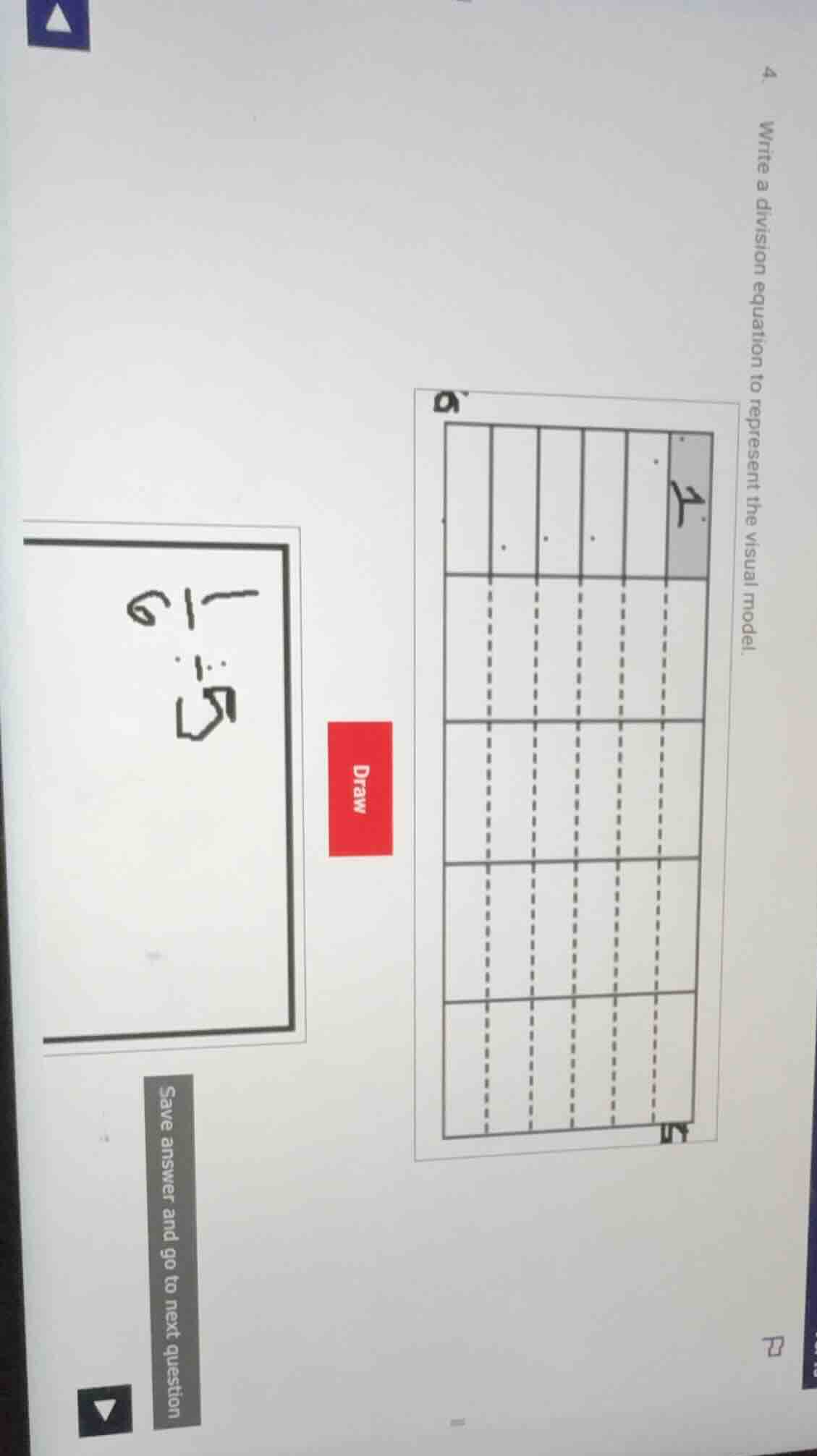
Looking at the visual model (the grid), we can see that there is a shaded or represented part. Let's assume the total area or quantity is $\frac{1}{6}$ (from the left - maybe a fraction bar or area model) and we are dividing it by 5 (since there are 5 columns or parts in the division). Wait, actually, maybe the visual model represents a fraction being divided. Let's re - examine. If we consider that the initial fraction is $\frac{1}{6}$ and we are dividing it into 5 equal parts, or maybe the other way. Wait, another way: if the model shows a rectangle divided into 6 columns (first part) and then into 5 rows? Wait, maybe the visual model is a fraction of a fraction. Let's think of the division of fractions. Suppose the first part is $\frac{1}{6}$ and we are dividing by 5, but no, maybe the numerator and denominator. Wait, let's look at the numbers. The left - hand side has something like $\frac{1}{6}$ and divided by 5? No, maybe the visual model is a rectangle divided into 6 columns (so the width is $\frac{1}{6}$ of the whole) and then into 5 rows? Wait, no, the problem says "write a division equation to represent the visual model". Let's assume that the visual model is representing the division of $\frac{1}{6}$ by 5, but that might not be right. Wait, maybe the correct approach is: if we have a fraction, say $\frac{1}{6}$, and we are dividing it into 5 equal parts, the division equation would be $\frac{1}{6}\div5$. But let's check the visual. Alternatively, maybe the model is a rectangle divided into 6 columns (so each column is $\frac{1}{6}$) and then one of those columns is divided into 5 parts? No, the right - hand grid has 6 columns (first row) and 5 rows? Wait, the right - hand grid: first row has 6 columns (one shaded), and then 5 rows. Wait, maybe the total area of the shaded part is $\frac{1}{6}$ (from the 6 columns) and we are dividing by 5 (the 5 rows). So the division equation is $\frac{1}{6}\div5$. But let's compute that: $\frac{1}{6}\div5=\frac{1}{6}\times\frac{1}{5}=\frac{1}{30}$. But maybe the visual model is different. Wait, another interpretation: if the model is a rectangle with area $\frac{1}{6}$ and we are dividing it into 5 equal parts, the division equation is $\frac{1}{6}\div5$.
Step2: Write the division equation
From the analysis of the visual model (assuming the fraction is $\frac{1}{6}$ and we are dividing by 5), the division equation is $\frac{1}{6}\div5$. But let's check the calculation: $\frac{1}{6}\div5=\frac{1}{6}\times\frac{1}{5}=\frac{1}{30}$. Wait, maybe the visual model is a fraction of a fraction. If we have a rectangle divided into 6 columns (so the width is $\frac{1}{6}$) and then into 5 rows (height is $\frac{1}{5}$), but no, the division equation. Wait, maybe the correct equation is $\frac{1}{6}\div5=\frac{1}{30}$. But let's confirm. Let's assume that the visual model is representing the division of $\frac{1}{6}$ by 5. So the division equation is $\frac{1}{6}\div5$.

Snap & solve any problem in the app
Get step-by-step solutions on Sovi AI
Photo-based solutions with guided steps
Explore more problems and detailed explanations
$\frac{1}{6}\div5 = \frac{1}{30}$ (or if the visual model is different, but based on the given information, this is a possible division equation. If the visual model was representing a different fraction, the equation would change, but with the given visual cues, $\frac{1}{6}\div5=\frac{1}{30}$ is a likely equation)