QUESTION IMAGE
Question
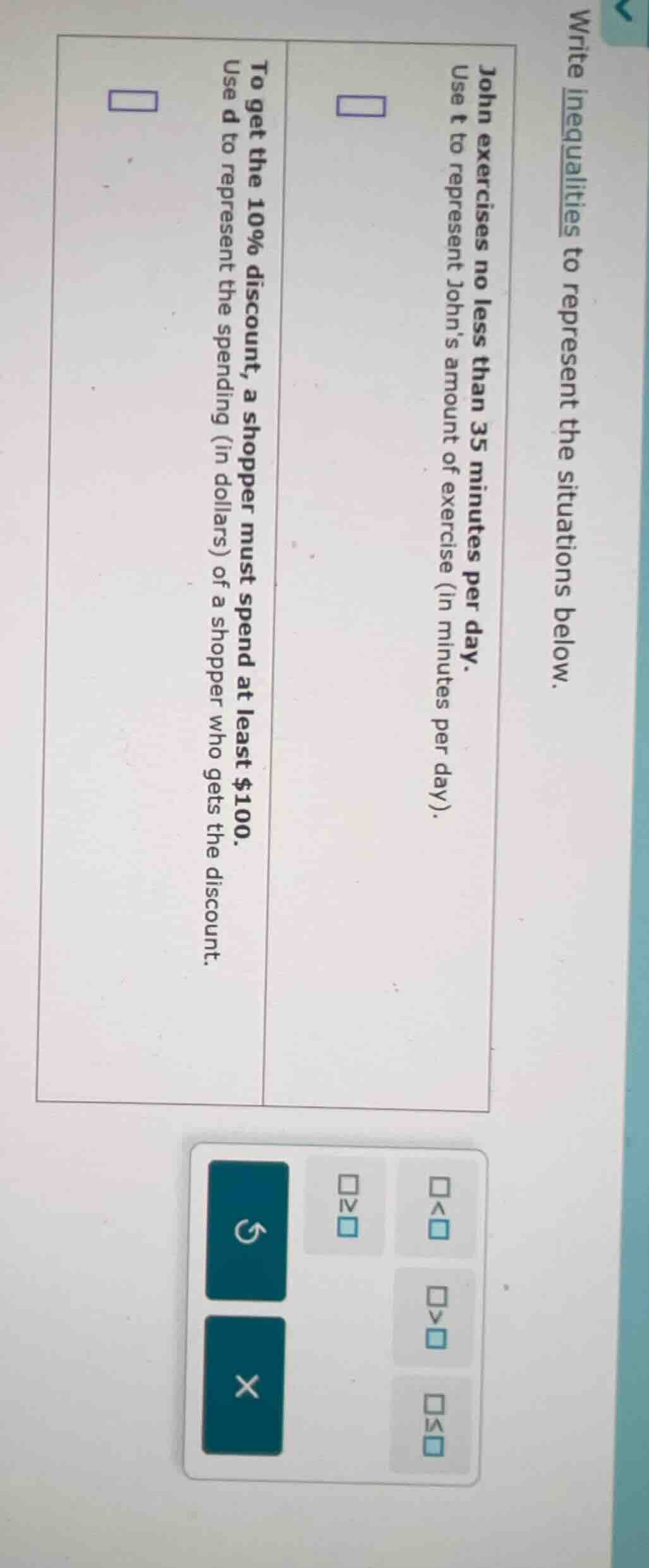
write inequalities to represent the situations below. john exercises no less than 35 minutes per day. use t to represent john’s amount of exercise (in minutes per day). to get the 10% discount, a shopper must spend at least $100. use d to represent the spending (in dollars) of a shopper who gets the discount.
First Situation (John's Exercise Time)
Step1: Understand the phrase "no less than"
The phrase "no less than" means that the value is greater than or equal to the given number. Here, John's exercise time \( t \) (in minutes per day) is no less than 35 minutes. So we need to represent this as an inequality where \( t \) is greater than or equal to 35.
Step2: Write the inequality
Using the symbol for "greater than or equal to" (\( \geq \)), the inequality is \( t \geq 35 \).
Second Situation (Shopper's Spending)
Step1: Understand the phrase "at least"
The phrase "at least" means that the value is greater than or equal to the given number. Here, the shopper's spending \( d \) (in dollars) is at least 100 dollars. So we need to represent this as an inequality where \( d \) is greater than or equal to 100.
Step2: Write the inequality
Using the symbol for "greater than or equal to" (\( \geq \)), the inequality is \( d \geq 100 \).

Snap & solve any problem in the app
Get step-by-step solutions on Sovi AI
Photo-based solutions with guided steps
Explore more problems and detailed explanations
s:
- For John's exercise time: \( t \geq 35 \)
- For the shopper's spending: \( d \geq 100 \)